
CAMEL-AI's OASIS Simulates One Million AI Agents on Fake Social Networks
A CAMEL-AI framework spins up to a million LLM agents on simulated Twitter and Reddit to study polarization, herd behavior, and misinformation.
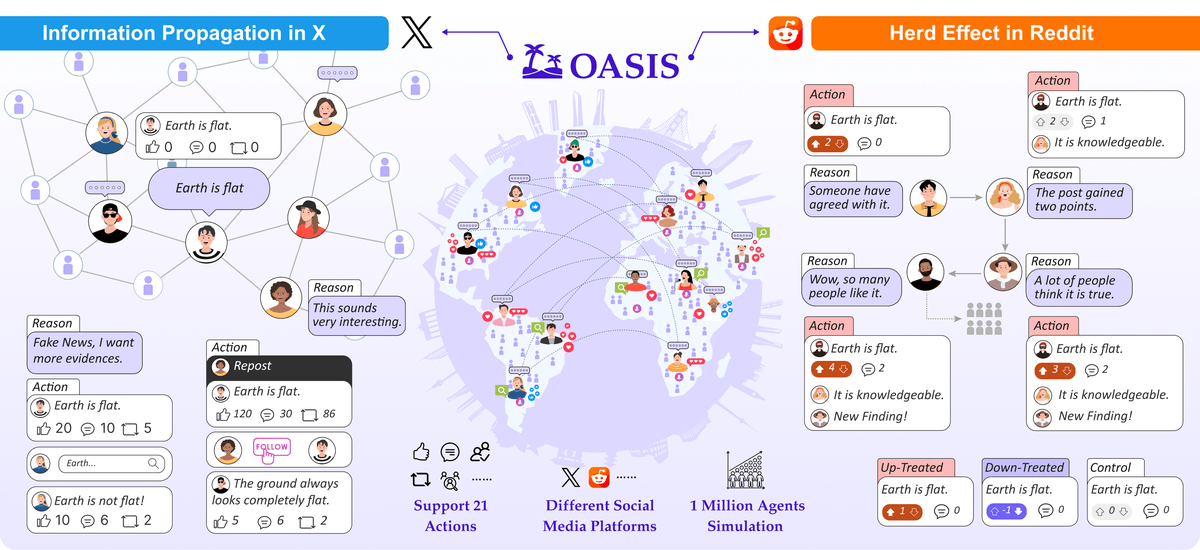
Takeaways
- CAMEL-AI released OASIS, an open simulator running up to 1M LLM agents on Twitter/Reddit clones.
- Reproduces information spread, group polarization, and herd effects; larger scales show richer group dynamics.
- Ships 23 actions, interest and hot-score recommenders, and dynamic social graphs, all Apache 2.0 licensed.
- PettingZoo-style API, install via
pip install camel-oasis, works with any CAMEL-supported model. - Paper co-authored by Shanghai AI Lab, Oxford, KAUST, Imperial, and Max Planck researchers.
- Follow-up projects target collusion, fraud, and Unity3D-based custom environments for extended simulations.
Running a controlled experiment on a real social network is basically impossible. You cannot A/B test misinformation on live users, and small sandbox simulations with 50 agents miss the emergent behavior that only shows up at scale. OASIS, from the CAMEL-AI team, is an open-source simulator that pushes LLM-based social simulations up to one million agents on Twitter and Reddit clones, giving researchers a way to actually study these dynamics.
The project has crossed 4.6k stars on GitHub and ships with a paper backed by contributors from Shanghai AI Lab, Oxford, KAUST, Imperial, and Max Planck. The paper lays out the motivation clearly: existing LLM-based agent simulators are one-off codebases, each hardwired for a specific study, and none scale past a few thousand agents.

What you actually get
OASIS is modeled on real social media platforms, with a dynamically updated environment, a broad action space, and pluggable recommendation systems. In practice the framework provides three things that most agent-based social simulators skip:
- A live social graph that updates as agents follow, unfollow, and post, rather than a static network fixed at simulation start.
- A recommendation layer with both interest-based and hot-score-based algorithms, so agents see feeds shaped by the same forces real users experience.
- A rich action space that originally covered 21 actions such as following, commenting, and reposting, now expanded to 23 in the current release including reporting posts and group chat.
Each agent is an LLM (examples default to GPT-4o-mini, though any CAMEL-supported model works) driven by a profile file that defines personality, interests, and prior posting history. Agents observe a feed produced by the recommender, then choose an action from the allowed set. The simulator handles platform state, database persistence, and the fan-out of information across the network.