
ByteDance's OpenViking Turns AI Agent Memory Into a Navigable Filesystem
Volcengine's OpenViking treats agent memory like a filesystem, cutting token costs by up to 91% and tripling retrieval accuracy over native memory systems
 Pro
Takeaways
- OpenViking is an open-source context database from Volcengine that organizes agent memory, documents, and skills as a virtual filesystem under the
viking://protocol. - Benchmarks show up to 3.4x accuracy improvement and 91% token reduction on long-conversation memory tasks vs. native agent memory systems.
- A three-tier loading system (L0 abstract / L1 overview / L2 full content) loads context on demand, dramatically cutting token costs for large knowledge bases.
- Directory Recursive Retrieval first locks a high-score directory via vector search, then drills down recursively -- every retrieval path is fully observable and debuggable.
- The system is backed by the VikingMem paper (VLDB 2026), which outperforms memory baselines by up to 30%.
- Available now via
pip install openviking(AGPLv3); a hosted Personal tier with a free 50-file trial is also live at openviking.ai.
OpenViking is an open-source context database from Volcengine, the cloud arm of ByteDance, that rethinks how AI agents store and retrieve information. Instead of dumping everything into a flat vector store and hoping semantic search finds the right chunk, OpenViking organizes all agent context into a hierarchical virtual filesystem. Memories, documents, and reusable skills each get a viking:// URI, and agents navigate them with familiar commands like ls, tree, and find. The repo has grown to over 26,000 stars, with nearly 2,000 added in a single week.
The problem it actually solves
Anyone who has built a multi-step agent knows the pain: conversation history lives in one place, reference documents in a vector database, and any reusable "skills" are hardcoded somewhere in the prompt. Memory in code, resources in vector databases, skills scattered everywhere -- there is no unified layer that manages all three. On top of that, traditional RAG uses flat storage, and OpenViking's directory recursive retrieval understands complete context with a global perspective. And when retrieval goes wrong, black-box retrieval makes debugging impossible, while OpenViking provides visualized retrieval trajectories for full observability.
A filesystem for your agent's brain
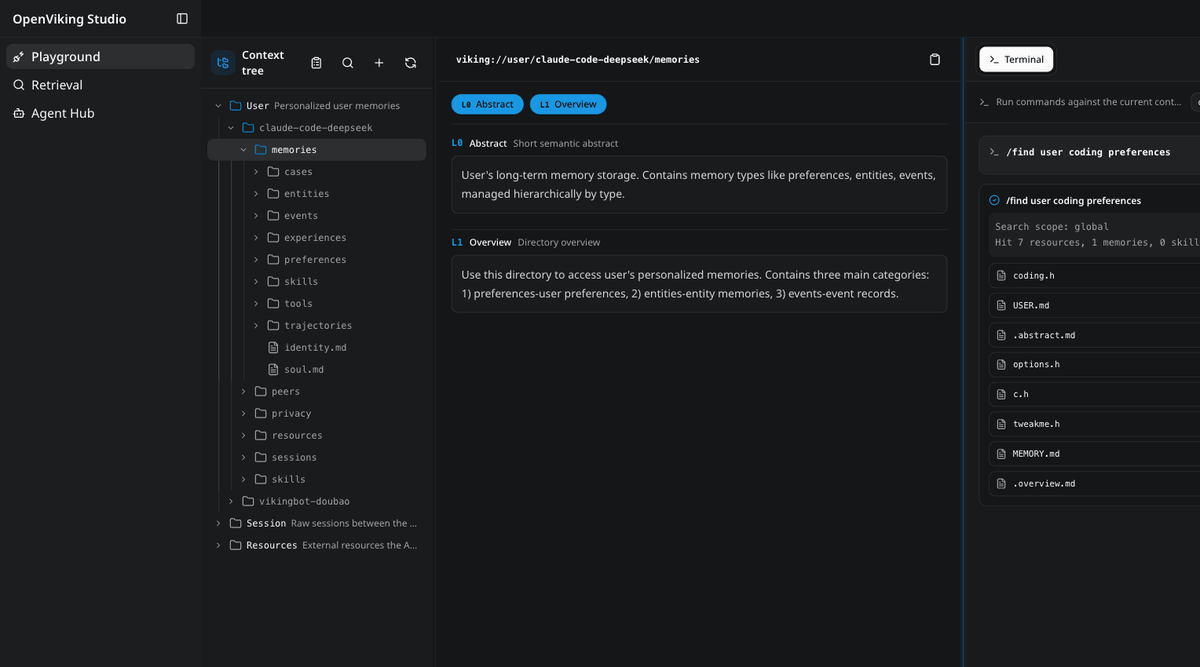
OpenViking stores memories, resources, and skills as one virtual filesystem under the viking:// protocol, so an agent browses its own context with ls, tree, and find instead of querying a black-box vector store. The structure looks like this:
viking://
├── resources/          # Docs, repos, web pages
│   └── my_project/
│       ├── docs/
│       └── src/
└── user/
    └── {user_id}/
        ├── memories/   # Preferences, habits
        ├── skills/     # Reusable agent capabilities
        └── resources/  # Private documents
Every path is a unique, addressable URI. This transforms context management from vague semantic matching into deterministic, traceable file operations -- something you can actually reason about and debug.
Three layers, loaded on demand
The most practically important feature is tiered context loading. Content is processed into three tiers -- L0 abstract, L1 overview, L2 details -- and loaded on demand. In practice:
- L0 (~100 tokens): A one-sentence summary used for quick relevance checks during retrieval
- L1 (~2k tokens): Core information and structure used during the agent's planning phase
- L2 (full content): The complete original data, loaded only when the agent actually needs to read deeply
This means an agent scanning 50 documents to find the right one pays L0 prices, not L2 prices. The savings compound fast at scale.
Directory-recursive retrieval
The retrieval pipeline first uses vector retrieval to identify a high-score directory, then performs a second retrieval within that directory, and recursively drills down into subdirectories if needed -- the project calls this Directory Recursive Retrieval. The basic idea is that retrieval should preserve both local relevance and global context structure: the system should not only find the semantically similar fragment, but also understand the directory context in which that fragment lives.
Every retrieval leaves a trajectory you can watch and debug. This is a meaningful shift from the status quo, where a RAG pipeline that returns the wrong chunk gives you no signal about why it failed.
The numbers
OpenViking's benchmarks are striking. On the LoCoMo long-conversation memory benchmark, pairing agents with OpenViking versus their native memory systems produced:
| Agent | Accuracy (native) | Accuracy (+ OpenViking) | Token reduction | Latency reduction |
|---|---|---|---|---|
| OpenClaw | 24.20% | 82.08% | -91.0% | -59.2% |
| Hermes | 33.38% | 82.86% | -34.3% | -66.1% |
| Claude Code | 57.21% | 80.32% | -63.2% | -58.5% |
On knowledge-base QA (HotpotQA multi-hop), OpenViking top-20 retrieval hits 91% accuracy at just 0.23s latency -- beating LightRAG's 89% while being 325x faster. On agent experience memory (tau2-bench), adding OpenViking improves airline task success from 54.38% to 66.25%.
Self-evolving memory
The session management loop is where the "self-evolving" claim comes from. After each session, OpenViking asynchronously analyzes what happened and writes two kinds of updates:
- User memory: Preferences, writing style, coding habits -- things that should shape future responses
- Agent experience: Operational tips, tool usage patterns, task-specific knowledge extracted from execution traces
The agent doesn't just remember conversations -- it accumulates structured, retrievable experience over time. This is closer to how a human expert builds intuition than how current memory systems work.
Academic grounding
OpenViking is the open-source implementation of ideas from the VikingMem paper, accepted at VLDB 2026. OpenViking is an open-source context database for AI agents. It stores memories, resources, and skills as one virtual filesystem under the viking:// protocol. The paper introduces the concept of a "Memory Base" -- a data management paradigm where memories are selectively extracted, progressively summarized, and time-weighted to prioritize recent interactions. The system outperforms baselines by up to 30% on long-term memory benchmarks.
Getting started
Installation is a single pip command. You need Python 3.10+, and optionally the Rust CLI for more control:
pip install openviking --upgrade --force-reinstall
# Interactive setup wizard (handles Ollama, cloud APIs, config)
openviking-server init
# Validate your setup
openviking-server doctor
# Start the server
openviking-server
OpenViking requires two model backends: an embedding model (for semantic search) and a VLM (vision-language model, for understanding document content). Supported VLM access paths include Volcengine, OpenAI, and LiteLLM, while example server configurations include OpenAI embeddings through text-embedding-3-large. Local models via Ollama are also supported through the setup wizard. Once running, you interact through the ov CLI:
ov add-resource https://github.com/volcengine/OpenViking
ov find "what is openviking"
ov tree viking://resources/volcengine -L 2
A hosted version called OpenViking Personal is also available, with a free tier covering up to 50 files and a live Studio playground that requires no installation. The main project is licensed under AGPLv3, with the CLI and examples under Apache 2.0.
What this changes
The deeper shift here is conceptual. The field has largely treated agent memory as a retrieval problem -- build a better vector store, tune your chunking strategy, add a reranker. OpenViking argues it's a data management problem. The Viking team's exploration in context engineering reflects a commitment to continuous innovation, and they plan to use OpenViking as a public verification platform for new concepts and approaches, building in the open together with the community. If the filesystem metaphor holds up at production scale, it suggests that the next generation of agent infrastructure looks less like a search engine and more like an operating system.
