
ByteDance Opens Coze Studio, Its Agent Builder Used by Millions
ByteDance open-sources Coze Studio, its enterprise-grade AI agent builder used by millions, under a clean Apache 2.0 license with full self-hosting support.
 Pro
Takeaways
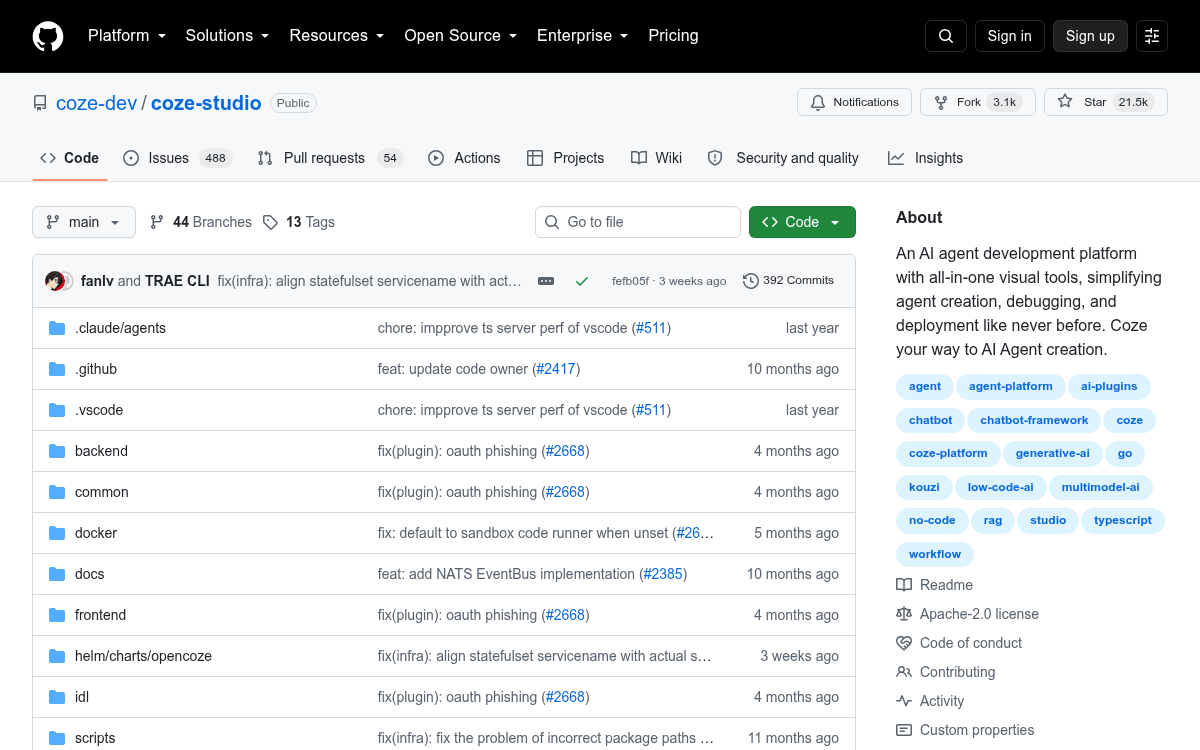
- ByteDance open-sourced Coze Studio, its enterprise AI agent builder, under a clean Apache 2.0 license with no commercial restrictions. [GitHub]
- 20,000+ GitHub stars quickly; the platform already served tens of thousands of enterprises and millions of developers in its commercial form.
- Full stack included: visual drag-and-drop workflow builder, RAG, plugins, multi-model support (OpenAI, Volcengine), Chat SDK, and REST API.
- Deploys on minimal hardware -- 2 CPU cores and 4GB RAM via Docker Compose; no Kubernetes support yet.
- Key limitations: no multi-tenant/multi-user support, fewer plugins than the cloud version, no direct workflow-to-API publishing.
- Cleaner license than Dify (pure Apache 2.0 vs. Dify's modified version), making it more commercially friendly for teams building on top of it.
Coze Studio is ByteDance's full-featured AI agent development platform, and it's now fully open-source. The commercial version was already used by tens of thousands of enterprises and millions of developers before ByteDance decided to open the core engine to the world. The repo crossed 20,000 GitHub stars quickly, and it's a signal that the agent tooling space is heating up fast.
What got open-sourced, exactly?
ByteDance announced the open-sourcing of two core projects of its AI Agent development platform Coze: Coze Studio and Coze Loop. This article focuses on Studio, the visual builder. Coze Loop is a companion platform focused on the full lifecycle management of AI agents, covering prompt debugging, performance evaluation, and monitoring. Both are separate repos, and both ship under the same license.
Both projects adopt the permissive Apache 2.0 open-source license, supporting free commercial use and secondary development, with a minimum local deployment requirement of just 2 cores and 4GB of RAM. That's a deliberately low bar, and it matters for teams that want to self-host without spinning up serious infrastructure.
The engine under the hood
Coze Studio's backend is developed using Golang, and the frontend uses React + TypeScript, following domain-driven design (DDD) principles -- a software architecture approach that organizes code around business concepts rather than technical layers, making the codebase easier to extend. The overall architecture is based on microservices, providing a high-performance, highly scalable, and easy-to-customize underlying framework to help address complex business needs.
The project leans on some well-regarded open-source internals. The agent and workflow runtime is powered by the Eino framework, which handles model abstractions and knowledge base retrieval. The visual workflow canvas is built on top of FlowGram, ByteDance's own workflow-building engine. The HTTP layer runs on Hertz, a high-performance Go HTTP framework. These are all production-tested components from ByteDance's internal stack.
What you actually get
Coze Studio ships with a full suite of agent-building primitives. Here's what's included out of the box:
- Visual workflow builder: Through a drag-and-drop interface, you can connect nodes such as large language models, plugins, and knowledge bases to quickly build complex business logic.
- RAG support: Retrieval-Augmented Generation (RAG) addresses model hallucination and lack of domain-specific knowledge by grounding agents in your own documents and databases.
- Plugin system: Extend agent capabilities with custom or community-built plugins.
- Multi-model support: Manages model lists and integrates services like OpenAI and Volcengine, so you're not locked into a single provider.
- Chat SDK and API: Embed agents directly into your own apps via a Chat SDK or REST API authenticated with Personal Access Tokens.
- Apps and agents: Build standalone apps with full workflow-driven business logic, or build conversational agents with memory, knowledge, and tool use.
Spinning it up
Getting a local instance running is straightforward. You need Docker and Docker Compose, then:
git clone https://github.com/coze-dev/coze-studio.git
cd coze-studio
make web  # macOS or Linux
After the containers start, you register at http://localhost:8888/sign, configure a model provider at http://localhost:8888/admin/#model-management, and you're live at http://localhost:8888/. The image version must be at least 0.5.0 to use the model management UI. One note: if you're exposing this to a public network, the README flags real security risks around the Python execution environment in workflow code nodes and potential SSRF vulnerabilities -- read the security section before deploying externally.
Where it shines, and where it falls short
Coze emphasizes scenario-based implementation efficiency, especially suitable for rapid prototyping and local deployment. The visual builder is genuinely polished -- it comes from a platform that has served production traffic at scale, not a greenfield open-source project. The Golang backend ensures high-concurrency processing, and the microservices architecture supports modular expansion.
That said, the open-source edition has real gaps compared to the commercial version:
- The number of plugins in the open-source version is fewer than in the cloud version, requiring developers to create their own to expand functionality.
- The current open-source version only supports a single-account system and does not support multi-user collaboration.
- Dify supports directly publishing workflows as APIs; Coze Studio's open-source version does not have this direct publishing capability.
- Coze Studio currently only supports one-click deployment via Docker, with no Kubernetes support yet.
How it stacks up against Dify
The obvious comparison is Dify, the most established open-source LLM app platform. Dify has been open-source since May 2023 and has released 143 versions, while Coze Studio only open-sourced in July 2025 and has released 7 versions so far. Dify is more mature and battle-tested. But there's a meaningful licensing difference: Dify's license is essentially Apache 2.0 but with additional restrictions around LOGO retention and commercial SaaS use, while Coze Studio adopts a pure Apache 2.0 license with no such restrictions. If you're building a commercial product on top of the platform, that distinction matters.
Dify is known for standardizing LLMOps and supports multi-tenancy and application sharing, making it suitable for teams needing collaboration. Coze Studio's strength is the depth of its agent-building primitives and the fact that it's backed by ByteDance's production infrastructure experience. The intended workflow is to prototype on Coze's SaaS quickly, then export the agent into self-hosted Coze Studio for data sovereignty.
The bigger picture
Facing increasingly fierce competition in the AI agent market, ByteDance chose to open-source the core components of Coze, sending a strong signal: by opening up technology and ecosystems, it aims to lower the barriers to AI development and promote industry innovation. This is a familiar playbook -- open-source the platform to build ecosystem gravity, keep the cloud service as the monetization layer.
Through the Apache 2.0 license, ByteDance encourages community contributions of code and plugins, enriching the Coze ecosystem, with innovation from the open-source community feeding back into the commercial version, creating a virtuous cycle. The roadmap points toward multi-tenant support and a richer plugin ecosystem as the next priorities. For teams that need full control over their agent infrastructure without starting from scratch, Coze Studio is now a serious option to evaluate.
