
Builderz Labs Drops Mission Control to Run Open-Source AI Agent Fleets
Mission Control is a free, self-hosted dashboard for running AI agent fleets with zero external dependencies, built on SQLite and Next.js
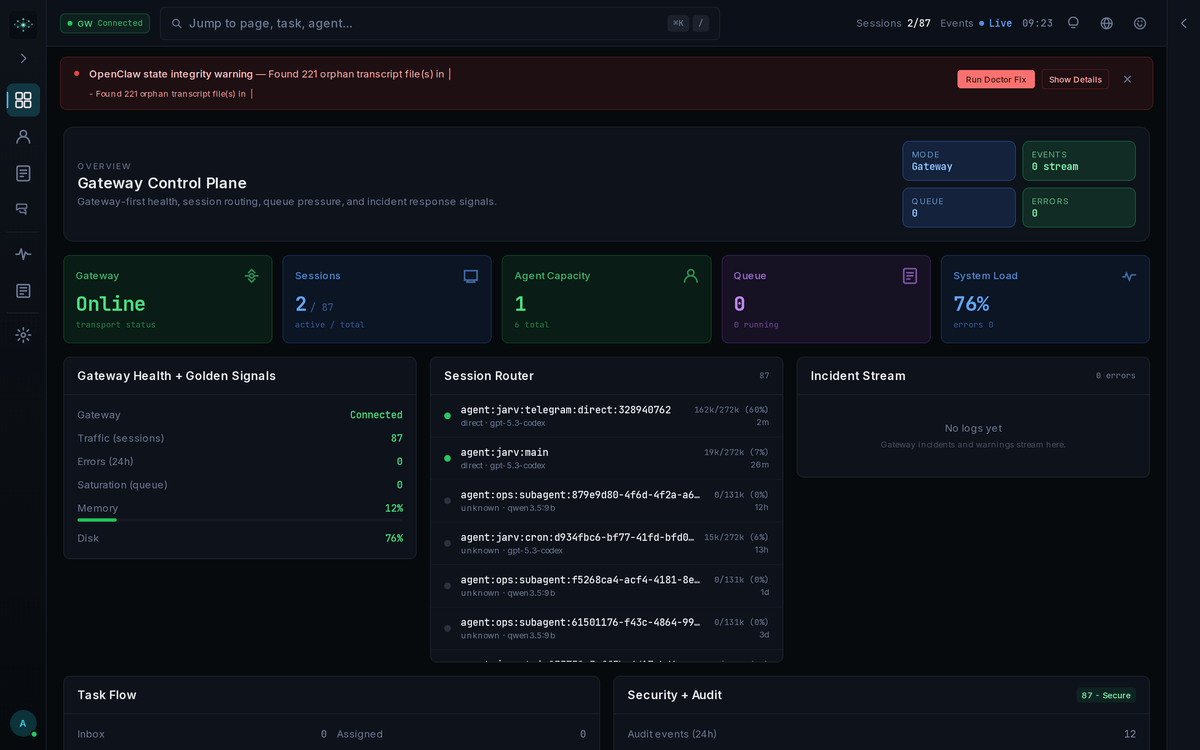
Takeaways
- Open-source, self-hosted: Mission Control is a free MIT-licensed dashboard for AI agent orchestration with zero external dependencies — just SQLite and
pnpm start. - 32 panels, 101 API endpoints: Covers tasks, agents, costs, memory, security, cron, webhooks, pipelines, and more from a single interface.
- Multi-framework support: Built-in adapters for OpenClaw, CrewAI, LangGraph, AutoGen, and Claude SDK normalize registration and task reporting to one interface.
- Security built-in: RBAC, Ed25519 device identity, MCP call auditing, trust scoring, and a skill security scanner ship out of the box.
- Alpha caveat: APIs and DB schemas may change between releases; must be deployed behind a TLS proxy for production use.
- Roadmap includes Flight Deck (Tauri v2 desktop app) and a managed Pro cloud tier at $29/mo. GitHub repo →
Mission Control is an open-source, self-hosted dashboard for orchestrating AI agent fleets. Built by Builderz Labs, it gives you a single interface to register agents, dispatch tasks, track token costs, coordinate multi-agent workflows, and audit everything your agents do , all without touching Redis, Postgres, or any other external service. The entire stack runs on SQLite and a single pnpm start.
The problem it solves
Running more than one AI agent in production today usually means stitching together a pile of scripts, log files, and ad-hoc dashboards. Faster operator response requires real-time agent, task, and security telemetry without stitching tools together , and that's exactly the gap Mission Control fills. As multi-agent systems scale, operational visibility becomes the primary lever for trust: you can't trust what you can't observe.
What's inside
Tasks, agents, skills, logs, tokens, memory, security, cron, alerts, webhooks, pipelines, and more are all accessible from a single SPA shell. The dashboard ships with 32 panels and 101 REST endpoints, backed by 282 unit tests and 295 end-to-end tests. Here are the headline capabilities:
- Task Board: A Kanban board with six columns (inbox → assigned → in progress → review → quality review → done), drag-and-drop, priority levels, assignments, threaded comments, and inline sub-agent spawning.
- Agent Management: Monitor agent status, configure models, view heartbeats, and manage the full agent lifecycle from registration to retirement. Local agent discovery from