
AutoResearchClaw Beats AI Scientist v2 by 54.7% Writing Full Papers Autonomously
AutoResearchClaw turns a research topic into a conference-ready paper through a 23-stage multi-agent pipeline that debates, self-heals, and learns across runs.
Takeaways
- AutoResearchClaw is a 23-stage autonomous research pipeline turning a topic into a conference-ready paper with LaTeX.
- Reports outperforming AI Scientist v2 by 54.7% on the authors' new ARC-Bench benchmark.
- Multi-agent debate, self-healing Pivot/Refine executor, and cross-run learning form the core mechanisms.
- Seven human-in-the-loop modes; targeted intervention beats both full autonomy and step-by-step oversight.
- Four-layer citation verification and a VerifiedRegistry block hallucinated references and fabricated experiment numbers.
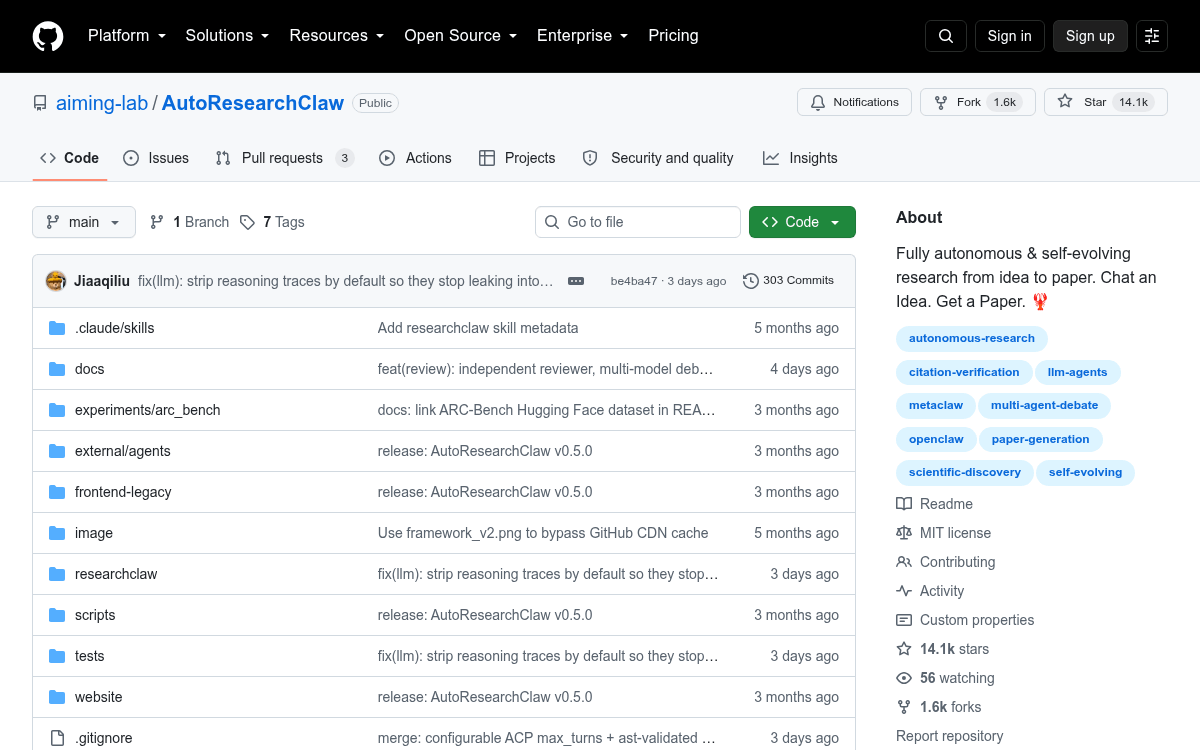
- MIT-licensed, 13.5k stars, installs via pip and runs on any ACP-compatible coding agent.
An open-source project called AutoResearchClaw is pushing end-to-end autonomous research past the demo stage. You hand it a topic in plain English and it hands back a full academic paper: literature review pulled from real APIs, executed experiments with charts, peer-reviewed drafts, and compile-ready LaTeX targeting NeurIPS, ICML, or ICLR templates. The repository has climbed to 13.5k stars, and the accompanying paper reports that it beats AI Scientist v2 by 54.7% on a new benchmark the team also released.
Five mechanisms define the core loop described in the arXiv paper: structured multi-agent debate for hypothesis generation and result analysis, a self-healing executor with a Pivot/Refine decision loop that turns failures into information, verifiable result reporting that blocks fabricated numbers and hallucinated citations, human-in-the-loop collaboration with seven intervention modes spanning full autonomy to step-by-step oversight, and cross-run evolution that converts past mistakes into future safeguards. Those five ideas are what separate this from a scripted prompt chain.
Twenty-three stages, eight phases
The pipeline breaks into 23 discrete stages grouped into phases for scoping, literature discovery, synthesis, experiment design, execution, analysis, writing, and finalization. Three of those are hard gates (literature screening, experiment design, and the final quality gate) where the run pauses for approval or auto-continues with a flag. Stage 15 is where things get interesting: it makes a PROCEED, REFINE, or PIVOT decision, and REFINE loops back to the execution stage while PIVOT goes all the way back to hypothesis generation with versioned artifacts.