
AutoGluon v1.5 Ships Chronos-2 and Beats Every AutoML System in 5 Minutes
The AWS-backed AutoML framework hits version 1.5 with a new foundation forecasting model, tabular foundation models, and an 80 percent win rate over the previous release.
Takeaways
- AutoGluon 1.5 ships with an 80 percent win rate over v1.4 on time series benchmarks, powered by Chronos-2.
- Chronos-2 handles dynamic covariates natively and supports zero-shot inference, full fine-tuning, and LoRA fine-tuning.
- Tabular side adds an
extremepreset with TabPFNv2, TabICL, TabM, and RealMLP for stronger small-dataset performance. - Mitra, AutoGluon's own tabular foundation model, is state-of-the-art on TabRepo, TabZilla, AMLB, and TabArena.
- Independent AutoML Benchmark 2025 ranks AutoGluon first, with 5-minute runs beating other frameworks running for an hour.
- Python 3.13 supported experimentally; models trained on older versions must be retrained on 1.5.
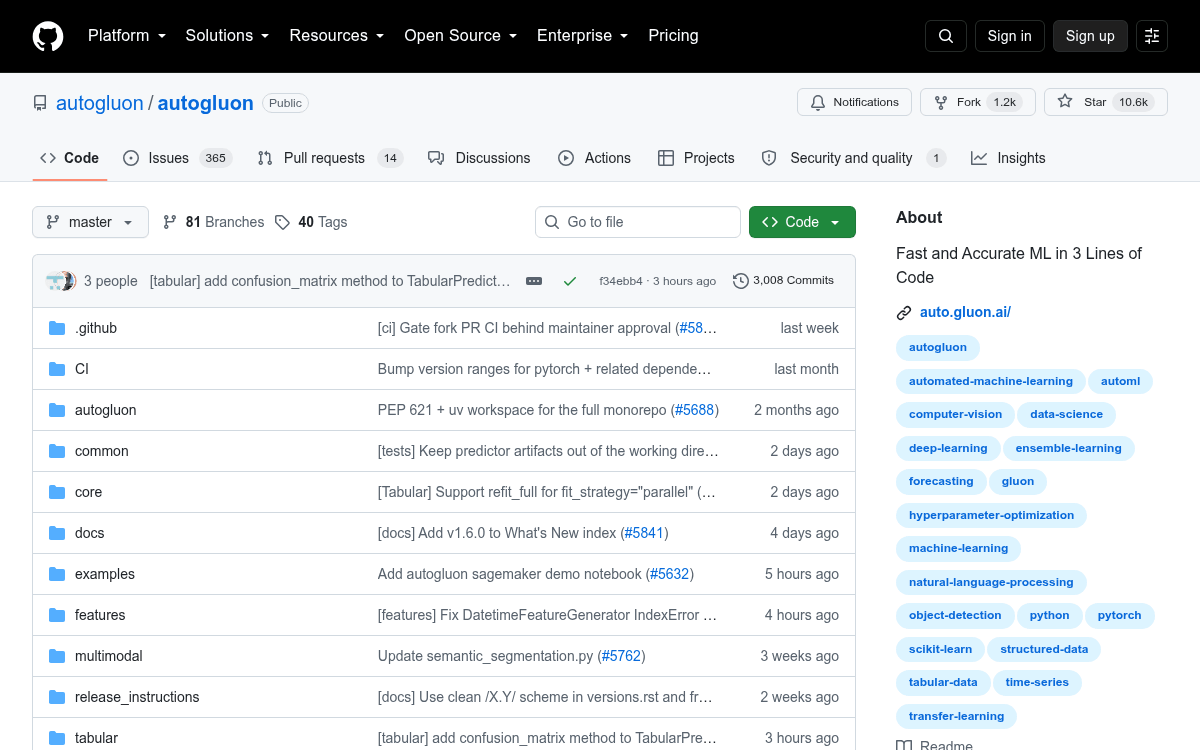
AutoGluon, the open-source AutoML library that promises a working model in three lines of Python, has quietly become one of the most competitive systems on tabular and time series benchmarks. The project sits at more than 10,000 GitHub stars, and recent releases push it well beyond a friendly wrapper around XGBoost. Version 1.5 ships a new foundation model for forecasting, integrates tabular foundation models into the tabular predictor, and continues a streak of measurable gains against its own past versions.
The headline claim is straightforward. AutoGluon v1.5 improves the time series module across both accuracy and usability, achieving up to an 80 percent win rate compared to v1.4 across benchmarks, and adding new models, more flexible ensembling options, and quality-of-life fixes. That follows v1.2, where the Tabular and TimeSeries modules each hit a 70 percent win rate against v1.1. Each release is measurably better than the last on the same benchmarks, which is not something most AutoML projects can say.
Three lines, one predictor, several foundation models
The core API has not changed. You still hand a DataFrame to a predictor and call fit. What changed is what happens underneath. Earlier versions trained a stack ensemble of gradient boosted trees, neural nets, and classical models. The library now also pulls in pre-trained foundation models on both the tabular and time series sides.
from autogluon.tabular import TabularPredictor
predictor = TabularPredictor(label="target").fit(
    train_data,
    presets="extreme",
)
predictor.predict(test_data)