
ATLAS Trades Stocks by Rewriting Its Own AI Prompts as Weights
ATLAS wraps 25+ debating LLM agents in a Darwinian prompt-evolution loop, using Sharpe ratio as a loss function to self-improve trading strategies.
 Pro
Takeaways
- ATLAS is an open-source multi-agent trading framework that treats prompts as weights and Sharpe as loss.
- 25+ Claude Sonnet agents debate across macro, sector, superinvestor, and decision layers daily.
- Autoresearch loop rewrites the worst agent's prompt, runs 5 days, commits or reverts via git.
- PRISM trains separate cohorts per regime; JANUS meta-layer weights them by recent accuracy.
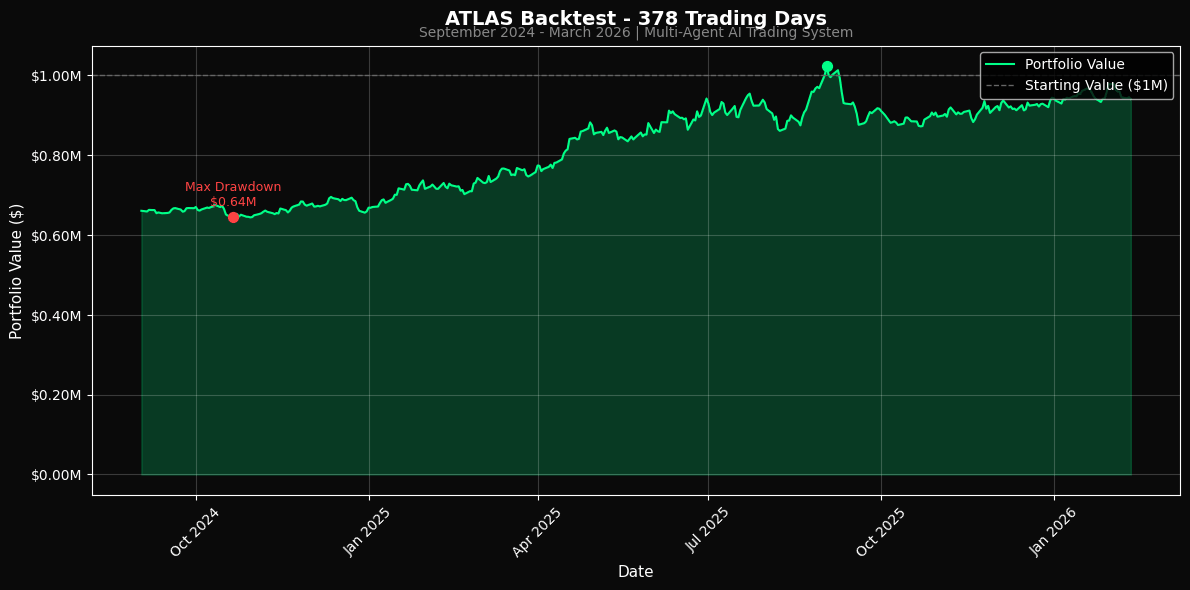
- 18-month backtest: +22% deployment return, 30% of prompt edits kept, best pick +128%.
- Trained prompts are proprietary; repo ships architecture, placeholder prompts, and methodology only.
A new open-source framework called ATLAS takes an unusual approach to algorithmic trading. Rather than train neural networks, it treats agent prompts themselves as the trainable weights and uses a live market Sharpe ratio as the loss function. The repo ships the architecture, autoresearch loop design, and backtest methodology for a self-improving multi-agent system built on Claude Sonnet, and it has been climbing GitHub with over 1,900 stars.
The whole thing runs on a $20/month VM. No GPU, no gradient descent, no fine-tuning. The learning signal comes from whether an agent's trade calls actually made money over rolling windows, and the update step is a targeted rewrite of that agent's system prompt.
Prompts as weights, git as the optimizer
The core idea borrows explicitly from Karpathy's autoresearch pattern. ATLAS identifies the worst agent by rolling Sharpe, generates one targeted prompt modification, runs it for five trading days, then checks whether that agent's Sharpe improved. If yes, the change stays as a git commit. If no, git reset. Each trading day is one training iteration.
Agents also carry Darwinian weights between 0.3 and 2.5. Top-quartile agents get multiplied by 1.05 daily, bottom-quartile agents by 0.95. A CIO agent proportionally weights input by these scores, so good agents get louder and bad agents get quieter.
A four-layer trading desk of LLMs
Twenty-five-plus agents debate markets daily across four layers, every recommendation is scored against real outcomes, and the worst-performing agent gets its prompt rewritten. The layers roughly mirror a real fund: