
Apple Open-Sources Embedding Atlas to Visualize Millions of AI Data Points
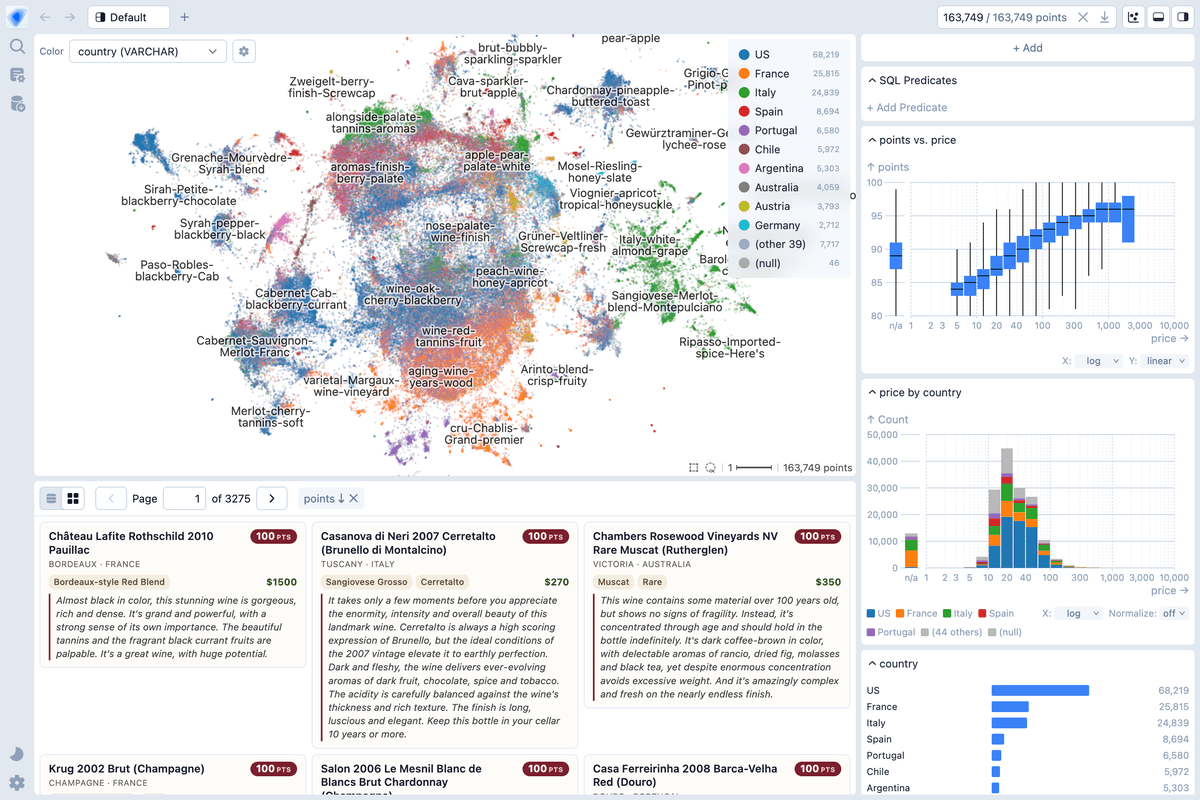
Apple open-sources Embedding Atlas, a WebGPU-powered tool for interactively exploring millions of embedding vectors with auto-clustering, cross-filtering, and MCP agent access.
 Pro
Takeaways
- Apple open-sourced Embedding Atlas, a WebGPU-powered tool for interactively visualizing millions of embedding vectors in the browser.
- Automatic clustering and labeling runs in milliseconds by operating on a 2D density map rather than the full high-dimensional embedding space.
- Cross-filtering dashboards link embedding selections to metadata charts bidirectionally: lasso-select points, see metadata histograms update instantly.
- An MCP server (via
--mcpflag) lets AI agents query schemas, run SQL, create charts, and capture screenshots programmatically. - Available as a Python CLI, Jupyter widget, and npm package with React and Svelte bindings; MIT-licensed and free.
- Requires pre-projected embeddings (UMAP, t-SNE, etc.); performance is benchmarked up to a few million points, with hierarchical sampling recommended beyond that.
Visualizing embeddings has always been more painful than it should be. You reduce your high-dimensional vectors down to 2D, dump them into a scatter plot, and end up staring at an undifferentiated blob. Apple's research team just open-sourced Embedding Atlas, a tool built to make that whole experience actually useful, handling millions of points interactively in the browser with automatic clustering, linked metadata dashboards, and even MCP support for AI agents.
The friction problem it's solving
People often encounter friction when using embedding visualization tools: barriers to adoption like tedious data wrangling and loading, scalability limits, and no integration of results into existing workflows, as well as limitations in possible analyses without integration with external tools to show coordinated views of metadata. Embedding Atlas was built specifically to eliminate those pain points. The project emerged from the need to eliminate tedious setup processes, scalability limitations, and lack of integration with existing workflows, resulting in a platform that handles millions of data points with remarkable speed while providing rich, interactive analysis capabilities.
What's under the hood
Embedding Atlas renders millions of embedding points interactively using WebGPU (with WebGL 2 fallback), Wasm-compiled UMAP, and density-based clustering that runs in milliseconds. The technical stack is deliberately client-side: by offloading rendering (WebGPU) and compute (UMAP via WASM, clustering via Rust) to the client, it minimizes heavy backend dependency and enables low-latency exploration.