
Aperant Runs 12 Claude Agents in Parallel to Build Software Autonomously
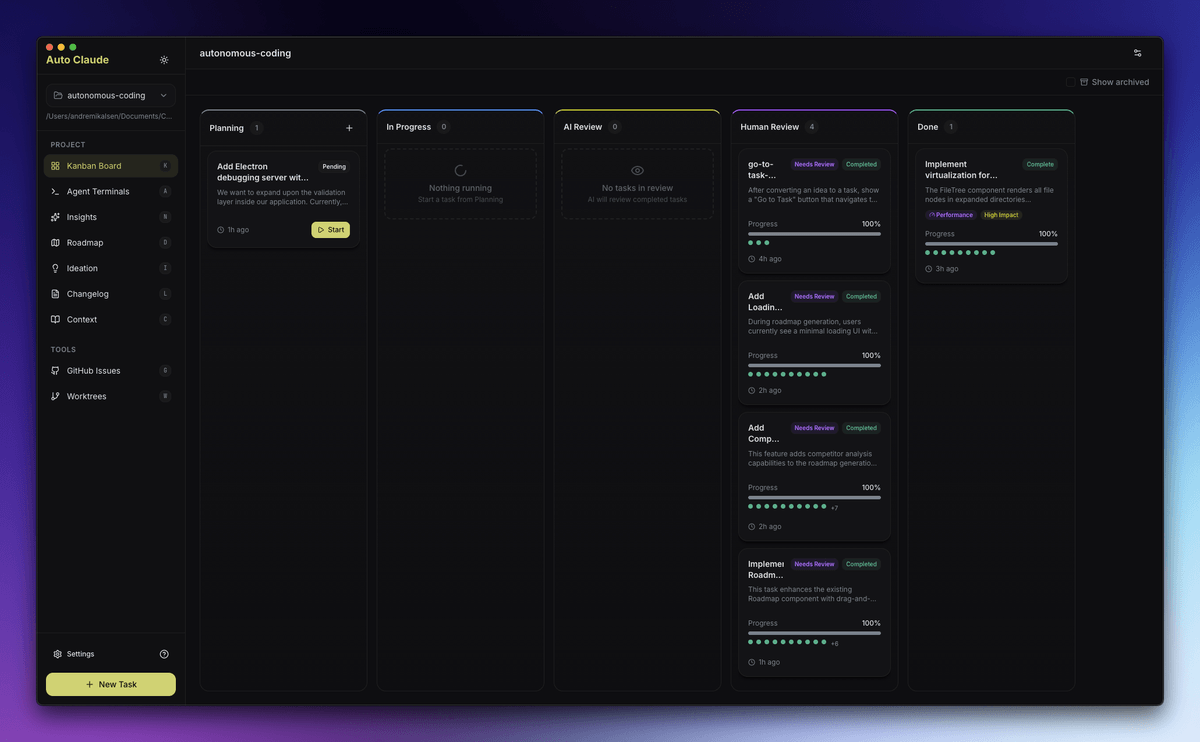
Aperant (formerly Auto Claude) brings a Kanban-driven multi-agent pipeline to your local desktop, running up to 12 parallel Claude agents in isolated git worktrees to plan, build, test, and ship software autonomously.
Takeaways
- What it is: Aperant (formerly Auto Claude) is an open-source desktop app that orchestrates up to 12 parallel Claude agents to plan, build, test, and ship software.
- Core mechanic: Each agent runs in an isolated git worktree, preventing file conflicts; an AI-powered merge step integrates work back to main.
- Rebrand: The project renamed from "Auto Claude" to Aperant in March 2026, partly driven by Anthropic's new OAuth usage restrictions.
- Current state: v2.7.6 is stable on Windows, macOS, and Linux; v3.0 is being rebuilt from scratch with cloud features, still AGPL-3.0.
- Requirements: Claude Pro/Max subscription + Claude Code CLI; note the new monthly Agent SDK credit cap introduced June 15, 2026.
- Pricing: The desktop app is free and open source; Aperant 3.0 cloud tiers are forthcoming with pricing to be announced at launch.
Aperant is an open-source, autonomous multi-agent coding framework that orchestrates Claude agents to handle the full software lifecycle: architecture planning, parallel implementation, self-validating QA, and AI-assisted merging. It started life as "Auto Claude" and quietly accumulated over 14,000 GitHub stars before rebranding in March 2026. The project is now actively rebuilding toward version 3.0, which will add cloud features on top of the existing local desktop experience.
The problem it actually solves
Single-agent AI coding tools are fast but sequential. You wait for one task to finish before the next begins, and you're still the one doing the architecture, writing the tests, and managing the merge. If you've used Claude Code for serious development work, you've probably hit the same wall: one agent, one terminal, one branch, one task at a time. You wait for the agent to finish the auth system before it can start on the API layer. You sit idle while it works through a refactor. The model is fast, but the workflow is sequential.
Aperant's answer is to turn that single-agent loop into a managed pipeline. You describe what you want to build, and a team of agents handles the breakdown, implementation, and validation in parallel, while a Kanban board gives you a live view of what each agent is doing.
How the parallel execution actually works
The core technical trick is git worktrees. Git worktrees give each AI coding agent its own isolated codebase so parallel sessions never overwrite each other's changes. Instead of cloning the repo multiple times, git worktrees enable parallel AI agent execution by giving each agent its own isolated working directory and git index while sharing a single object store, preventing file-level conflicts, context contamination, and lock contention when multiple agents operate on the same repository.