
Anthropic Ships 10 Open-Source AI Agents Built for Wall Street
Anthropic releases 10 open-source finance agent templates covering pitchbooks, KYC, GL reconciliation, and more — deployable in Cowork or via API in days
 Pro
Takeaways
- Anthropic released 10 open-source finance agent templates covering pitchbooks, KYC, GL reconciliation, earnings review, and more.
- Each agent ships as a Claude Cowork/Code plugin and as a Claude Managed Agents cookbook deployable via
/v1/agentsAPI. - 12 MCP data connectors included out of the box: FactSet, Morningstar, PitchBook, LSEG, Moody's, S&P Global, and more.
- Claude add-ins for Excel, PowerPoint, and Word are now generally available, with cross-app context carried automatically between tools.
- Agents draft analyst work product only — no transaction execution, no ledger writes, every output staged for human sign-off.
- Available free (Apache 2.0) on all paid Claude plans; Managed Agents in public beta; MCP connectors may require provider subscriptions.
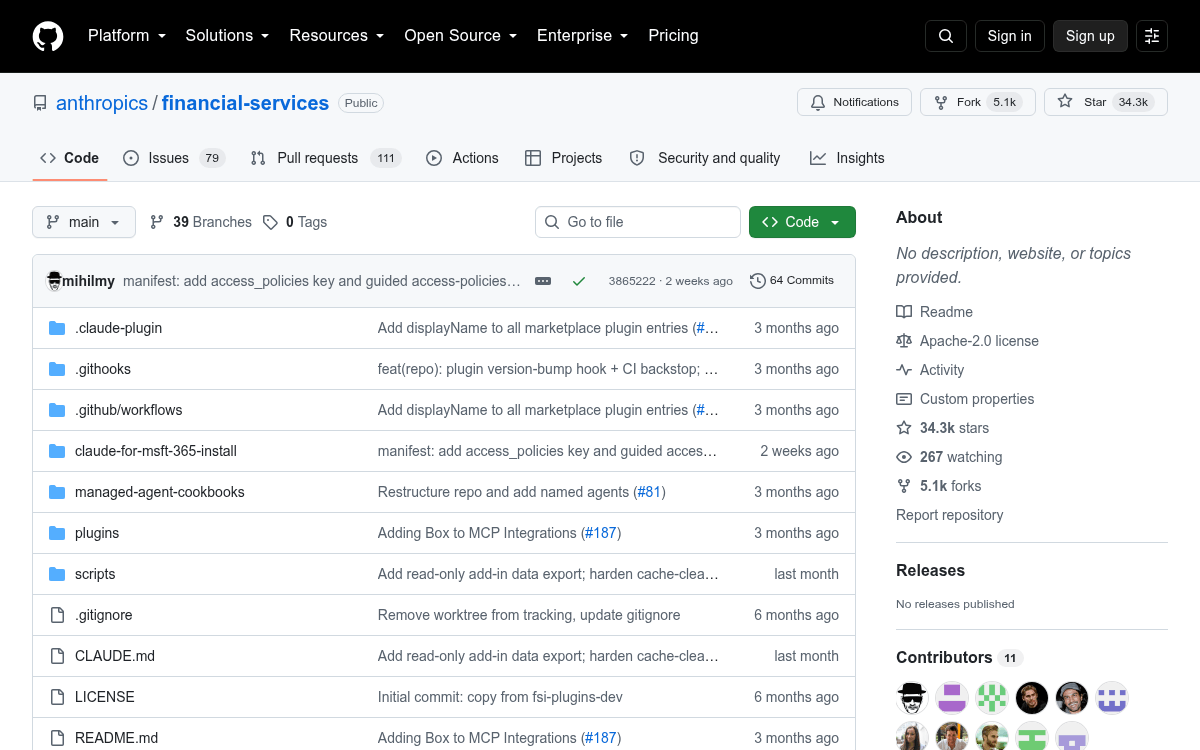
Anthropic just shipped what might be the most complete AI toolkit Wall Street has ever seen. The company released Claude for Financial Services , an open-source repository of ten ready-to-run agent templates, vertical skill bundles, and 12 live data connectors targeting the most time-consuming workflows in investment banking, equity research, private equity, wealth management, and fund operations.
The release is notable not just for its breadth, but for how it is packaged. Each agent template ships as a plugin in Claude Cowork and Claude Code, and as a cookbook for Claude Managed Agents, so a team can put Claude on real financial work in days rather than months. Same system prompt, same skills , you pick the deployment model.
Ten agents, two deployment paths
Anthropic is releasing ten new Cowork and Claude Code plugins, integrations with the Microsoft 365 suite, new connectors, and an MCP app for financial services and insurance organizations. The ten named agents break down across two functional areas:
Research and client coverage:
- Pitch Builder , creates target lists, runs comparables, and drafts pitchbooks end-to-end
- Meeting Preparer , assembles client and counterparty briefs before calls
- Earnings Reviewer , reads transcripts and filings, updates models, flags thesis-relevant changes
- Model Builder , builds and maintains financial models (DCF, LBO, 3-statement) from filings and data feeds
- Market Researcher , tracks sector and issuer developments, synthesizes news, filings, and broker research, and flags items for credit and risk review
Finance and operations:
- Valuation Reviewer , checks valuations against comparables and methodology
- GL Reconciler , reconciles general ledger accounts and runs NAV calculations
- Month-End Closer , runs the close checklist, prepares journal entries, produces close reports
- Statement Auditor , reviews financial statements for consistency, completeness, and audit-readiness
- KYC Screener , assembles entity files, reviews source documents, and packages escalations for compliance review
The architecture behind the agents
Each agent template is built from three composable parts: skills (domain knowledge and step-by-step instructions Claude draws on automatically), connectors (governed, real-time access to data providers), and subagents (additional Claude models called for specific sub-tasks like comparables selection or methodology checks). Everything in the repo is file-based , markdown and JSON , with no build step required.
The dual deployment model is the real engineering decision here. Everything is available two ways from one source: install it as a Claude Cowork plugin, or deploy it through the Claude Managed Agents API behind your own workflow engine. Same system prompt, same skills , you choose where it runs. For teams that want headless, scheduled runs over a whole book of deals, the Managed Agent path adds long-running sessions, per-tool permissions, managed credential vaults, and a full audit log in the Claude Console.
Deploying a managed agent is a single shell command:
export ANTHROPIC_API_KEY=sk-ant-...
scripts/deploy-managed-agent.sh gl-reconciler
The deploy script resolves file references, uploads skills, creates leaf-worker subagents, and POSTs the orchestrator to /v1/agents. A reference event loop in scripts/orchestrate.py handles routing handoff_request events between agents through your own orchestration layer.
Claude moves into Excel, PowerPoint, and Word
Claude now works across Microsoft Excel, PowerPoint, Word, and Outlook (coming soon) through the Claude add-ins for Microsoft 365. Once the add-ins are installed, context carries automatically between applications, so work that starts in a model can end in a deck without re-explaining anything in between. That cross-app context is a meaningful quality-of-life improvement , an analyst building a coverage model in Excel no longer has to re-explain it when moving to PowerPoint for the pitch deck.
If your firm runs Claude inside Excel, PowerPoint, Word, and Outlook via the Microsoft 365 add-in, the claude-for-msft-365-install/ directory is the admin tooling to provision it against your own cloud , Vertex AI, Bedrock, or an internal LLM gateway , instead of Anthropic's API. That last point matters for regulated institutions that cannot route data through Anthropic's servers directly.
12 data connectors out of the box
Agents are only as good as the data they can reach. The financial-analysis core plugin ships with 12 MCP connectors centralized in one place and shared across all other plugins:
- Daloopa, Morningstar, S&P Global (Kensho), FactSet, Moody's
- MT Newswires, Aiera, LSEG, PitchBook, Chronograph
- Egnyte and Box for document storage
New connectors added with this release include Dun & Bradstreet, Fiscal AI, Financial Modeling Prep, Guidepoint (100,000+ expert interview transcripts), IBISWorld, SS&C Intralinks for deal data rooms, Third Bridge, and Verisk for insurance data. Moody's also launched a full MCP app that brings proprietary credit ratings and data on more than 600 million public and private companies directly into Claude.
What it is good at , and where it stops
The benchmark numbers back up the financial focus. Anthropic has unveiled plugins for its Claude Cowork agent software that are designed to automate work in a host of financial services areas, including investment banking and wealth management. The underlying model, Claude Opus 4.7, leads the industry on Vals AI's Finance Agent benchmark at 64.37%.
The agents are explicitly scoped to drafting and analysis, not execution. These agents draft analyst work product , models, memos, research notes, reconciliations , for review by a qualified professional. They do not make investment recommendations, execute transactions, bind risk, post to a ledger, or approve onboarding; every output is staged for human sign-off. That boundary is a feature for compliance teams, not a limitation , it keeps the human in the loop at every decision point that carries regulatory weight.
The plugins handle the analytical half of the work , financial plans, models, rebalancing, performance reports. They deliberately stop at the numbers. The half they leave to you is the compliant, client-facing words: the Reg BI rationale memo for the file, the Form ADV-consistent disclosure, the SEC Marketing Rule review.
Who is already using it
The client roster Anthropic is citing reads like a financial services directory. Citadel analysts are using it to build and update coverage models. Financial services organizations are using Claude for research, deal work, analysis, claims, model reviews, reporting, and more. Most firms run more than one Claude product: Claude for chat and research, Claude Cowork for project-level work across files and apps, Claude Code for quantitative and engineering teams, and Claude for Microsoft 365 for the hours spent in Excel, PowerPoint, and Word. Walleye Capital reports 100% employee adoption of Claude Code across its 400-person hedge fund. FIS is building AML investigation agents that compress timelines from days to minutes.
LPL Financial is taking another step forward in its AI journey through a new partnership with Anthropic, beginning to introduce wealth-management-focused Claude plugins across its platforms.
Getting started
The new Claude agents are available today at the financial services marketplace. They can be used as plugins in Claude Cowork or Claude Code on all paid plans, or as Managed Agents in the Claude Platform (in public beta) for programmatic use. The repo is Apache 2.0 licensed and free to fork. MCP connector access may require a subscription or API key from the individual data provider.
Installing via Claude Code takes three commands:
# Add the marketplace
claude plugin marketplace add anthropics/financial-services
# Install the core modeling skills and connectors first
claude plugin install financial-analysis@claude-for-financial-services
# Then add the agents you need
claude plugin install pitch-agent@claude-for-financial-services
claude plugin install gl-reconciler@claude-for-financial-services
The repo is designed to be forked and tuned. You can swap connectors by pointing .mcp.json at your own data providers, add firm-specific terminology and formatting standards to skill files, teach Claude your branded PowerPoint layouts with /ppt-template, and extend the agent roster by copying the existing structure. Partner-built plugins from LSEG and S&P Global are already included under plugins/partner-built/.
The broader signal here is that Anthropic is moving from general-purpose model provider to vertical workflow infrastructure , shipping the reference architecture, the data connectors, and the deployment tooling together, and letting firms customize from there rather than starting from scratch.
 X X post by @anthropicai