
Alibaba's SkillClaw Lets AI Agents Share and Evolve Skills Across Users
SkillClaw lets LLM agent skills evolve automatically from real user sessions, sharing improvements across every connected agent with zero manual effort.
Takeaways
- What it is: SkillClaw is an open-source framework from Alibaba's AMAP-ML team that auto-evolves LLM agent skills from real user sessions.
- Zero friction: A local API proxy intercepts agent traffic silently; users interact normally while skills improve in the background overnight.
- Collective learning: Skills are shared across all connected agents via S3/OSS, so one user's fix instantly benefits the entire group.
- Benchmark gains: On WildClawBench's 60 real-world tasks, Search & Retrieval improved +52%, Creative Synthesis +88%, with an average controlled gain of +42.1% after one evolution round.
- Broad compatibility: Natively integrates with Hermes, Claude Code, Codex, OpenClaw, QwenPaw, and any OpenAI-compatible API endpoint.
- MIT licensed and free: Available now at github.com/AMAP-ML/SkillClaw; only cost is LLM API calls for the nightly evolve server runs.
SkillClaw is an open-source framework from Alibaba's AMAP-ML team that solves a quiet but persistent problem in production AI agents: skills stay frozen after deployment. Every time a user finds a better workaround, that insight dies with the session. SkillClaw intercepts that loss, automatically distilling real interaction data into improved, shared skills that propagate to every agent in the group.
The problem nobody was fixing
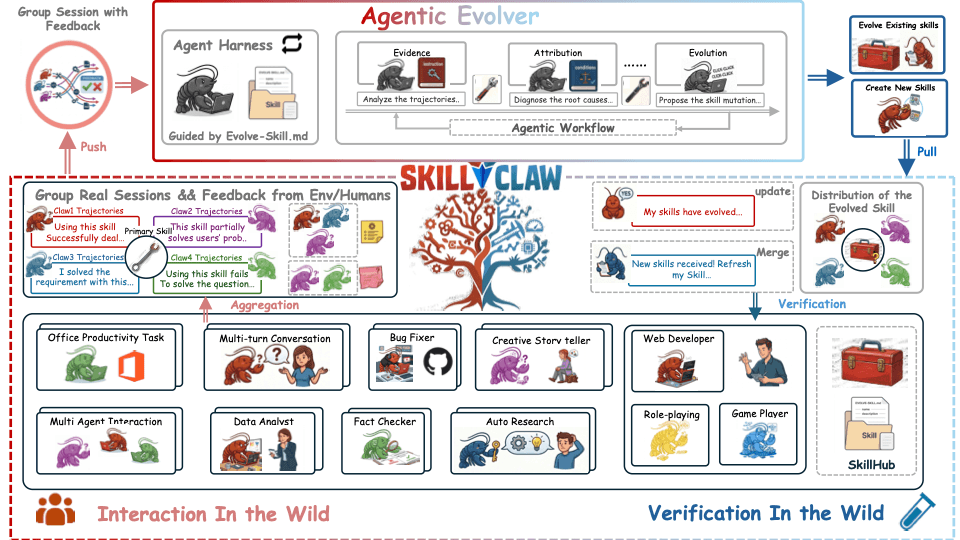
SkillClaw is an agentic skill evolution framework that automates the refinement and management of AI agent capabilities based on real-world interactions, operating as a background process that deduplicates, improves, and merges skills across multiple sessions, devices, and users. The root issue it targets is what the paper calls the "static skill library" problem. Agent frameworks like OpenClaw and Hermes rely on reusable skills (code snippets, tool-use patterns) to handle complex tasks, but those skills stay frozen after deployment. When one user finds a better approach or workaround, that knowledge stays trapped with them.
Consider a concrete scenario: your home agent learns React, your work agent learns Kubernetes, your school agent learns ML. Without SkillClaw, each starts from scratch. With it, skills unify across all environments so every agent instance benefits from every other's experience, regardless of where you are. Scale that to a team and the compounding effect becomes significant: User A debugs a database issue and the skill evolves. Users B, C, and D benefit instantly without ever hitting the same problem. N users, one skill, continuous evolution.
How the machinery works
SkillClaw has three interacting components that form a closed loop. It adds a local API proxy that records session artifacts, and an evolve server with an autonomous evolver that aggregates trajectories across users, identifies recurring behavioral patterns through clustering, and translates them into concrete skill updates. The full pipeline is:
- Client Proxy , a local API proxy (
/v1/chat/completions,/v1/messages) that intercepts agent requests and records every session artifact silently in the background. - Workflow Evolve Server (
evolve_server) , a fixed 3-stage LLM pipeline (Summarize → Aggregate → Execute) that reads session data from shared storage, then evolves or creates skills.