
Alibaba's GUI-Owl-1.5 Beats Claude on Tool-Calling Across Every Major OS
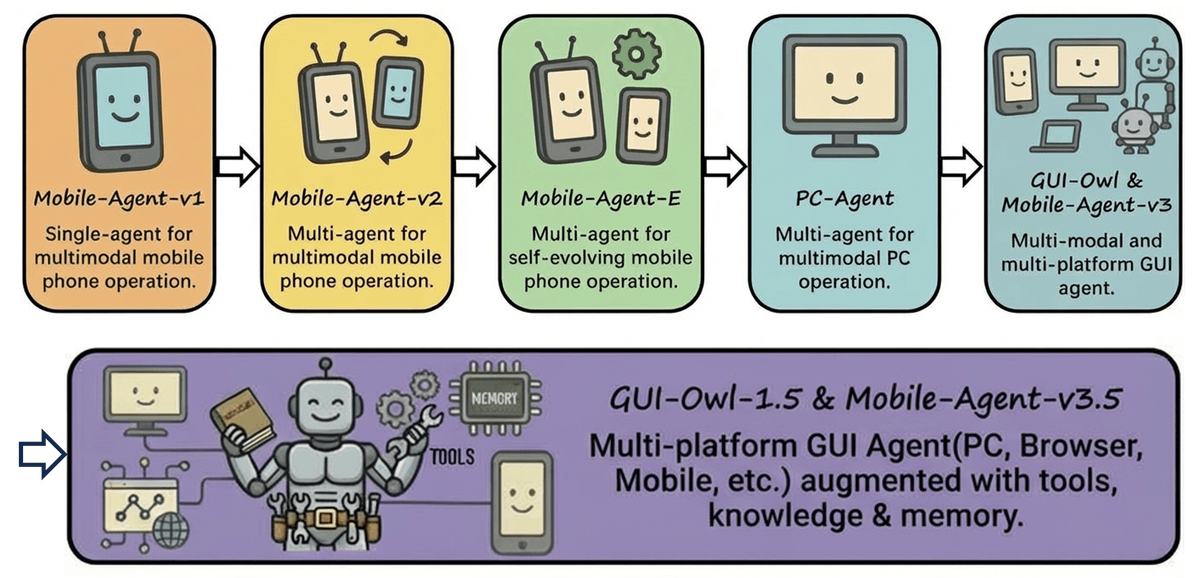
Alibaba's Tongyi Lab open-sources GUI-Owl-1.5 and Mobile-Agent-v3.5, a native multi-platform GUI agent family built on Qwen3-VL that tops 20+ benchmarks.
Takeaways
- Alibaba's Tongyi Lab released GUI-Owl-1.5 and Mobile-Agent-v3.5, an open-source multi-platform GUI agent family.
- Built on Qwen3-VL with Instruct and Thinking variants at 2B, 4B, 8B, 32B, and 235B scales.
- Hits 80.3 on ScreenSpotPro grounding, surpassing Gemini-3-Pro; 56.5 on OSWorld-Verified with the 32B.
- Beats Claude-4-sonnet on OSWorld-MCP tool-calling (47.6 vs 43.3), a 7x-smaller model besting MAI-UI-235B.
- New MRPO algorithm trains one policy across Android, Ubuntu, macOS, Windows, and browsers.
- Weights on HuggingFace; hosted inference via Alibaba Cloud Bailian and ModelScope.
Alibaba's Tongyi Lab has pushed a substantial update to its X-PLUG/MobileAgent repository, releasing GUI-Owl-1.5, a family of native multi-platform GUI agent foundation models, alongside Mobile-Agent-v3.5, the multi-agent framework that wraps them into planning, reflection, and memory workflows. GUI-Owl-1.5 builds on Qwen3-VL and ships 2B/4B/8B/32B/235B Instruct and Thinking variants covering desktop, mobile, and browser automation, with reported state-of-the-art results on more than 20 GUI benchmarks.
Instead of stitching together separate models per operating system, a single policy learns to click, type, scroll, and call tools across Android, Ubuntu, macOS, Windows, and browsers. GUI-Owl-1.5 trains one unified policy across all device types via a new reinforcement learning algorithm called MRPO, in contrast to UI-TARS-2, which targets platforms individually.
From edge weights to cloud reasoners
The family is laddered so you can trade off latency, footprint, and reasoning depth without switching architectures. Instruct and Thinking variants ship at 2B, 4B, 8B, 32B, and 235B parameter scales on HuggingFace. Smaller Instruct checkpoints can run on edge devices for real-time interaction, while larger Thinking checkpoints handle complex planning in the cloud.
- Instruct variants are tuned for low-latency clicking, typing, and scrolling.
- Thinking variants generate explicit reasoning traces before emitting an action, useful for long-horizon tasks with backtracking.
- Sizes range from 2B for on-device inference up to a 235B tier for the heaviest cloud workloads.
What the benchmarks actually show
The headline numbers are competitive with, and in several places ahead of, proprietary frontier models. Tongyi Lab reports the open-source release beats Claude on tool-calling tasks and hits 80.3 on ScreenSpotPro grounding, surpassing every model tested, including Gemini-3-Pro.
On the desktop side, results scale surprisingly well down the parameter curve. For computer use, the 32B-Instruct model scores 56.5 on OSWorld-Verified, ahead of UI-TARS-2 (53.1) and OpenCUA-72B (45.0). Even the 2B variant reaches 43.5, outperforming UI-TARS-72B-DPO (27.1) with over 10x fewer parameters.