
Alibaba's AgentScope 2.0 Rebuilds Open-Source Agents for Real Production Deployments
AgentScope 2.0 ships a full-stack agent platform with sandboxed execution, triple-layer permissions, and built-in multi-tenant deployment — all open-source from Alibaba's Tongyi Lab.
 Pro
Takeaways
- AgentScope 2.0 released: Alibaba Tongyi Lab ships a breaking-change overhaul of its open-source agent framework, targeting production deployments over demos.
- Triple-layer security: Tool-specific review, human-in-the-loop permission gates (allow/approve/deny), and sandboxed execution in Docker, K8s, or E2B.
- Workspace abstraction: Decouples agent logic from execution environment — the same agent runs locally, in Docker, or in the cloud without code changes.
- MCP + A2A protocol support: Native interoperability with the Model Context Protocol for tools and Google's Agent-to-Agent protocol for cross-framework agent communication.
- Production-grade deployment: Built-in multi-tenant, multi-session FastAPI service with stateless horizontal scaling and state persistence to Redis/MySQL/PostgreSQL.
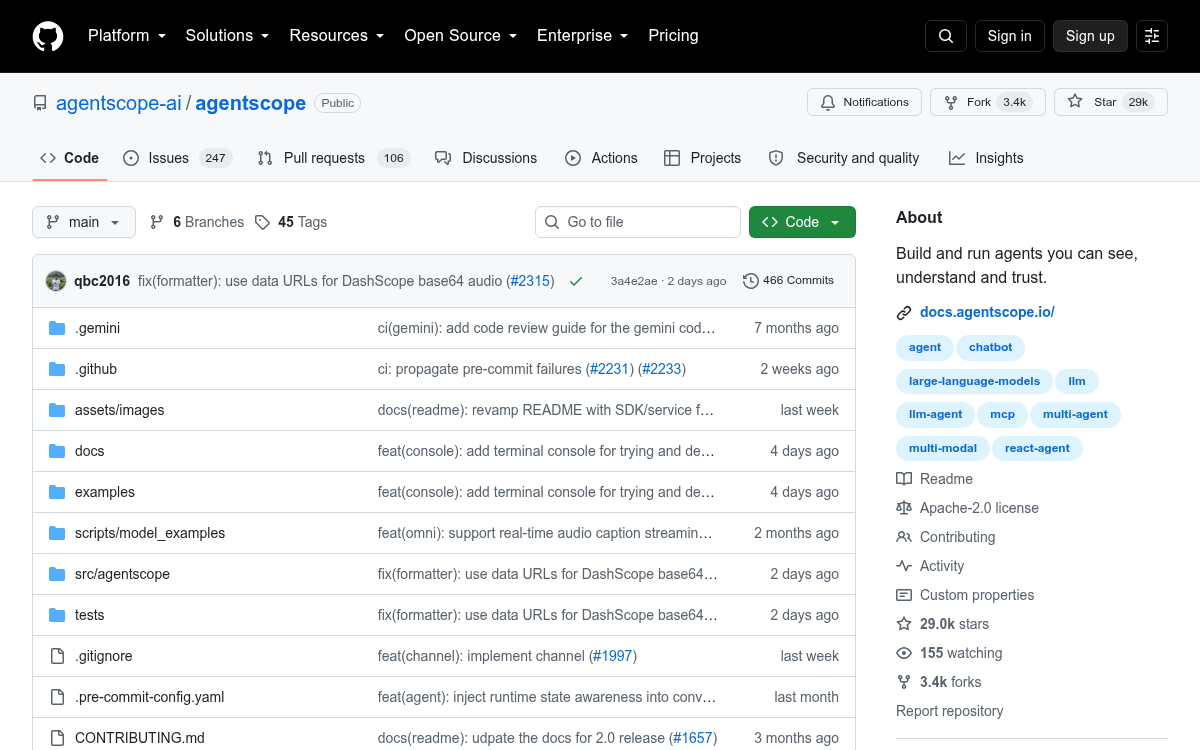
- Free and open-source: Apache 2.0 license, ~19K GitHub stars; get started at github.com/agentscope-ai/agentscope with full docs here.
AgentScope 2.0 is a major architectural overhaul of Alibaba Tongyi Lab's open-source agent framework, and it draws a clear line between "agent demos" and "agents you can actually ship." It is built for security, efficiency, flexibility, and completeness, with multi-tenant, multi-session management and distributed deployment as first-class citizens. With nearly 19,000 GitHub stars and backing from a research team that has published two peer-reviewed papers on the system, this is one of the more serious bets in the open-source agent framework space.
The problem every agent builder hits
The Tongyi/Qwen team was shipping agents in production and kept running into the same walls: model failures, context overflow, permission gaps, and deploy friction. Most frameworks solve the "one agent, one task" case well. The hard part is what happens at scale: multiple users, long-running sessions, untrusted tool code, and the need to survive rolling restarts without losing state. AgentScope 2.0 targets those last-mile engineering issues , retries and fallback models, auditable event streams, tool and shell guardrails, structured memory compression, and one-step service exposure.
What's actually new in 2.0
AgentScope 2.0 is a breaking change from 1.0, with significant improvements. The core design philosophy also shifted: rather than constraining agents with strict prompts and opinionated orchestrations, the framework leans into the models' own reasoning and tool-use abilities. The key new systems are:
- Triple-layer security: tool-specific review, human-in-the-loop permissions, and sandboxing. The permission engine is a three-state gate , allow, require approval, or deny , applied per tool call.
- Workspace abstraction: AgentScope 2.0 introduces the Workspace to separate "what the agent does" from "where it runs." It provides tools, MCP services, the Skills library, and context persistence, unifying local filesystem, Docker container, and E2B cloud sandbox behind a single interface.