
agtx Turns Your Terminal Into a Parallel AI Coding Workforce
agtx is an open-source terminal kanban board that runs multiple AI coding agents in parallel, from idea to merge, hands-free
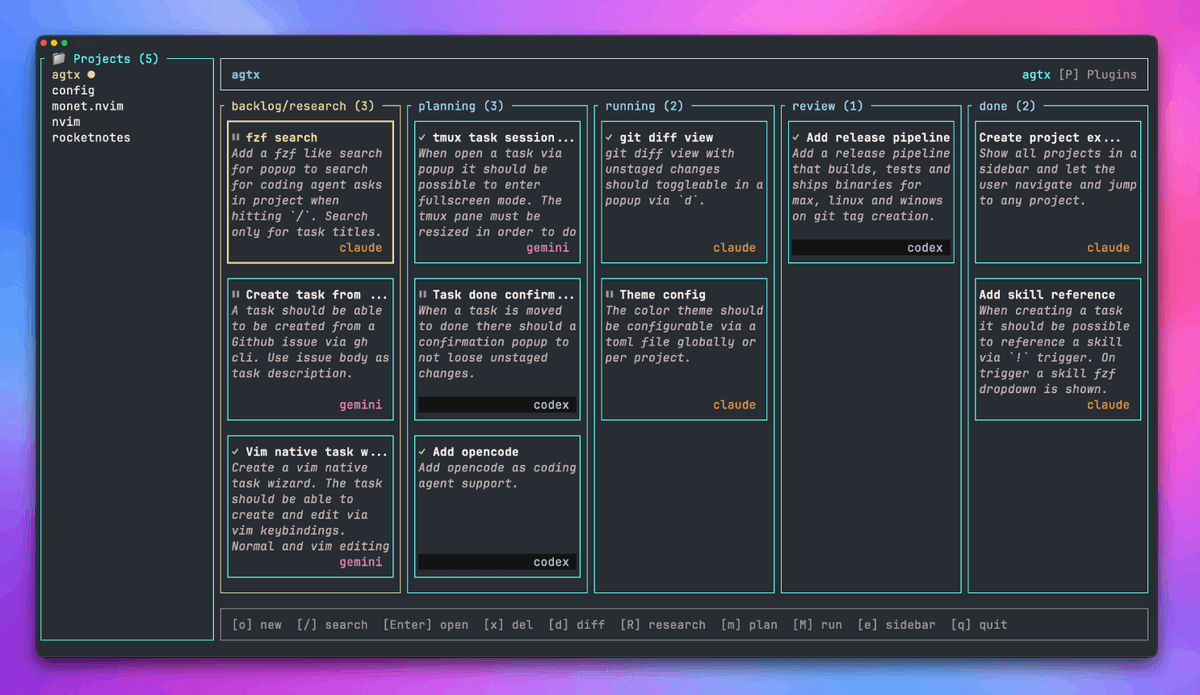
Takeaways
- What it is: agtx is an open-source terminal kanban board that runs multiple AI coding agents in parallel, each in its own Git worktree and tmux window.
- Orchestrator: An experimental AI orchestrator (via MCP) manages the board autonomously, advancing tasks through phases and resolving merge conflicts hands-free.
- Multi-agent phases: Different agents can handle different phases per task (e.g. Gemini for research, Claude for implementation, Codex for review) with automatic switching.
- Brainstorm & Sweep:
/agtx:brainstormand/agtx:sweeplet you capture ideas mid-session and push them to the board as tasks without leaving your agent. - Plugin system: Ships with 10 built-in plugins including spec-kit, BMAD, and GSD; custom plugins defined in a single TOML file.
- Free & open-source: Apache 2.0 license, written in Rust, installed via a single curl command with tmux as the only hard dependency.
agtx is a terminal-native kanban board that turns your AI coding tools into a parallel workforce. Instead of babysitting one agent through one task in one terminal window, you drop tasks onto a board, press a key, and walk away. An orchestrator agent handles the rest: planning, delegating to coding agents, advancing phases, and flagging anything that needs your attention. You come back to changes ready to merge.
The problem it solves
Most AI coding tools give you one agent, one task, one terminal. agtx gives you a kanban board where multiple coding agents work in parallel, each in its own git worktree, each in its own tmux window, running autonomously through a spec-driven workflow managed by an orchestrator agent. The bottleneck with AI coding agents today is no longer generation speed. The problem is drift: confident, plausible code that quietly solves the wrong problem because nobody grounded the work in a real specification. agtx attacks both problems at once.
Spec-driven development (SDD) is the idea of writing a detailed specification before any code is generated, so the agent has a complete picture of what to build, why it matters, and what to avoid. Empirical studies suggest that human-refined specs significantly improve LLM-generated code quality, with controlled studies showing error reductions of up to 50%. Specifications also enable parallel agent execution on non-overlapping tasks, allowing multiple AI agents to implement different components simultaneously without interference.
How it works under the hood
agtx uses tmux for session and window isolation per project and task, and Git worktrees for task separation. It orchestrates multiple AI coding agents, allowing phase-specific agents with automatic switching and preserved context. The architecture is straightforward: