
Agno's Open-Source AgentOS Gives Developers Full Control Over AI Agent Infrastructure
Agno is an open-source SDK and runtime that turns any agent into a production-ready, multi-tenant API with RBAC, memory, and observability baked in
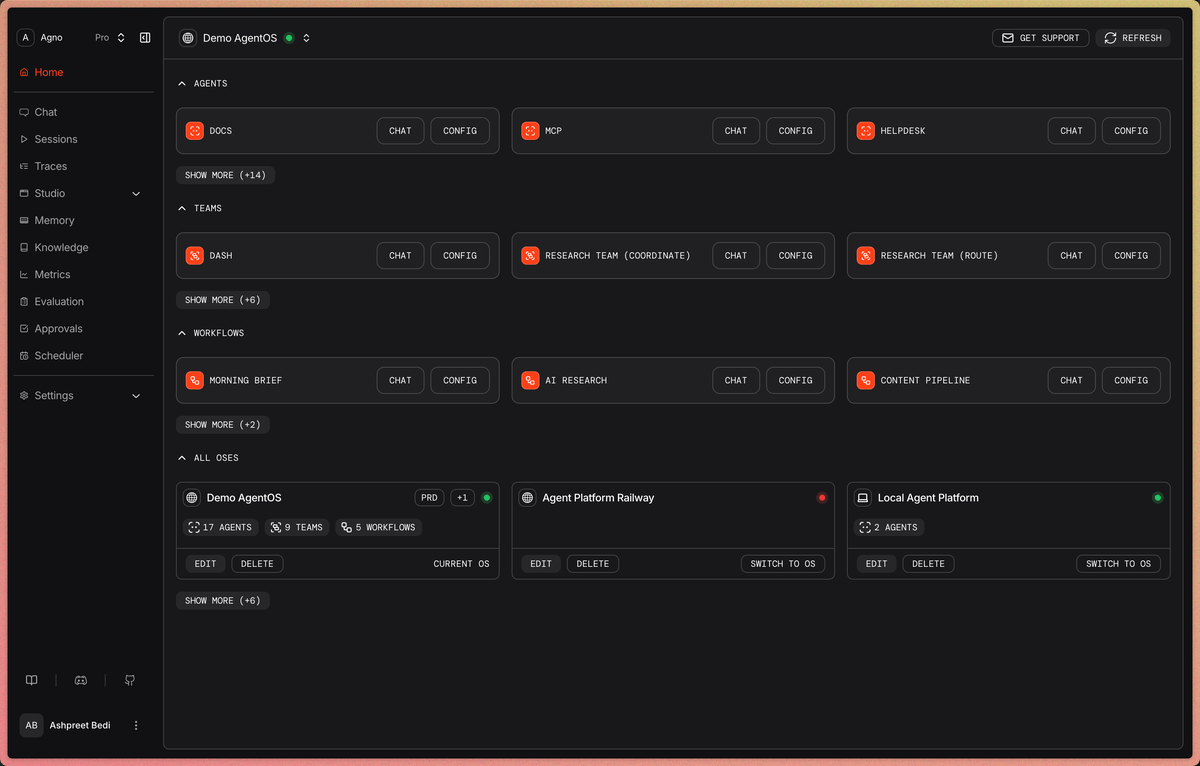
Takeaways
- Full-stack agent platform: Agno combines an agent SDK, a production runtime (AgentOS), and a web control plane in one open-source package.
- Production-ready out of the box: JWT-based RBAC, multi-tenant session isolation, SSE streaming, tracing, and 50+ API endpoints ship by default.
- You own all your data: Sessions, memory, traces, and knowledge are stored in your own database -- Agno stores nothing on its servers.
- Multi-framework runtime: AgentOS can serve agents built with LangGraph, DSPy, or Claude Agent SDK alongside native Agno agents.
- Dynamic multi-tenancy: New factory pattern lets one AgentOS instance spin up per-tenant agent configurations at request time, no separate deployments needed.
- Free and self-hostable: Apache 2.0 license, deployable on Docker, AWS, GCP, Railway, or air-gapped environments; 40,800+ GitHub stars.
Agno (formerly Phidata) has quietly become one of the most-starred agent frameworks on GitHub, sitting at over 40,800 stars and 5,500 forks. But the headline number undersells what the project actually is: not just another way to wrap an LLM in a loop, but a full-stack platform for building, deploying, and managing agent systems you actually own.
The gap it fills
Most agent frameworks hand you the building blocks and walk away. You still need to wire up auth, session storage, observability, scheduling, and multi-user isolation yourself. Agno addresses the complexities involved in building and managing multi-agent systems by providing a streamlined, secure, and efficient framework, abstracting the challenging aspects of agent development such as session management, memory integration, and reasoning capabilities so developers can focus on creating intelligent behaviors without being bogged down by infrastructure concerns.
The result is a three-layer stack:
- Agno SDK -- build agents, multi-agent teams, and step-based workflows in Python
- AgentOS Runtime -- serve those agents as production APIs with auth, tracing, and session isolation
- AgentOS Control Plane -- a web UI at os.agno.com to test, monitor, and manage everything
What AgentOS actually gives you
AgentOS ships with a production API with 50+ ready-to-use endpoints with SSE-compatible streaming, data ownership where sessions, memory, knowledge, and traces are stored in your own database, request isolation with no state bleed between users or sessions, JWT-based RBAC with hierarchical scopes, observability traces stored in your database with no third-party egress, and governance via guardrails, human-in-the-loop, and approval flows.