
AgentScope's ReMe Gives AI Agents Lasting Memory With Plain Markdown Files
A local-first memory kit that turns agent conversations into editable Markdown files with wikilinks, hybrid search, and self-consolidating knowledge nodes.
Takeaways
- ReMe stores agent memory as editable Markdown files with frontmatter and wikilinks under a local
.reme/workspace. - Auto Memory, Auto Resource, Auto Dream, and Auto Link consolidate raw sessions into daily notes and long-term digest nodes.
- Hybrid search combines BM25, wikilinks, and optional embeddings via reciprocal rank fusion, with line-range chunk recall.
- Reports 89.4% on LongMemEval cleaned-s and 66.1% on BEAM 100K; ACL 2026 Findings paper accepted.
- Integrates with Claude Code via MCP, QwenPaw via Python API, and CLI agents via a drop-in
SKILL.md. - Apache 2.0 licensed,
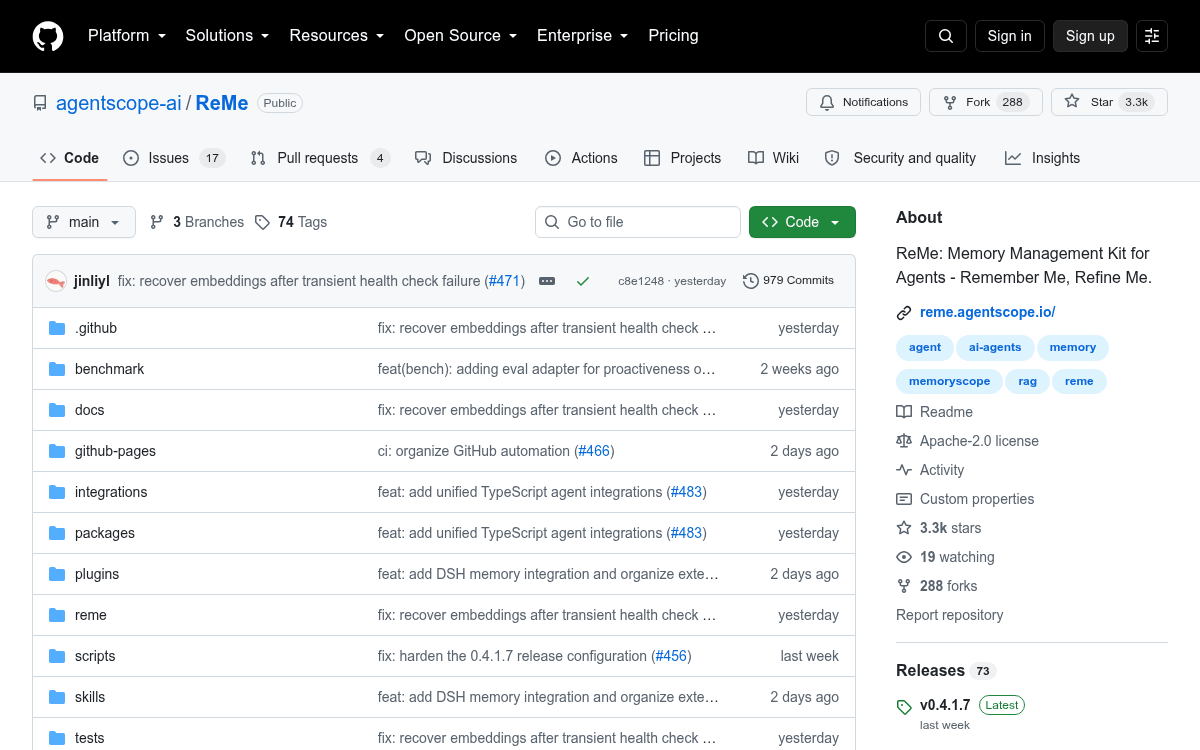
pip install "reme-ai[core]", runs on Python 3.11+ at github.com/agentscope-ai/ReMe.
Long-term memory is still the weakest layer of most agent stacks. Vector databases capture semantics but hide the data behind opaque IDs, and prompt-based memory decays as soon as the context window rotates. ReMe, an open-source project from the AgentScope team, takes a different route: every memory is a plain Markdown file on your disk, and the agent learns to organize, link, and search that folder over time.
The project describes itself as a local-first knowledge base for AI agents. It turns conversations and resources into readable, editable, searchable, and interconnected Markdown memory, then plugs into agents like QwenPaw, Claude Code, Hermes, and OpenClaw while keeping the underlying files under user control.
Markdown as the storage engine
Files are the source of truth. Markdown documents with frontmatter and wikilinks serve as memory nodes that both users and agents can inspect, edit, move, and back up directly. Anything the system computes on top of that (embeddings, BM25 indexes, or graph snapshots) lives under a metadata/ folder and is fully rebuildable from the source files.
The workspace is layered in a way that mirrors how humans process notes:
session/andresource/hold raw conversations and imported files.daily/contains lightly processed cards for the day.