
AgentFlow Treats Multi-Agent AI Workflows Like Data Pipelines, Hits 1k Stars
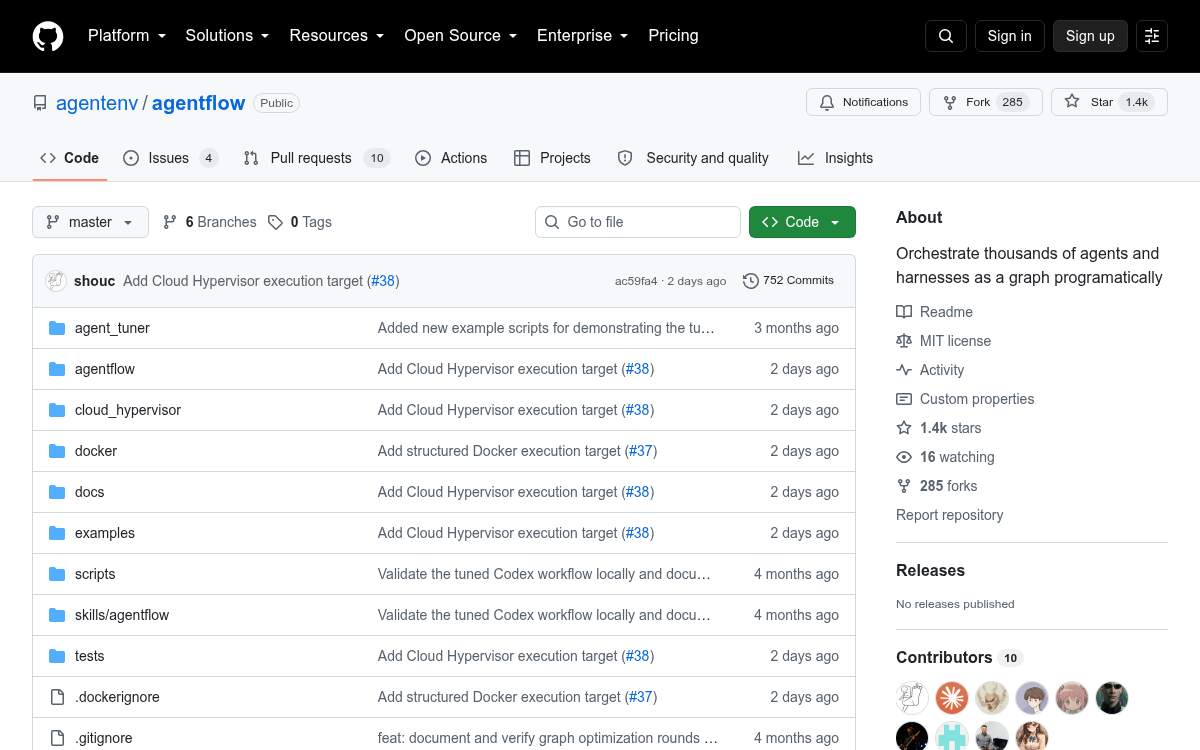
AgentFlow is a new open-source Python library that lets you wire codex, claude, and kimi agents into dependency graphs with fanout, loops, and remote execution.
Takeaways
- AgentFlow open-sourced as a Python library for wiring agents into dependency graphs, now at 1.3k stars
- Supports codex, claude, and kimi agents with parallel fanout, iterative loops, and cartesian product expansion
- Remote execution built in for EC2, ECS Fargate, and SSH targets with shared instance persistence across nodes
- Shared vLLM or SGLang inference endpoints launch via SkyPilot and auto-inject into pipeline nodes
- Evolve command turns completed Codex traces into reusable tuned agents stored locally with version metadata
- MIT licensed, installs via one-line curl script, includes local web UI bound to 127.0.0.1
A new Python library called AgentFlow hit GitHub with a simple pitch: treat multi-agent workflows the way Airflow treats data pipelines. You declare a directed graph where each node is a coding agent, and the framework handles parallel fanout, iterative retry loops, and remote execution on EC2, ECS, or SSH boxes.
The repo orchestrates Codex, Claude, and Kimi agents in dependency graphs with parallel fanout, iterative cycles, and remote execution. It has already crossed 1k stars and comes with a companion arXiv paper on synthesizing multi-agent harnesses for vulnerability discovery, the workload that appears to have motivated the library.

Graphs instead of glue code
The core abstraction is a Graph context manager where you instantiate agent nodes and connect them with the >> operator. A minimal three-step pipeline looks like this:
from agentflow import Graph, codex, claude
with Graph("my-pipeline", concurrency=3) as g:
    plan = codex(task_id="plan", prompt="Inspect the repo and plan the work.", tools="read_only")
    impl = claude(task_id="impl", prompt="Implement the plan:\n{{ nodes.plan.output }}", tools="read_write")
    review = codex(task_id="review", prompt="Review:\n{{ nodes.impl.output }}")
    plan >> impl >> review