
A College Student Built ATLAS to Beat Frontier Coding Models Locally
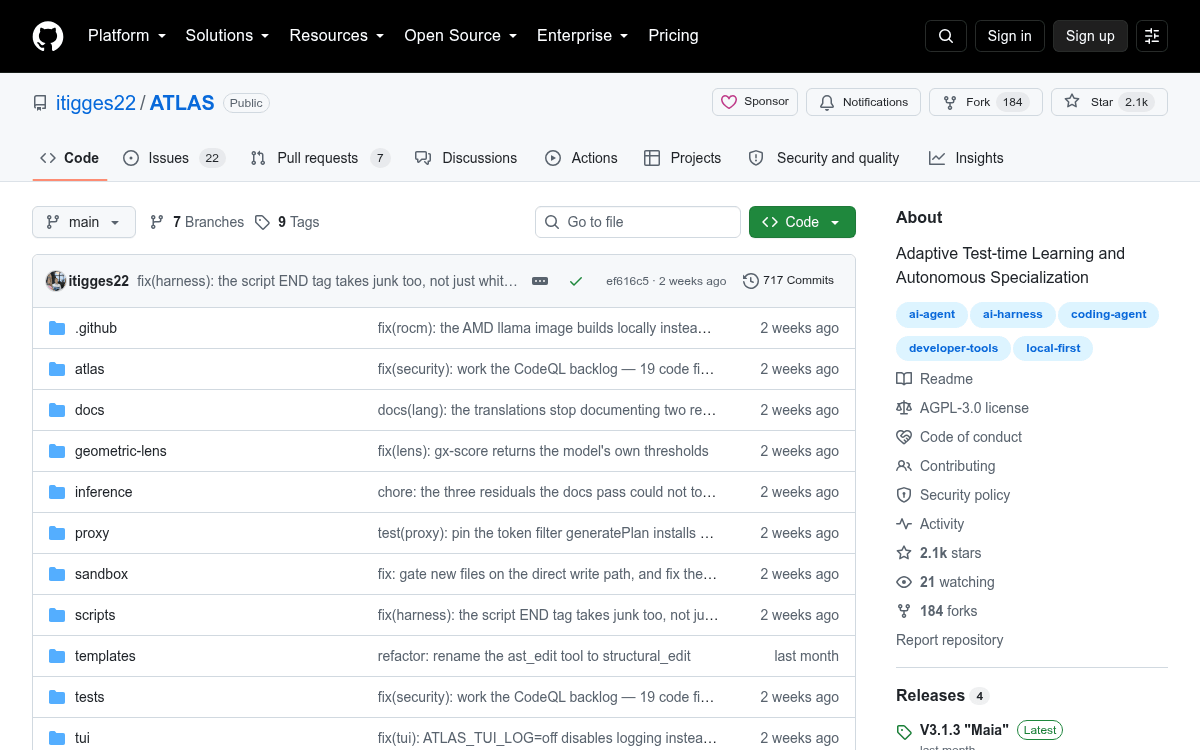
ATLAS is a fully local, open-source coding agent that wraps a frozen 14B model in a multi-phase pipeline to hit 74.6% on LiveCodeBench — no API keys, no cloud, no fine-tuning required.
 Pro
Takeaways
- ATLAS is a fully local, open-source coding agent that achieves 74.6% on LiveCodeBench using a frozen 14B model on a single consumer GPU.
- It works by wrapping a small model in a multi-phase pipeline: structured planning, diverse candidate generation, energy-based scoring, sandboxed testing, and iterative repair.
- The Geometric Lens — a small MLP trained on model embeddings — predicts which candidate is correct before running any tests, cutting down expensive sandbox execution.
- No API keys, no cloud, no fine-tuning: your code never leaves your machine; the only cost is electricity.
- Limitations include slow generation (~51 tok/s with grammar constraints), a 16GB+ VRAM requirement, and benchmark scores measured under a more favorable methodology than single-shot frontier comparisons.
- The latest release, V3.1.3 "Maia", replaces Redis with SQLite, adds staged rollback, signed manifests, and session resume for production stability.
ATLAS (Adaptive Test-time Learning and Autonomous Specialization) is a self-hosted coding agent built by a single college student on a single consumer GPU. The premise is simple but powerful: instead of relying on a bigger model or expensive API calls, ATLAS wraps a compact, frozen 14B model in a smart pipeline that plans, generates multiple candidates, scores them, tests them in a sandbox, and repairs failures , all locally, with no data leaving your machine.
ATLAS achieves 74.6% on LiveCodeBench using a frozen 14B quantized model (Qwen3-14B-Q4_K_M) on a single consumer GPU (RTX 5060 Ti 16GB). That's a result that puts it in the same conversation as hosted frontier models , and it costs nothing but electricity per query.
The Problem It Solves
The standard coding agent workflow is a single-shot gamble: you send a prompt, you get one generation, and you hope it works. When the model is small, that gamble fails often. ATLAS is a local coding agent that brings frontier-style reasoning and verification to compact open models, putting more intelligence in the system around the model , planning, candidate generation, quality scoring, sandboxed testing, and repair , so smaller models can tackle real software work entirely on your own hardware, without a hosted API or per-token fees.
This matters most if you care about privacy, cost control, or just don't want to depend on a third-party service that can change its terms, rate-limit you, or disappear. ATLAS does not intentionally upload your repository or prompts to a hosted model or ATLAS-operated service.
How the Pipeline Actually Works
The magic is in the orchestration layer, not the model. ATLAS runs a multi-phase process called the V3 Pipeline every time you make a request:
- PlanSearch: Before writing any code, ATLAS generates a structured, constraint-driven plan. It figures out what the problem requires before attempting a solution.
- DivSampling: Multiple candidate solutions are generated with varied temperatures and strategies , not just one attempt, but a diverse pool.
- Budget Forcing: Thinking-token budgets are allocated per phase, so harder problems get more reasoning compute.