
0xPlaygrounds' Rig Quietly Becomes Rust's Most Starred Agent Framework
Rig crosses 7k GitHub stars as a Rust framework unifying 20+ LLM providers and 10+ vector stores behind one typed, modular API.
Takeaways
- Rig, a Rust framework for LLM apps by 0xPlaygrounds, has crossed 7,000 GitHub stars
- Unified API across 20+ model providers and 10+ vector store integrations under one typed interface
- Split into
rig-core(provider-neutral) andrig-agent(builder, streaming, state machine) - Full WebAssembly support, no feature flags needed for wasm32-unknown-unknown targets
- Production users include St Jude, Neon, Nethermind, Coral Protocol, Dria, and ilert
- Ships full OpenTelemetry GenAI semantic convention compatibility for standard observability
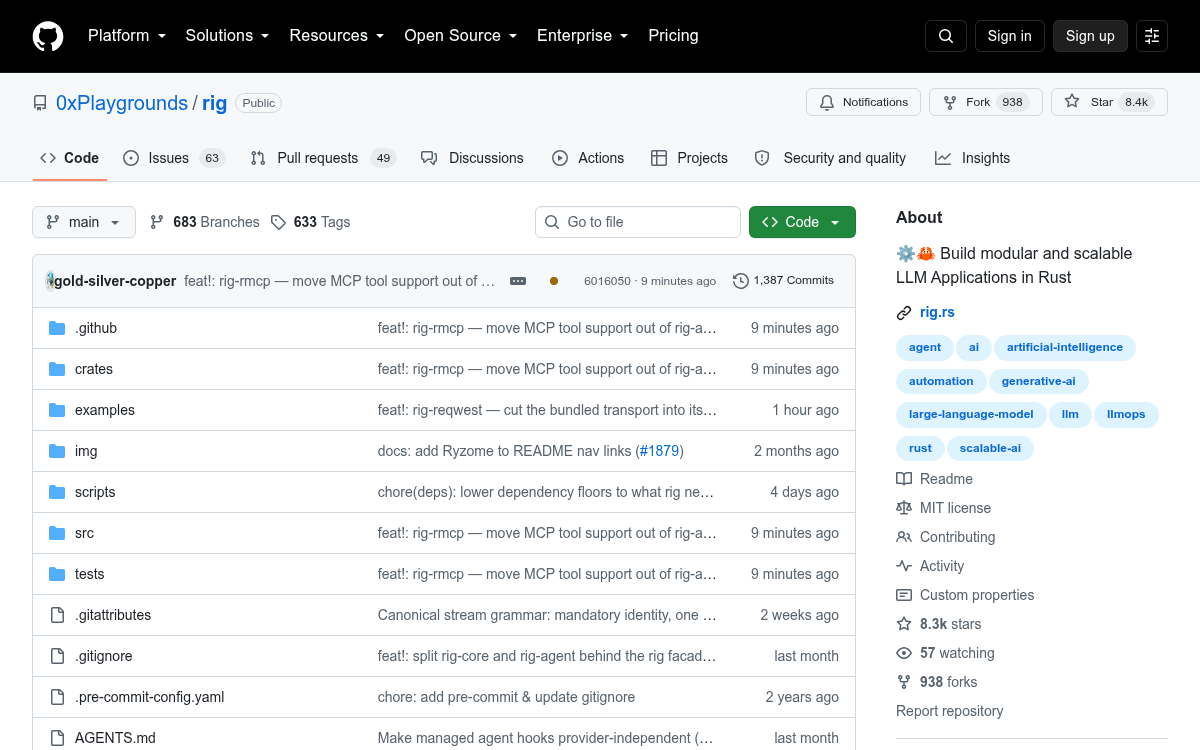
A Rust framework for building LLM applications has quietly become one of the most starred agent toolkits outside the Python ecosystem. Rig, built by 0xPlaygrounds, now sits above 7,000 GitHub stars and runs in production at St Jude, Neon, Nethermind, and Coral Protocol, among others.
The pitch is straightforward: give Rust developers an ergonomic, strongly typed foundation for agents, retrieval pipelines, and multi-provider workflows, without the runtime overhead or dependency sprawl that comes with Python-based stacks. One overview describes Rig as an attempt to tackle the growing pains of juggling incompatible provider APIs, wiring vector stores, and keeping sprawling RAG pipelines readable, by offering a unified, strongly typed, and modular toolkit for constructing everything from lightweight chatbots to multi-agent back-ends.
One interface, twenty providers
The headline feature is breadth of integration under a single trait-based abstraction. Rig exposes a unified interface for over 20 model providers and 10+ vector store integrations, with support for completion, embeddings, transcription, audio generation, and image generation.
The backend list reads like a full infrastructure catalog:
- Vector stores: LanceDB, Qdrant, Milvus, MongoDB, Neo4j, PostgreSQL, SQLite, SurrealDB, ScyllaDB, HelixDB