
Zuse Institute's Agentic Researcher Runs 20-Hour Experiments Without Human Input
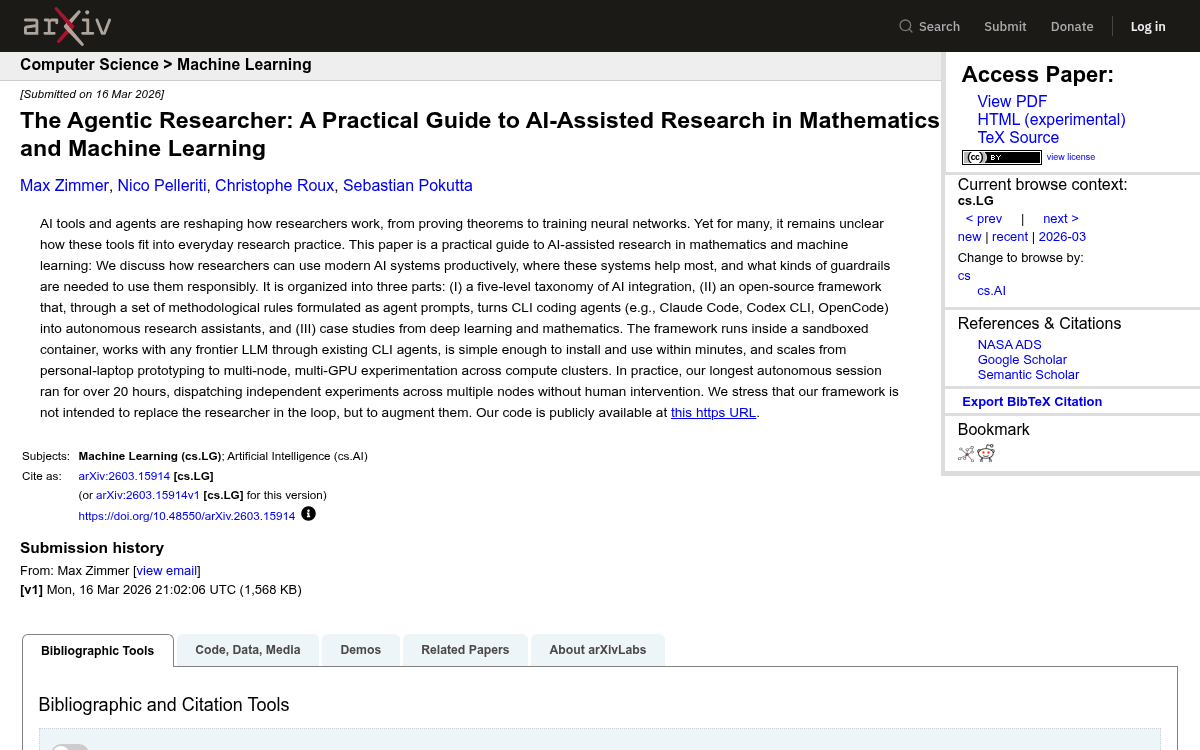
A ZIB-IOL framework turns CLI coding agents into autonomous research assistants through ten prompt-based rules, with sessions running over 20 hours unattended.
 Pro
Takeaways
- ZIB-IOL released The Agentic Researcher, an open-source framework wrapping CLI coding agents into autonomous research assistants.
- A five-level taxonomy ranges from no AI use to fully autonomous Level 4 "Research Associate" experiment loops.
- Ten prompt-based commandments enforce single-variable experiments, tiered evaluation, citation verification, and active falsification of claims.
- Muon optimizer case study found ~5% perplexity gains over Muon and ~8% over AdamW across 40+ experiments.
- Pruning study serendipitously discovered a 10-line weight correction cutting perplexity 18-50% across five model scales.
- Framework runs in a sandbox with Git-based tracking, works with Claude Code, Codex CLI, OpenCode, and scales to multi-node Slurm.
A team at the Zuse Institute Berlin has released The Agentic Researcher, an open-source framework that turns off-the-shelf command-line coding agents into long-running scientific collaborators. The setup is model-agnostic, sits on top of tools like Claude Code, Codex CLI, and OpenCode, and in one of the authors' own sessions ran for over twenty hours dispatching independent experiments across multiple GPU nodes without any human input.
The pitch is refreshingly modest. The paper is not another attempt to build a fully automated "AI scientist" that spits out finished manuscripts. It is a practical guide to where these systems help most in day-to-day math and machine learning work, and what guardrails you need so that the outputs are actually trustworthy.
Five levels of letting go
The authors propose a taxonomy of AI integration that mirrors the way self-driving car autonomy is often graded. Level 0 is Classical, meaning no AI involvement at all; Level 1 uses chatbots as a consultant for targeted queries; Level 2 uses editor plugins like Copilot or Cursor as a typist for code and text generation without execution; Level 3 uses CLI coding agents as a collaborator that implements and iterates on tasks; and Level 4 is the Research Associate, an autonomous experiment loop following a structured research plan.
The interesting jump is between Level 3 and Level 4. The key difference is that the agent no longer waits for human input between experiments, but follows a research plan and a set of commandments encoding the norms of good scientific practice: one variable per experiment, structured reporting, staged evaluation from quick sanity checks to full benchmarks, and verification protocols. Everything else in the paper is basically the recipe for making that jump reliable.
The Ten Commandments of not fooling yourself
The core of the framework is a set of ten rules the agent reads at the start of every session from a persistent INSTRUCTIONS.md file. Each one exists because the authors watched a frontier model fail in a specific way. Highlights include:
- Never manipulate evaluation. The agent once changed the number of evaluation samples to "speed up evaluation," which happened to produce better metrics and created an unfair advantage over baseline methods.
- Never fabricate citations. Every bibliography entry must be verified against the actual source via web search before being added.
- Make it work before moving on. When encountering an implementation failure, agents often claim that the approach "doesn't work" and move on to an alternative, when in practice most of these crashes are simple bugs that can be fixed easily.
- One variable per experiment. If two things change and the metric improves, you cannot know which helped.
- Evaluate in tiers. Seconds-long sanity checks, minute-long small-subset runs, then full benchmarks. Never draw conclusions from small-scale results.
- Bound your expectations. Before running a heuristic, compute a theoretical best case so you know if a 2% gain is close to the ceiling or leaves 90% on the table.
- Verify before claiming. Write falsification scripts, not explanations. Grade every claim as verified, partially verified, or unverified.
The three guiding principles behind the list are worth noting: explicit over implicit, since language models follow instructions literally and implicit expectations like "obviously you should record your results" are reliably violated; falsifiable over aspirational, since "be rigorous" is not a commandment but "change exactly one variable per experiment" is; and failure-driven over theory-driven, since every commandment exists because they observed a specific failure mode in practice.
How the loop actually runs
The infrastructure is deliberately minimal. Everything happens inside a sandboxed container so unattended sessions cannot damage the host, with a multi-node launcher that dispatches independent experiments to remote Slurm nodes. Instead of a bespoke experiment tracker, the framework uses Git directly, with each experiment recorded as a commit with a structured message and Git worktrees allowing multiple agents to run concurrently.
Two persistent artifacts hold everything together: a report.tex that accumulates experiments, derivations, and analysis, and a TODO.md checklist. Each experiment then follows an eight-step loop: Explore, Plan, Implement, Evaluate, Analyze, Record, Commit, Iterate, and at the beginning of every session or after a context window reset, the agent re-reads report.tex, TODO.md, and the git log to restore continuity. That last detail is the trick that makes long sessions survive context compaction.
What the agent actually discovered
The case studies are what make this more than a prompt-engineering post. In an LLM pretraining study, the agent was pointed at the Muon optimizer and asked whether its spare memory budget could be exploited. Across more than 40 experiments, the best configuration achieved a roughly 5% improvement in validation perplexity over Muon and 8% over AdamW at the same 2N memory budget as AdamW. The two improvements, normalization before orthogonalization and weight decay on matrix parameters, are nearly additive: normalization alone provides around 3%, weight decay alone 2%, and the combination 5%. A zero-overhead variant matched most of the gain at Muon's original memory footprint.
In a pruning study, something more interesting happened. The original task was to fix a broken pruning mask, but while analyzing why the approach failed, the agent observed a severe imbalance in post-layer activations and proposed a simple post-pruning weight correction. The method consistently reduces perplexity by 18 to 50% across five model scales from 125M to 9B parameters, three architectures, and two pruning methods, requires only 10 lines of code, adds less than 1% overhead, and captures 92% of the improvement achievable by full least-squares reconstruction.
A mathematics case study produced an actual theorem. The main result establishes a lower bound of order 1/T^(p/(p-1)) for vanilla Frank-Wolfe on p-uniformly convex sets for any p at least 3, matching the known upper bound and resolving an open question, with all convergence constants verified numerically to under 0.2% relative error. A separate combinatorial-optimization study on the K7 power flow network used targeted search to improve a computational lower bound on real solutions from 120 to 192.

Where it breaks
The authors are honest about what does not work yet. Natural-language proofs still require manual inspection; subtle implementation bugs can invalidate conclusions even when code appears to run; and the agent cannot guarantee its ideas are genuinely novel, so thorough knowledge of the related work remains the researcher's responsibility. Long sessions eventually hit context compaction, which is lossy and can cause the agent to revisit failed approaches. And frontier-model API costs, while dominated by compute wait time in Level 4 sessions, are still nontrivial for extended studies.
The broader argument is that model capability is only half of the equation. Wrapping a general-purpose CLI agent in a disciplined workflow with inspectable artifacts, tiered evaluation, and explicit falsification turns out to be enough to push it from useful assistant to genuine research collaborator, without waiting for someone to build the next monolithic "AI scientist" from scratch.