
ZOZO's VTON-IQA Finally Judges AI Fashion Try-Ons Like Humans Do
A new research paper introduces a reference-free quality scorer for virtual try-on, trained on 431,800 human ratings across 14 generation models.
 Pro
Takeaways
- New paper proposes VTON-IQA, a reference-free image quality scorer for virtual try-on aligned with human perception.
- Comes with VTON-QBench: 62,688 try-on images, 431,800 curated human annotations from 13,838 crowd workers.
- Introduces Interleaved Cross-Attention module that models three-way interactions between garment, person, and generated image.
- Achieves 0.750 Spearman correlation with humans, matching human-vs-human pairwise consistency (0.790 vs 0.791).
- Benchmarks 14 try-on models; proprietary editors like Nano Banana Pro top the ranking, exposing FID/SSIM blind spots.
- Dataset and code released at github.com/litelightlite/VTON-IQA.
Evaluating virtual try-on (VTON) images has always been awkward. You give a model a photo of a person and a photo of a garment, it generates a synthesis of the person wearing that garment, and then you have to somehow decide whether the result is good. In production, you almost never have a ground-truth image of the same person actually wearing that specific garment, so classical metrics like SSIM and LPIPS do not really apply. A new paper from researchers at ZOZO Research, ZOZO Inc., and Keio University proposes a fix: VTON-IQA, a reference-free image quality assessment framework trained to match human perception, along with VTON-QBench, the largest human-annotated dataset ever built for this task.
Why existing metrics fall over
The paper is blunt about the state of evaluation. In real-world deployment, ground-truth images of the same person wearing the target garment are typically unavailable, rendering reference-based metrics such as SSIM and LPIPS impractical. The other common option, distribution-level metrics like FID and KID, only measure how similar an entire generated dataset looks to a reference set. They cannot tell you whether one specific try-on image is good or bad.
Large user studies work, but they are expensive and slow, and the ad hoc studies run inside individual papers are not reproducible across the field. There have been earlier attempts at reference-free VTON evaluators (VTONQA, VTON-VLLM, VTBench), but the authors argue they either lack large-scale human validation or do not release implementations, making standardized comparison difficult.
The dataset behind the model
The heart of the contribution is VTON-QBench. It comprises 62,688 try-on images generated by 14 representative models and 431,800 quality annotations collected from 13,838 crowd workers who met reliability criteria. That scale dwarfs prior work, which topped out around 8,000 try-on images and 40 annotators.

The construction pipeline runs in five stages:
- Augment the VITON-HD and Dress Code test sets with synthetic garment-person pairs generated by a LoRA-tuned FLUX.1-dev, expanding coverage to 24 fashion styles.
- Build pseudo-triplets so reference-based metrics can still be computed as baselines.
- Generate try-on images with 14 models spanning GANs (VITON-HD, HR-VITON), U-Net diffusion (IDM-VTON, CatVTON, OOTDiffusion), DiT-based diffusion (FitDit, Any2AnyTryon, Qwen-Image-Edit), and proprietary editors (Nano Banana Pro, GPT-Image-1.5).
- Collect three-level ordinal ratings (unnatural, slightly unnatural but acceptable, natural) from crowd workers, with a reference image of the garment being worn provided as auxiliary context.
- Curate aggressively.
That last step matters. The team ran a two-stage filter using dummy sanity-check tasks and Krippendorff's alpha for inter-rater agreement. These annotator-level filters reduce the total number of annotations from 1,149,144 to 480,412. Next, we perform questionnaire-level filtering based on inter-rater agreement. After curation, average agreement jumped from 0.286 to 0.550, a level generally considered acceptable for subjective visual tasks.
Interleaved Cross-Attention, explained
Standard image quality models predict quality from a single image. Virtual try-on breaks that assumption: you need to check garment fidelity (does the shirt in the output match the shirt in the input?) and preservation (does the person still look like themselves, in the same pose, on the same background?). That requires reasoning across three images at once.
The proposed Interleaved Cross-Attention (ICA) module handles this by running three parallel transformer branches over the garment, person, and generated try-on images. For the first half of the network, standard transformer blocks are applied independently to each branch. In the latter half, cross-attention is applied between the try-on representation and each of the garment and person representations.

The design is asymmetric on purpose. The try-on branch pulls information from both garment and person, but garment and person branches only exchange information with the try-on image, not with each other. There is no reason for the raw garment features to talk directly to the raw person features. Final scores come from cosine similarities between the CLS tokens of each branch, weighted by a learnable parameter alpha that balances garment fidelity against identity preservation.
Training uses a joint loss: a Bradley-Terry style pairwise preference term (which pair of outputs did humans prefer for this same input?) combined with direct regression to the mean human score. The backbone is DINOv3 ViT-L/16, with the last 12 blocks fine-tuned and ICA layers inserted.
How well it actually works
On the held-out test set, VTON-IQA reaches Spearman correlation of 0.750 with human ratings and micro pairwise accuracy of 0.790. SSIM manages only 0.150 SRCC. Zero-shot DINOv3 without task-specific training gets 0.244. Even a version of VTON-IQA without the ICA module drops to 0.617 SRCC, showing the cross-attention design is doing real work.
More striking: the paper compares the model to a bootstrap estimate of human-vs-human agreement, obtained by splitting annotators into two groups. On pairwise accuracy the model essentially matches human consistency (0.783 vs 0.791 micro accuracy), though a gap remains on absolute-score regression.
| Scorer | SRCC | Micro Pairwise Acc |
|---|---|---|
| SSIM (reference-based) | 0.150 | 0.593 |
| LPIPS (reference-based) | 0.406 | 0.695 |
| DINOv3 zero-shot | 0.244 | 0.641 |
| VTON-IQA w/o ICA | 0.617 | 0.747 |
| VTON-IQA (full) | 0.750 | 0.790 |
| Human upper bound | 0.760 | 0.791 |
What the benchmark reveals about VTON models
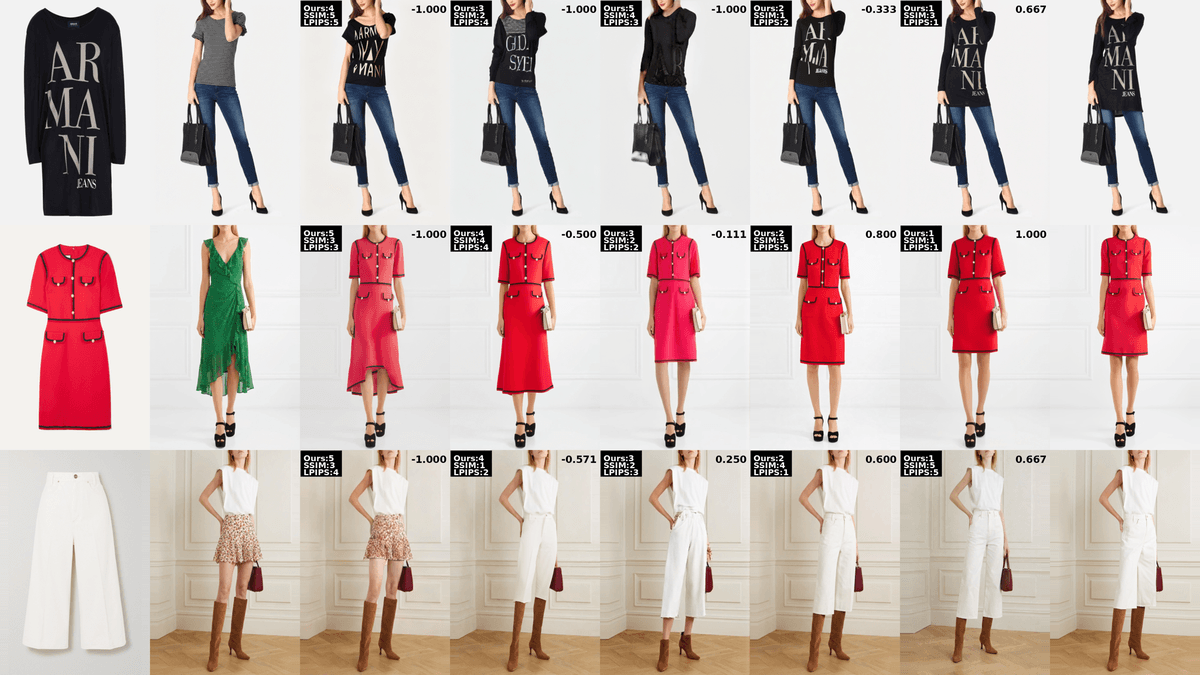
Applied across 14 try-on systems on Dress Code and VITON-HD, VTON-IQA produces a leaderboard that looks quite different from traditional metrics. Proprietary editors dominate: Nano Banana Pro is first in every configuration, followed by GPT-Image-1.5. The interesting wrinkle is that under SSIM and LPIPS, GPT-Image-1.5 performs substantially worse, particularly on VITON-HD, where it ranks below earlier GAN-based models. These metrics penalize global structural variations such as pose and zoom changes.
The authors sampled 30 outputs per model and found that GPT-Image-1.5 introduced noticeable pose or zoom shifts in 19 of them, versus just 1 for Nano Banana Pro. Pixel-alignment metrics punish that, humans do not. VTON-IQA sides with humans.
Where it breaks
The generalization tests are honest about limits. When VTON-IQA is trained on half the models and evaluated on the other half, performance on unseen models drops about 10.6 percent relative to seen ones on ranking correlation, though pairwise accuracy holds up better with only a 3-5 percent drop. Rankings still mostly agree with the full-training version, but future substantially stronger models will likely need a small calibration set.
The framework also only produces a scalar score. It cannot tell you why an image is bad (sleeve length wrong, texture blurry, wrong collar). And it is designed for standard studio images with controlled poses. In-the-wild backgrounds, video try-on, and 3D settings are explicitly future work.
What is released
The dataset and source code are available at the project's GitHub repository. For teams building try-on systems for fashion e-commerce, this is potentially the first reproducible, reference-free evaluator that actually correlates with what shoppers would say. It replaces the ad hoc user study that has to be re-run every time someone wants to compare two checkpoints, and it flags a real gap that FID has been quietly hiding: strong recent editors that reshape pose or scale can look great to humans while looking terrible to older metrics.