
Zhejiang University's UniCAC Benchmark Stress-Tests 24 AI Models Across 993 Real Camera Lenses
A new benchmark with 120 auto-designed lenses and a fresh degradation metric reveals which restoration models actually generalize across camera optics.
 Pro
Takeaways
- UniCAC benchmarks 24 restoration models on 120 auto-designed lenses spanning realistic photographic camera specifications
- New Optical Degradation Evaluator metric correlates with restoration difficulty at R²=0.761 versus 0.194 for RMS radius
- FeMaSR wins overall thanks to its clean-image codebook prior; NAFNet offers best speed-quality tradeoff at 0.64 ms
- Diffusion-based DiffBIR excels only under severe aberrations by hallucinating plausible detail from generative priors
- CNNs beat transformers on fidelity per millisecond because aberration is inherently a local convolution operation
- Code, dataset, and Zemax files released at github.com/XiaolongQian/UniCAC
Every camera lens leaves a fingerprint on the images it captures: blurry corners, color fringes, and softness that shift across the frame. Computational Aberration Correction (CAC) tries to fix this in software, but most models are trained for one specific lens and fall apart on any other. A team from Zhejiang University, INSAIT, and Hunan University just built the first large-scale benchmark that stress-tests 24 restoration models across a physically realistic zoo of camera optics, and their findings reshape what we know about which architectures actually generalize.
Why one lens is never enough
Traditional image restoration assumes uniform blur across the frame. Real optics do not work that way. The paper points out that CAC has to handle spatially varying aberrations, where the point spread function changes depending on where you are in the image, plus channel-wise chromatic aberrations from wavelength-dependent dispersion. Existing universal CAC efforts have been stuck because commercial lens prescriptions are proprietary, so training sets stay tiny and unrepresentative.
The authors sidestep that wall by using automatic optical design. They extend a method called OptiFusion, adding aspherical surface parameters on top of spherical ones, and generate a large library of physically manufacturable lenses spanning half fields of view from 20 to 40 degrees, F-numbers from 2.0 to 4.0, and 1 to 6 elements. The final UniCAC benchmark uses 873 training lenses and 120 unseen test lenses, all conforming to real optical constraints.
A better ruler for lens difficulty
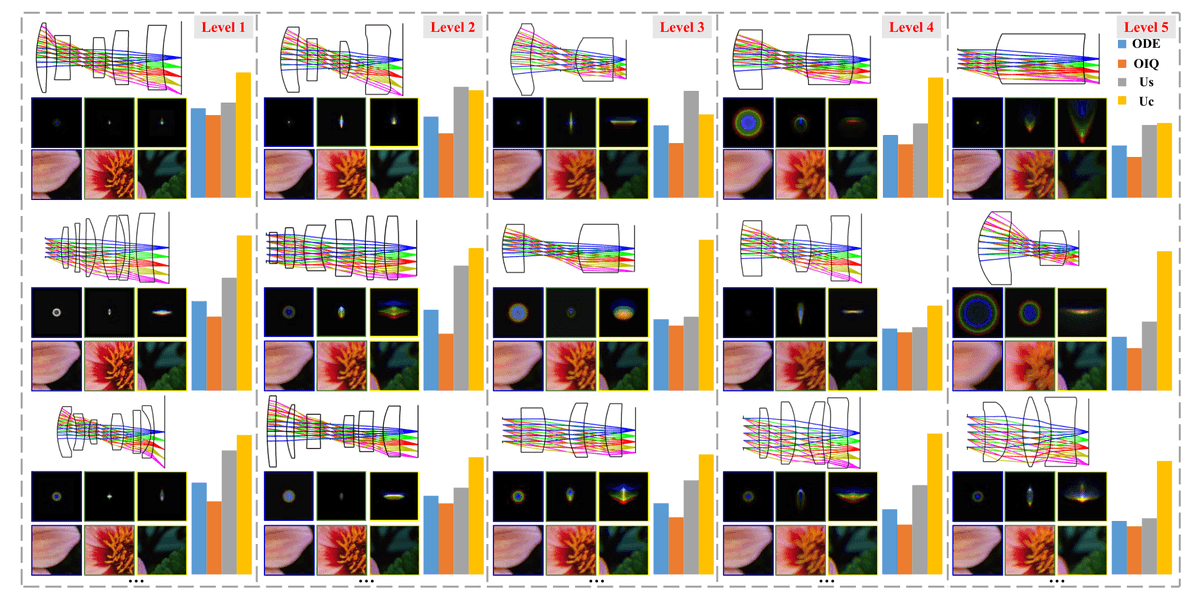
The old way of measuring lens aberration, the RMS spot radius, correlates poorly with how hard a lens actually is to restore. The team proposes the Optical Degradation Evaluator (ODE), which combines three signals from imaging a standard checkerboard:
- Optical Image Quality mixing PSNR, SSIM, and an MTF-based optical metric
- Spatial uniformity, the coefficient of variation of quality across five fields of view
- Channel uniformity, the coefficient of variation across RGB channels for chromatic aberration
On 12 lenses with lens-specific training, ODE shows an R² of 0.761 with final restoration performance versus 0.194 for RMS radius. That linearity lets the authors stratify lenses into five difficulty levels for honest benchmarking.

What the 24-model showdown revealed
The benchmark evaluates classic optimization methods like Wiener deconvolution alongside modern restoration networks including NAFNet, Restormer, Uformer, SwinIR, PromptIR, and DiffBIR, plus dedicated CAC approaches like FOV-KPN and PART. Overall performance rankings surface some surprises:
- FeMaSR, a codebook-based method with a pre-trained VQ dictionary of clean image patches, takes the top overall spot with 26.94 PSNR and the best LPIPS of 0.136
- NAFNet lands second with just 0.64 ms inference, delivering the best PSNR-to-latency ratio
- DiffBIR, the Stable Diffusion-based restorer, ranks third and pulls ahead specifically on severe aberrations where hallucinating plausible detail helps
- PART wins on raw PSNR fidelity thanks to its PSF-attention mechanism
The 24-method evaluation surfaces nine observations that boil down to three actionable takeaways. First, priors matter more than raw parameter count: models that ingest either optical priors like FoV coordinates and dense PSFs, or clean-image priors from codebooks and diffusion models, consistently outperform architecturally-similar peers that lack them. Second, CNNs beat transformers on the fidelity-per-millisecond curve, likely because aberration is inherently a convolution operation and local receptive fields align with it. Third, training paradigm dictates what you get: regression maximizes PSNR, GAN and diffusion win on perceptual metrics, and no one has really tried optimizing for optical quality directly.

The weak spots worth knowing
The benchmark exposes real limitations. Every method degrades as spatial non-uniformity increases, meaning corner sharpness remains genuinely hard. Chromatic aberration turns out to have surprisingly low correlation with final CAC results within refractive photographic lenses, which contradicts a lot of received wisdom in the field. Low-dimensional priors like FoV coordinates work great on mild aberrations but collapse under severe ones, where dense PSF-based methods take over. The benchmark itself does not yet cover metasurfaces, diffractive optical elements, microscopes, telescopes, or depth-dependent PSFs, all of which the authors flag as future work.
What you get to play with
The code, benchmark data, and Zemax lens files are available on GitHub. If you are building any kind of universal image restoration pipeline for consumer cameras or smartphone optics, this is now the reference battery to test against, and ODE gives you a principled way to pick which lenses to include when designing your own training set.