
Zhejiang University's Re² Gives AI a 70,000-Review Dataset to Fix Peer Review
A new open dataset of nearly 20,000 initial submissions, 70,000 reviews, and 53,000 rebuttals gives LLMs a foundation for reviewer assistants.
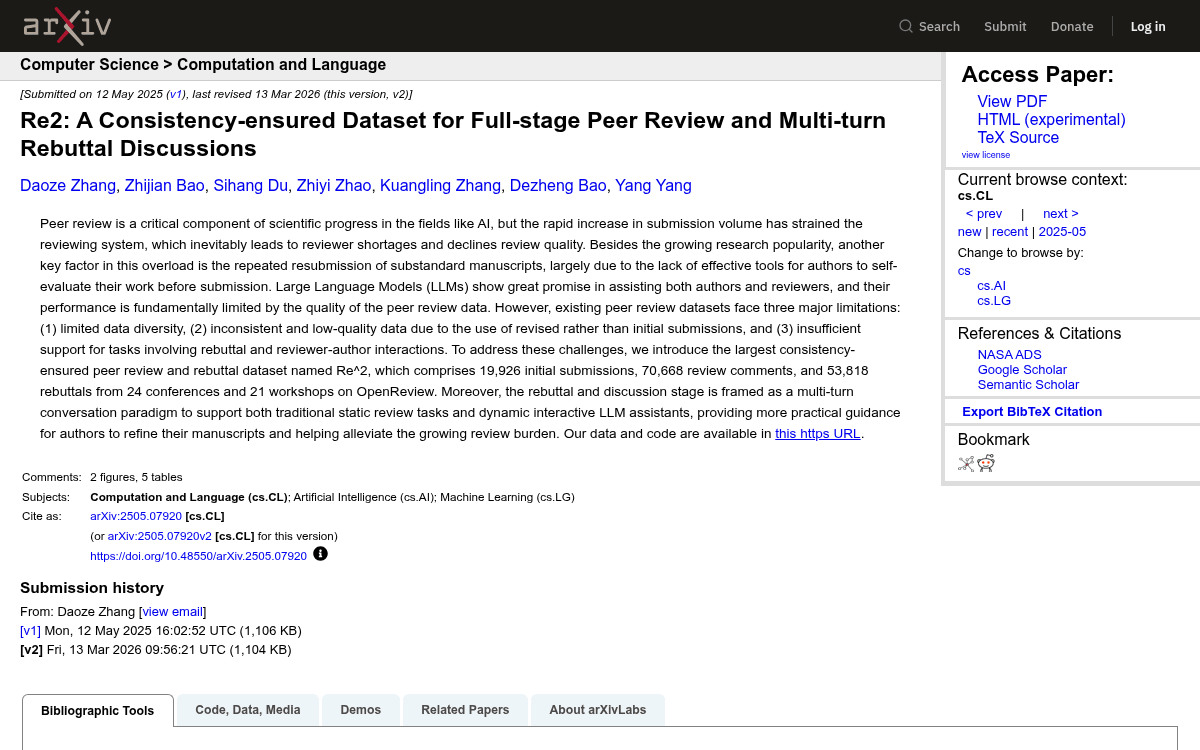 Pro
Takeaways
- Re² is the largest consistency-ensured peer review dataset, spanning 45 venues from 2017 to 2025. Paper
- Contains 19,926 initial submissions, 70,668 review comments, and 53,818 rebuttals from OpenReview.
- All papers are verified initial submissions, scraped from Revision History before each conference deadline.
- Rebuttals are structured as multi-turn conversations, with DeepSeek-R1 merging fragmented author responses.
- Fine-tuning LLaMA-3.1-8B on Re² cut score prediction MAE from 1.96 to 1.14 and beat specialist review models.
- Data and code available at the anonymous repository.
Peer review in AI is buckling under its own success. Submission volumes at top venues have exploded, reviewer pools are stretched thin, and a lot of the churn comes from authors resubmitting substandard drafts because they have no reliable way to gauge their own work. A group from Zhejiang University wants to fix the data problem sitting under that mess with Re², a peer review corpus large enough and clean enough to train LLMs that can actually help.
The pitch is straightforward. Re² comprises 19,926 initial submissions, 70,668 review comments, and 53,818 rebuttals from 24 conferences and 21 workshops on OpenReview, and the rebuttal stage is packaged as multi-turn conversations rather than flat text. Data and code are hosted on an anonymous repository.
Why existing review datasets keep breaking models
Prior review corpora have a subtle but fatal flaw: the provided paper content often corresponds to the revised version rather than the initial submission. If you train a model to predict a review from a paper that has already been edited in response to that review, you are teaching it to grade an answer key. The signal collapses.
The authors also point out that most existing datasets pull only from ICLR because it publishes reviews openly, and that most existing datasets do not contain any information related to rebuttals. That leaves out the most interesting part of peer review, where authors defend choices and reviewers update positions.
How they built a consistency-ensured corpus
Re² is split into two subsets. Re²-Review covers static tasks like acceptance and score prediction plus review generation. Re²-Rebuttal is the conversational half. To guarantee that papers match the reviews attached to them, the team collected submission deadlines for every venue-year pair and scraped the latest PDF version from OpenReview's Revision History page that predates the deadline. PDFs were converted to LaTeX and Markdown using a commercial tool called Doc2X, chosen for its handling of math formulas.
The rebuttal side is where the engineering gets interesting. OpenReview imposes character limits on comments, so authors frequently post their response in several chunks. The team merges these consecutive same-role posts into a single dialogue turn, using DeepSeek-R1 to stitch titles and body text into a coherent response. Reminder posts nagging silent reviewers are filtered out with a mix of manual inspection and automation so they do not get concatenated as if they were substantive rebuttal content.

Global responses, where authors answer several reviewers at once with a shared reply, are handled with a special format. Instead of pasting them into one reviewer's thread as if they were a direct reply, the pipeline inserts them as referential context so the multi-turn logic stays clean across threads.
What the numbers say
The dataset skews toward the shape of real ML papers and reviews. Most papers range in length from 6,000 to 16,000 tokens, while the majority of reviews are distributed between 300 and 1,100 tokens. ICLR and NeurIPS dominate paper counts and rebuttal counts, and median normalized scores across the ten largest venues sit between 5 and 7.
To show the data actually moves the needle, the authors fine-tuned LLaMA-3.1-8B-Instruct and Qwen2.5-7B-Instruct with LoRA and compared them against specialist review models like SEA-E, LLaMA-OpenReviewer-8B, DeepReviewer-14B, and CycleReviewer-8B. Some findings worth flagging:
- Zero-shot LLaMA-3.1-8B and Qwen2.5-7B accept all papers without discrimination, reflecting a common flaw in LLMs: a tendency to please humans without criticism. Fine-tuning on Re² fixed this and cut MAE and MSE on score prediction substantially.
- On review generation, fine-tuned LLaMA-3.1-8B led on BLEU and ROUGE-L, and improved embedding cosine similarity to reference reviews by roughly 50 percent over the third-place model.
- On the rebuttal conversation task, both fine-tuned models beat their zero-shot baselines on BLEU, ROUGE-L, BERTScore, EmbedCos, and on LLM-as-judge scores across accuracy, constructiveness, completeness, clarity, and overall quality.
What it is good for, and where it stops
The obvious use cases are pre-submission self-review tools, reviewer copilots along the lines of the assistant piloted at ICLR 2025, and evaluation harnesses for models like DeepReviewer and CycleReviewer. Framing rebuttals as multi-turn dialogues also opens the door to interactive agents that can respond to an author's counterarguments rather than just emitting a single static review.
There are real limits. The experiments cover only text and tables, so figures, plots, and diagrams that carry a lot of the argument in ML papers are ignored during evaluation, even though the released data includes them. Coverage is also skewed toward ICLR and NeurIPS, so a model trained purely on Re² will inherit the review culture and rating scales of those venues more than smaller workshops. And any tool built on this will inherit the well-documented sycophancy of base LLMs unless it is fine-tuned with the critical signal Re² provides.
The real contribution is less flashy than a new model and more foundational: a version-correct, rebuttal-aware training set that lets the next wave of review assistants be evaluated on something closer to the job reviewers actually do.