
Zhejiang University's MAVEN Flies Drones Through 70% Motor Failure With One Policy
MAVEN trains a single quadrotor policy to handle 66.7% mass changes and 70% rotor thrust loss, adapting online through a learned dynamics encoder.
 Pro
Takeaways
- MAVEN is a meta-RL framework letting one drone policy adapt to unknown mass and rotor failures. Paper
- Handles up to 66.7% mass increases and 70% single-rotor thrust loss with zero-shot sim-to-real transfer.
- A predictive context encoder infers hidden dynamics by predicting next-step position and reward.
- Hybrid design: off-policy encoder for task inference, on-policy PPO for motion planning.
- Trained in 35-53 minutes on one RTX 5090 using the Genesis GPU-vectorized simulator.
- Beats domain randomization on agility and standard RL on fault tolerance across 100 test tracks.
Reinforcement learning has become the go-to recipe for pushing quadrotors to their physical limits, but there is a catch that keeps showing up in real deployments: a policy trained for one drone configuration falls apart the moment you strap on a payload or lose thrust on a rotor. A team from Zhejiang University is proposing a fix called MAVEN, a meta-reinforcement learning framework that lets a single policy fly aggressively through waypoints even when the drone's mass jumps by two-thirds mid-flight or one motor loses 70% of its thrust.
Why standard RL drones are fragile
A quadrotor policy trained with vanilla PPO is essentially an expert of one specific machine. A standard RL policy, trained for a specific set of system dynamics, excels in its nominal environment but often struggles to generalize to significant dynamic variations, such as drastic changes in vehicle configuration or unforeseen actuator faults. The two common patches, domain randomization and fault-tolerant control, each have well-known trade-offs.
- Domain randomization trains one policy across a wide range of dynamics, but the result is a conservative flyer that never fully exploits any particular drone.
- Fault-tolerant control handles specific pre-modeled failures but breaks on faults it has never seen.
Prior meta-learning work on drones like Neural-Fly and RAPTOR has been promising, but their application has been largely confined to low-level control, tracking predefined references or narrow task scopes. In other words, they can stabilize a fixed trajectory, but they don't re-plan the trajectory itself when the physics change.
The meta-RL trick: infer the drone you're flying
MAVEN treats each combination of mass and rotor health as a distinct task in a Partially Observed Markov Decision Process. The policy cannot directly measure how heavy the drone is or which rotor is broken, so it has to infer those hidden variables from the recent history of what happened when it sent control commands. That inference lives in a compact latent vector z that conditions both the actor and critic networks.
The architecture is a hybrid that borrows the useful bits from two RL paradigms. This hybrid framework leverages the respective strengths of both paradigms: the high sample efficiency of off-policy learning for the task inference, and the stable policy updates of on-policy learning for the motion planning. Concretely, an off-policy probabilistic context encoder learns z from stored transitions, while an on-policy PPO agent uses z to plan agile motion.

The predictive context encoder
The real novelty is how the encoder is trained. Instead of relying on a critic signal like the PEARL algorithm it builds on, MAVEN's encoder is supervised directly to predict two things about the near future given the current state, action, and its guess of z:
- The next positional state difference (via a dynamics head trained with MSE)
- The immediate reward (via a reward head trained with Huber loss)
On top of that, a KL divergence term keeps the latent distribution close to a Gaussian prior to prevent overfitting, and a specialization loss forces different tasks to end up at different points in latent space so the encoder doesn't collapse to ignoring z. This direct supervision fosters a more structured latent representation, improving both sample efficiency and training stability.
Training in under an hour
Meta-RL is notorious for taking days to converge, which is a big reason nobody has done this at the trajectory-planning level for drones before. MAVEN sidesteps that by running on Genesis, a GPU-vectorized physics simulator, and assigning each task its own bank of 4,096 parallel environments so all tasks train concurrently. This setup allows the policies for these two scenarios to converge after approximately 4.92 and 7.37 billion timesteps, which corresponds to only 35 and 53 minutes of training time, respectively. Hardware was a single AMD Ryzen 9 9950 and an NVIDIA RTX 5090 D.
The mass-variation scenario sampled 16 tasks with masses from 0.25 to 0.5 kg. The thrust-loss scenario used 20 tasks, one per rotor at 10%, 20%, 30%, 40%, and 50% thrust loss.
What the numbers look like
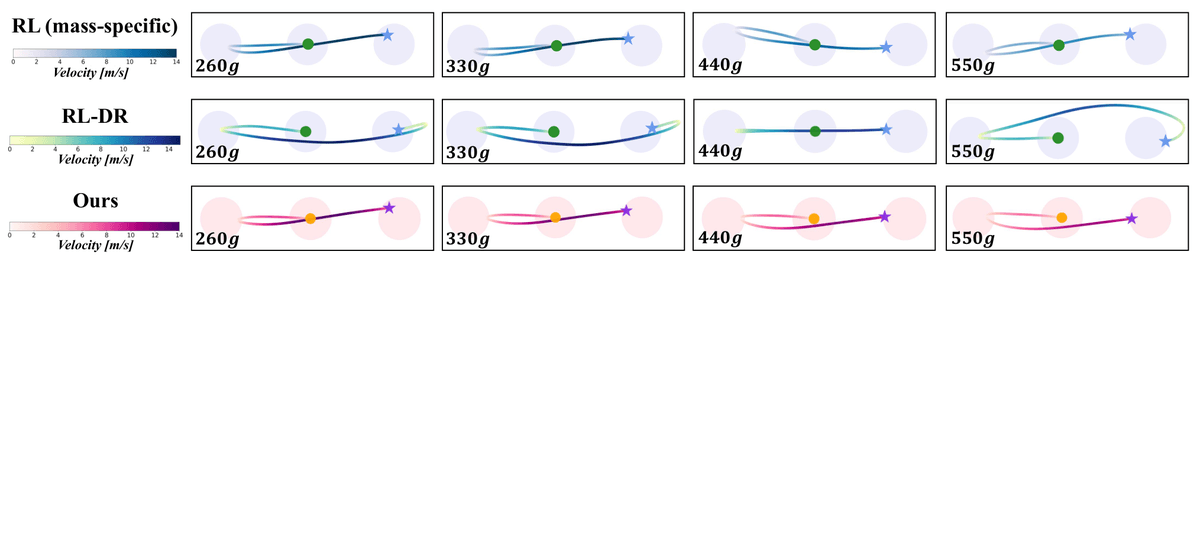
On a switchback track requiring aggressive turns, MAVEN's single policy nearly matches mass-specific expert policies while a domain-randomized baseline takes visibly slower, more conservative paths at light weights. In a 100-track statistical study of single-rotor thrust loss:
- Standard RL: success rate collapses to 69% at 30% thrust loss, 11% at 45%, and complete failure beyond that.
- RL-DR (domain randomization): stays above 96% success up to 45% thrust loss, but crashes to 31% at the out-of-distribution 60% loss.
- MAVEN: near-perfect success on in-distribution faults and still over 70% success at 60% loss, with faster completion times than a critic-based encoder ablation.

Zero-shot to a real drone
The real-world experiments used a 330g custom quadrotor with a Betaflight autopilot and a Cool Pi onboard computer running the policy at 100Hz via LibTorch. In the mass test the team did three consecutive flights without landing, attaching magnet payloads between runs to push the mass to 330g, 440g, and 550g. The three consecutive flight trajectories remain remarkably consistent. This consistency is the key finding: it visually confirms that the policy successfully inferred the new dynamics online and immediately compensated by adjusting its control strategy to maintain the desired path.
For the thrust-loss test, propellers were swapped for smaller ones inducing roughly 30%, 45%, and 70% thrust losses, with the failed rotor at different positions each time so the policy could not overfit to a specific yaw or roll bias. Even the 70% case, well outside the training range, completed a 13-waypoint 'A'-shaped track with only minor loss of agility.
Where this is and is not useful
MAVEN is a research paper from a university lab, not a released model or repo. The authors point to a video playlist of experiments, but there is no public code drop for the framework itself. If you are building agile inspection, delivery, or racing drones where payloads change or rotors can fail, the technique is directly relevant, especially since it demonstrates that trajectory-level adaptation (not just low-level stabilization) is achievable with a single network.
The current limits are worth noting too. Adaptation happens through an online buffer of recent transitions, so the drone needs a few timesteps of flight before z converges to the true dynamics, which is why it initializes from the prior N(0, I) at takeoff. The workspace is bounded to a 6x6x1 meter box during training, waypoints stay within that range, and the framework has so far only been validated for mass changes and single-rotor thrust loss, not aerodynamic disturbances or dual-motor failures. For anyone working on RL controllers for drones, though, the recipe of a predictive context encoder plus a GPU-vectorized meta-RL loop is a strong template to copy.