
Zhejiang University's InterDeepResearch Lets You Interrupt and Steer AI Research in Real Time
A new open-source system rebuilds deep research around a hierarchical context store, three linked views, and mid-run steering for human collaborators.
 Pro
Takeaways
- InterDeepResearch is the first interactive deep research system enabling mid-run human steering and evidence tracing (paper).
- A hierarchical context model splits research into information, actions, and sessions to enable pruning and provenance.
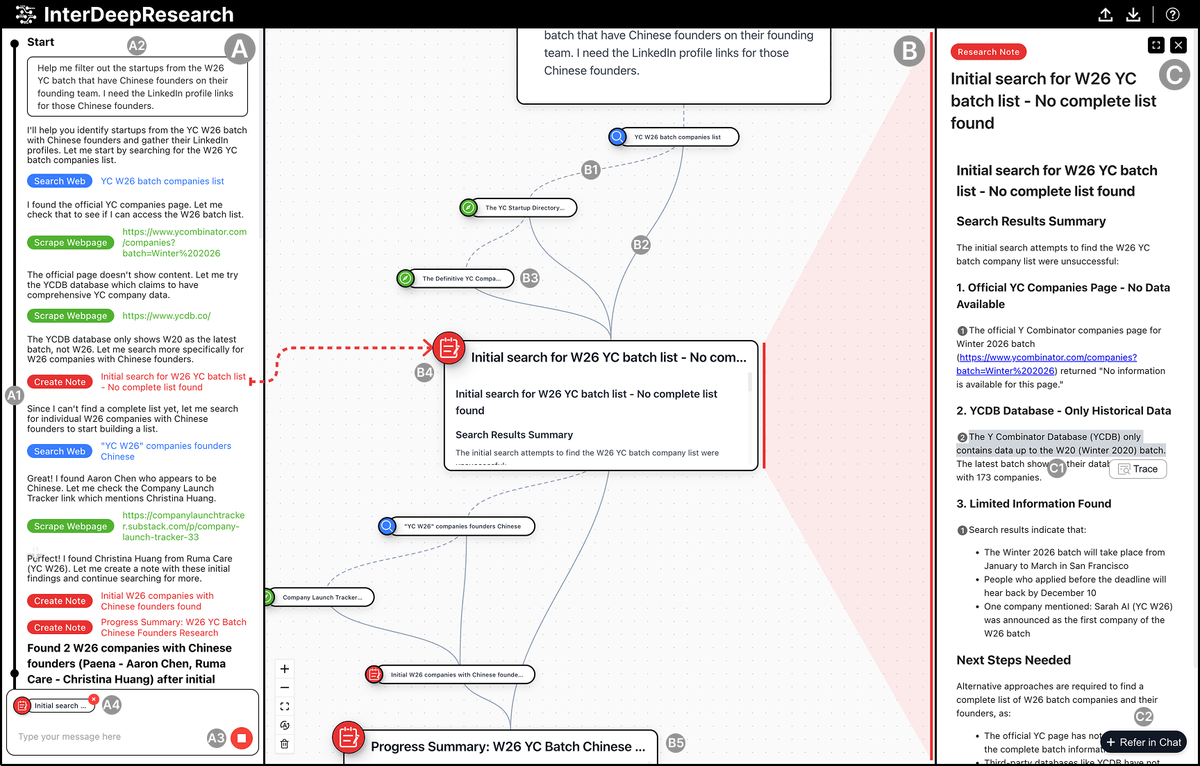
- Three coordinated views (chat flow, dependency graph, information cards) let users interrupt and redirect the agent anytime.
- Beats Perplexity Deep Research and Gemini Deep Research on Xbench-DeepSearch-v1 and Seal-0 benchmarks without user help.
- User study with 15 participants scored transparency 4.80/5 and dependency graph 4.60/5.
- Full stack open-sourced on GitHub, runs on Claude Sonnet 4.5 via LiteLLM.
Most deep research agents treat you like a customer at a drive-through: you place an order, wait ten minutes, and hope the bag contains what you wanted. A team from Zhejiang University wants to change that with InterDeepResearch, an interactive system that lets you watch the agent think, interrupt it, redirect it, and trace every conclusion back to its evidence.
The passive-user problem
Commercial deep research tools from OpenAI, Google, Perplexity, and others all follow what the authors call a query-to-report paradigm, limiting users to a passive role and failing to integrate their personal insights, contextual knowledge, and evolving research intents. The team ran a formative study with eight frequent users and found three concrete failure modes:
- Opaque process: streaming logs show that the agent is searching, but not what it is searching for or how steps connect.
- No steering: when the agent drifts, users can only wait for the final report and then start over with a new query.
- Unnavigable context: long reports with citations make it painful to trace a specific claim back to the exact webpage that supports it.
A three-level context model
The core contribution is not the UI, it is a research context management framework that organizes research context into a hierarchical architecture with three levels (information, actions, and sessions), enabling dynamic context reduction to prevent LLM context exhaustion and cross-action backtracing for evidence provenance.

The levels stack like this:
- Information is the atomic unit: a user message, a search result, a scraped page, or an agent-generated summary. Each type gets a color (blue, green, red) that persists across the whole interface.
- Actions are what produced that information. Web Search, Scrape Webpage, Create Note, User Interrupt, and Finish. Actions have explicit dependencies on prior information, forming a DAG rather than a linear log.
- Sessions group consecutive actions between milestones. User messages, administrative actions, and periodic progress summaries all mark milestone boundaries.
Two mechanisms sit on top. Context reduction replaces raw search results and scraped pages with pointers once the agent has produced a summary from them, and drops non-milestone information when a new session starts. This is a deliberate answer to context rot in long-horizon agents. Context backtrace spawns a dedicated LLM to walk the action dependency graph backward from any highlighted text, finding the specific supporting evidence and recursing until it hits the original raw source.
Three views, one canvas
The frontend, built with React and React Flow, exposes the hierarchy through three coordinated panels: a chat-style timeline of sessions and actions, a draggable dependency graph where nodes expand and collapse, and a card view for the raw information itself. Clicking any action in one view focuses the corresponding node in the others. Users can hit stop at any point, quote prior information with a Refer in Chat button, and hover over superscript citations to see the exact node that produced the claim.
How it holds up
On automated benchmarks with no human in the loop, the system was evaluated on Xbench-DeepSearch-v1 and Seal-0, two text-based deep research benchmarks. The authors report that InterDeepResearch achieves competitive performance in automated information seeking, even surpassing popular commercial deep research systems like Perplexity Deep Research and Gemini Deep Research. The underlying model is Claude Sonnet 4.5, routed through LiteLLM.

The user study with 15 participants is where the system shines. Transparent disclosure of the agent process scored 4.80 out of 5, the dependency graph 4.60, and the cross-action backtrace 4.33. One participant summarized it bluntly: the only deep research system that actually lets you follow along. The chat-style flow view was more divisive, with some users ignoring it entirely in favor of the graph.
What it is bad at
The paper is candid about limits. Backtrace launches a fresh LLM pass and users complained about wait times. Steering is still text-only, several users asked for direct edits to prior information or the ability to delete specific chunks of context. And the study covers a single agent working with a single user, so multi-agent or branching research remains open.
Running it locally
The full stack is available on GitHub as a Python 3.11 FastAPI backend and a React frontend. Setup requires a Serper API key for web search and an OpenRouter or equivalent key for the LLM:
conda create -n InterDeepResearch python=3.11
conda activate InterDeepResearch
pip install -r requirements.txt
pip install 'crawl4ai[pdf]'
playwright install
python IDR_backend/server.py --host 0.0.0.0 --port 5001
For anyone building agentic research tools, the interesting takeaway is not the UI polish but the data model. Treating the research trace as a typed DAG rather than a flat message log is what makes real-time interruption, dependency-aware context pruning, and evidence backtrace possible in the first place. That pattern generalizes well beyond deep research.