
Zhejiang University's HALO Lets Humanoid Robots Carry 10 kg With 100% Success
A two-stage differentiable simulation approach identifies robot dynamics under unknown payloads, enabling zero-shot RL policies that stay agile with 10kg loads.
 Pro
Takeaways
- HALO uses differentiable MuJoCo XLA to identify payload dynamics via gradient descent on trajectory matching.
- Two-stage design: calibrate the base robot without payload, then identify only mass and CoM under load.
- Data collection needs only joint encoders and a vise clamping one foot, no motion capture or torque sensors.
- On a Unitree G1 carrying 10 kg, cuts walking position error by 45-73% and jump angular error by 73%.
- Achieves 100% success on swallow balance, side kick, and roundhouse kick versus 50-70% for baselines.
- Code release pending on the HALO project page.
Bipedal robots trained in simulation tend to fall apart the moment you hand them something heavy. A backpack, a toolbox, or counterweights strapped to the wrists shift the mass, center of mass, and inertia enough that a policy which walked flawlessly in MuJoCo suddenly stumbles on hardware. A new framework called HALO (Heavy-Loaded humanoid motion control) tries to close that gap by identifying exactly how the payload changes the robot's dynamics before training the policy, rather than papering over the mismatch with domain randomization.
The team from Zhejiang University, TeleAI, Shanghai Jiao Tong University, and Lumos Robotics published the paper showing that with an accurate identified model, a Unitree G1 humanoid can carry a 10 kg payload while performing side kicks, roundhouse kicks, and swallow balances at a 100% success rate.

Why payloads break sim-to-real
Loads induce substantial shifts in a robot's system dynamics by altering total mass, center of mass, and inertia distribution, and policies trained with nominal dynamics typically degrade when exposed to large, structured payload variations. The standard workaround is domain randomization: train the policy on a wide distribution of masses and inertias so it learns to be robust to anything. Treating payload variations as disturbances leads to conservative behaviors that cannot fully exploit the robot's physical capabilities.
Traditional system identification, which directly measures physical parameters, has its own problems. It often relies on specialized sensing like joint torque sensors or external motion capture, and sometimes requires partially disassembling the robot. HALO wants the accuracy of system ID without the hardware overhead.
Gradients through the physics engine
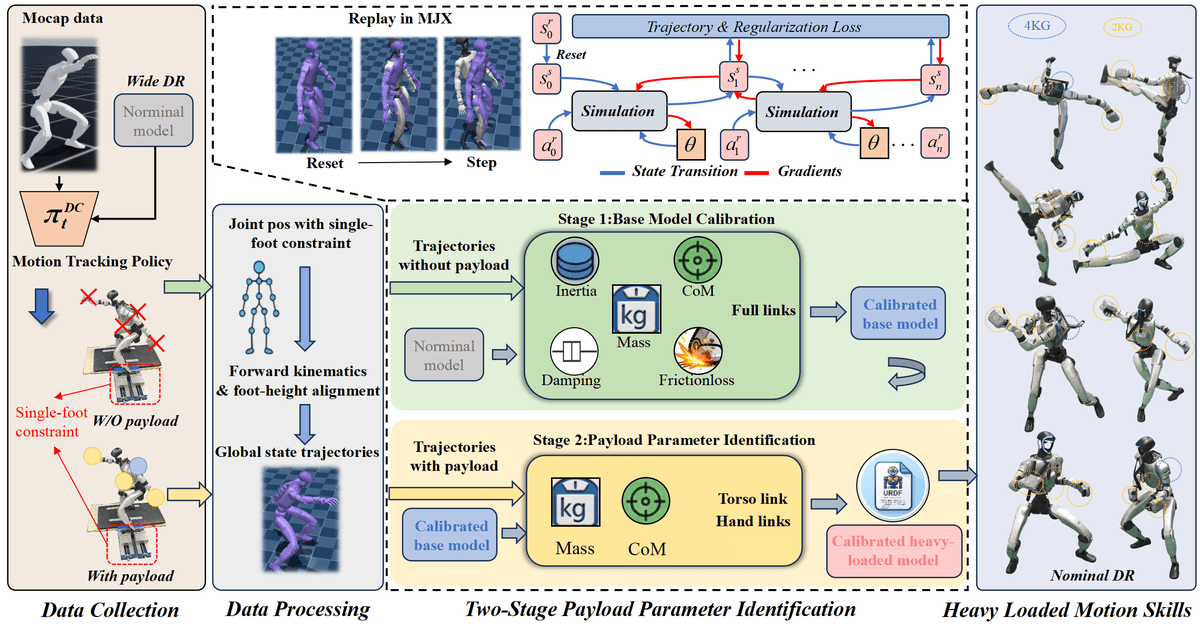
The core trick is running system identification inside MuJoCo XLA, a differentiable version of the MuJoCo physics simulator. Because you can take analytical gradients of the simulated trajectory with respect to physical parameters like link mass and center-of-mass position, you can pose parameter estimation as a straightforward gradient descent problem: minimize the difference between simulated and real trajectories, backprop through the physics.
To collect data without motion capture, the researchers clamp one of the robot's feet in a vise. That constraint removes the ambiguity in global base drift and enables reliable reconstruction of full-body motion from onboard joint encoders. A pre-trained exploration policy then wiggles the robot through a heuristic trajectory, and forward kinematics reconstructs the full body pose from joint angles alone.
The two-stage insight
If you naively run identification on data collected with the payload attached, the optimizer cannot separate errors caused by the payload from errors caused by the robot itself being slightly off-spec from wear, calibration drift, or manufacturing variation. HALO splits the problem:
- Stage 1: Base model calibration. Using trajectories collected without a payload, optimize the full set of model parameters starting from nominal values. This produces a calibrated base robot model.
- Stage 2: Payload identification. Using the calibrated model as a starting point and trajectories collected with the payload, optimize only the mass and center-of-mass positions of the links attached to the load (torso, hands).
The tracking loss compares Cartesian positions of every body link between the real and simulated rollouts, with extra weight on the upper body where the load actually sits. Regularization terms keep the identified mass, CoM, damping, and friction values physically plausible.

How the numbers stack up
Experiments were run on a Unitree G1 that stands approximately 132 cm tall with a nominal mass of 35 kg, using 6 kg diving counterweights on the torso and 2 kg counterweights on each wrist. Against CMA-ES, a sampling-based system identification baseline, HALO converges to the true parameters with essentially zero variance across seeds. Under heavy-loaded conditions, CMA-ES on certain seeds settles into local optima with physically unreasonable values, whereas the gradient-based approach robustly converges near the reference parameters.
On motion tracking with sequences from AMASS, LAFAN1, and HuB, HALO cut the global mean per-joint position error roughly in half compared to Wide-Range Domain Randomization on steady-state tasks, and delivered similar gains on high-agility motions like side kicks. In real-world locomotion, HALO reduces forward position error by 73.33% and 45.45%, decreases end-point residual error by 70.79% and 42.22%, and diminishes angular tracking error by 72.97% compared to the CM baseline on an in-place 90-degree yaw jump.
The success-rate table on hard maneuvers tells the clearest story:
| Method | Swallow Balance | Side Kick | Roundhouse Kick |
|---|---|---|---|
| Wide DR | 0/10 | 0/10 | 0/10 |
| Calibrated Mass | 5/10 | 7/10 | 5/10 |
| HALO | 10/10 | 10/10 | 10/10 |
The Wide DR baseline failed to initiate the takeoff phase during the jumping task, primarily because it could not manage the heavy payload dynamics. Simply weighing the load and updating the mass in simulation (the CM baseline) helps, but only accurate CoM identification unlocks the explosive whole-body maneuvers.
Where this fits
HALO is a practical answer to a specific but common problem: you have a well-tuned humanoid RL policy, and now you need it to carry a real, unknown payload without retraining from scratch or wrapping it in a giant domain randomization envelope. It requires:
- A differentiable simulator with your robot's kinematics (MuJoCo XLA in this case)
- A way to physically constrain one foot for data collection
- Joint encoders and roughly known nominal parameters
- Only a small amount of trajectory data, since small changes in mass or CoM position can quickly cause the simulated trajectory to drift
Limitations worth noting: the second stage only estimates mass and CoM, not full inertia tensors, and the foot-fixture data collection procedure assumes the robot can safely execute an exploration policy with one foot clamped. The project page lists code as "coming soon," so anyone hoping to plug this into their own MJX pipeline will have to wait for the release. Once it lands, the two-stage decomposition should generalize beyond humanoids to any floating-base system where structured model mismatch dominates over stochastic noise.