
Zhejiang University's Anchor Forcing Fixes AI Video Drift With 73% Motion Boost
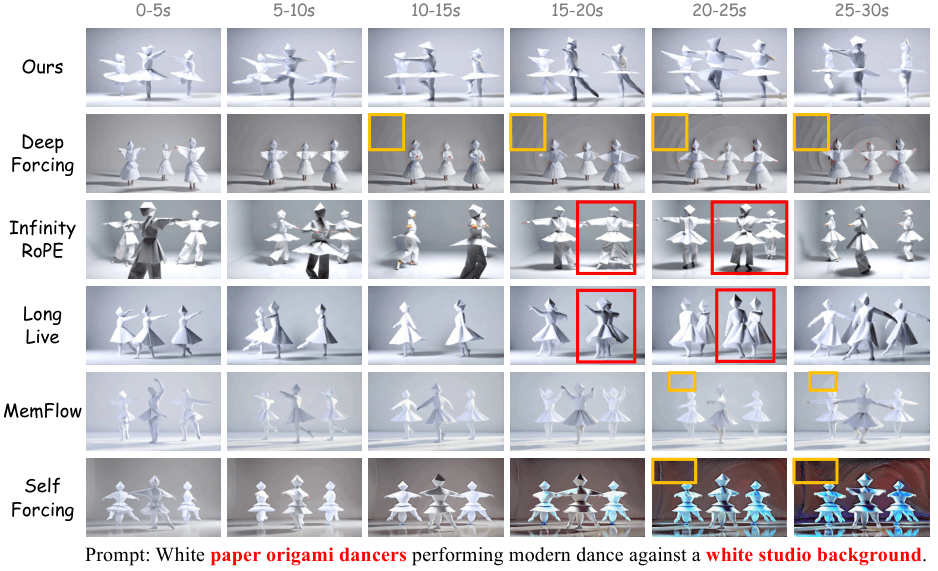
A new paper accepted to ECCV 2026 tackles quality decay in long streaming video diffusion by rethinking how the KV cache and positional encodings behave across prompt switches.
 Pro
Takeaways
- Anchor Forcing, from Zhejiang University and vivo BlueImage Lab, accepted to ECCV 2026 with code and weights released.
- Diagnoses two root causes of long-video drift: evidence loss at prompt switches and out-of-range RoPE indices during streaming.
- Introduces anchor memory combining sink, junction, and local caches to warm-start re-cache without flushing prior context.
- Tri-region RoPE caps effective positions at P_max = 21, matching the pretrained Wan backbone's positional range.
- Boosts VBench dynamic degree from 26.37 to 73.00 versus LongLive on 60-second interactive prompts, beating Infinity-RoPE and MemFlow.
- Built on Wan2.1-T2V-1.3B at 832x480; requires an A100-class GPU for inference and 56 A800s for training.
Streaming video diffusion models that let you swap prompts mid-generation, say, adding a new character halfway through a 60 second clip, tend to fall apart the longer they run. Backgrounds develop ring-like artifacts, motion flattens out, and the model often ignores the new instruction entirely. A team from Zhejiang University, vivo BlueImage Lab, and the University of Hong Kong has published a paper pinpointing why this happens and proposing a fix called Anchor Forcing. The code, inference pipeline, and model weights are all on GitHub, and the work has been accepted to ECCV 2026.
Why streaming video models drift
Modern long-video systems like CausVid, Self-Forcing, LongLive, and MemFlow avoid the quadratic cost of full spatiotemporal attention by generating in small chunks and reusing a rolling KV cache. When a user switches prompts, the cache is rebuilt so the model can pick up the new instruction. The authors argue this design has two specific failure modes.
The first is evidence loss at prompt boundaries. At each prompt switch, current cache maintenance cannot simultaneously retain KV-based semantic context and recent latent cues, resulting in weak boundary conditioning and reduced perceptual quality. The second is a positional encoding mismatch. Streaming rollouts keep incrementing RoPE indices forever, but the pretrained backbone was only ever trained on a bounded range, so the model drifts into positions it has never seen and forgets how to produce natural motion.
Anchor memory instead of a flush
The first half of Anchor Forcing replaces the standard re-cache operation with what the authors call anchor-guided re-cache. Rather than throwing away prior KV states at each switch, the model maintains an anchor memory assembled from three parts:
- A sink cache that stores KV states from the earliest generated frames and stays fixed, providing global semantic context.
- A junction cache capturing the first few frames right after each prompt switch, so newly introduced subjects and actions are preserved as persistent evidence.
- A local cache holding the most recent frames in a rolling window (the paper uses a window of 9 latent frames).
When a prompt changes, the local cache is warm-started from this anchor memory rather than rebuilt from scratch. The junction cache only activates once its frames roll out of the local window, avoiding redundancy. The result is that continuity survives across switches without the model losing responsiveness to the new instruction.
Keeping RoPE inside its training regime
The second half of the method addresses the positional shift. The generator is initialized from CausVid, which is trained with ODE trajectories capped at 21 latent frames distilled from Wan, so anything beyond index 21 is out-of-distribution. Anchor Forcing introduces tri-region RoPE, which assigns each of the three cache regions (sink, junction, local) its own bounded, relative indexing scheme and caps the effective RoPE index at P_max = 21.
Coupled with a RoPE re-alignment distillation step, this keeps the attention layers operating in the same positional range they saw during pretraining, no matter how long the rollout gets. In practice, this is the change that produced the biggest quantitative gains in the ablations.
The numbers
Anchor Forcing is built on Wan2.1-T2V-1.3B and generates 5-second clips at 832x480 that can be chained up to 60 seconds. On the interactive benchmark from MemFlow (100 narrative scripts, six 10-second prompts each), it lands well ahead of streaming baselines on motion and quality:
| Method | Dynamic Degree | Quality Score | CLIP Score (50-60s) |
|---|---|---|---|
| Infinity-RoPE | 35.17 | 79.98 | 22.20 |
| MemFlow | 45.47 | 79.35 | 21.59 |
| LongLive | 26.37 | 78.92 | 22.82 |
| Anchor Forcing | 73.00 | 82.25 | 23.63 |
The ablations tell a clean story about where the gains come from. Adding tri-region RoPE alone lifts dynamic degree from 26.37 to 74.83, meaning that most of the motion collapse in prior streaming methods was really a positional encoding problem in disguise. Layering anchor-guided re-cache on top nudges CLIP score from 23.71 to 23.85 and quality from 81.72 to 82.25, showing that the two components are complementary rather than redundant.

On the standard 5-second VBench setup, the method also matches or beats real-data-trained peers like LTX-Video and Pyramid Flow at similar parameter counts, hitting 73.61 dynamic degree, which is essentially the Wan2.1 teacher's own score.
What is not addressed
A few caveats worth knowing before you try it:
- Training is not cheap: about 24 hours on 56 A800 GPUs, on top of a LongLive-style Step 1 initialization the repo does not re-release.
- The recommended hardware for inference is an A100 with 40 GB of VRAM on Linux; other setups are untested.
- Videos cap at 60 seconds in the interactive evaluation, and it is unclear how the bounded P_max = 21 regime behaves at much longer horizons.
- The junction cache size (N_J = 3 latent frames) is fixed; scenes with dense back-to-back prompt switches may need re-tuning.
Where it fits
The interesting takeaway for anyone building on top of streaming video diffusion is that the community has been treating quality degradation and motion collapse as separate diseases when they may share a root cause in positional encoding. The project page demonstrates multi-shot narrative generation where subjects and actions can be introduced on demand without the scene resetting or the motion freezing, which is roughly what you want if you are building an interactive text-to-video tool where users iterate on a scene rather than regenerating it from scratch.