
Zhejiang University's AirDDE Cuts Air Quality Forecast Error 8.79% by Modeling Wind Delays
AirDDE is the first neural delay differential equation for air quality, treating pollutant transport as a delayed physical process and cutting MAE by 8.79%.
 Pro
Takeaways
- AirDDE is the first neural delay differential equation model for air quality forecasting, accepted at AAAI 2026.
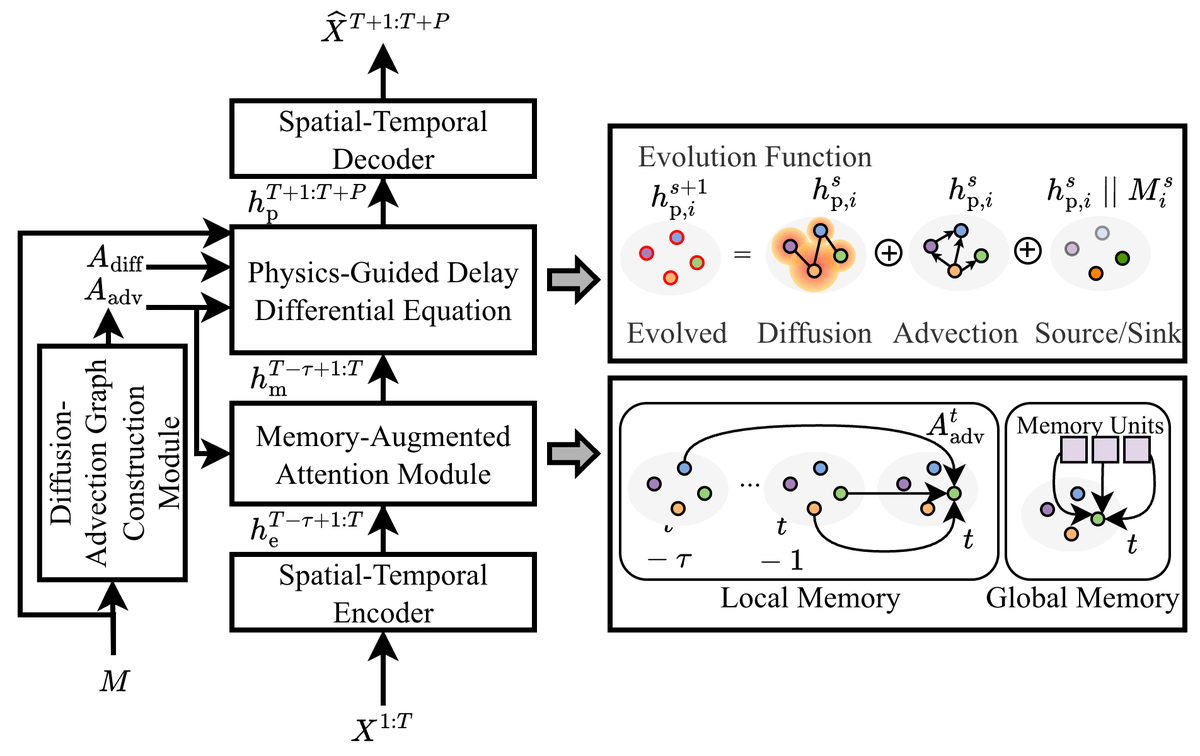
- It treats pollutant transport as a delayed continuous-time process, not an instantaneous one, using wind fields to build transport paths.
- Two novel components: memory-augmented attention over historical features and a physics-guided delay function based on diffusion-advection.
- Achieves an 8.79% average MAE reduction over the best baselines across KnowAir, China-AQI, and US-PM datasets.
- Advantage grows at long forecast horizons (96 to 168 hours) where transformer and ODE baselines degrade faster.
- Code, configs, and training scripts released at github.com/w2obin/airdde-aaai.
Most deep learning air quality models pretend pollution moves instantaneously. A team from Zhejiang University argues that assumption is exactly why forecasts break down at longer horizons, and they have built a new model that fixes it by treating pollutant transport as a delayed, continuous-time physical process governed by wind and diffusion.
Their system, AirDDE, was accepted at AAAI 2026 and, according to the authors, is the first physics-guided framework to integrate delay modeling into pollutant continuous-time evolution. On three real-world benchmarks it delivers an average MAE reduction of 8.79% over the best baselines.
Why instantaneous models keep getting it wrong
PM2.5 concentrations at a monitoring station rarely come from that station alone. Pollutants travel from upwind cities, arriving hours or even days later depending on wind speed, direction, and terrain. Existing deep learning methods often model these dynamics as an instantaneous process, overlooking the intrinsic lag in propagation, which means a model can see a spike in Beijing but misjudge when and where it will show up in Tianjin.
The authors point out that these cumulative effects are grounded in atmospheric dynamic processes, which cannot be captured by existing statistics-based or purely data-driven delay modeling techniques. Prior physics-guided attempts like AirPhyNet and Air-DualODE introduced continuous-time modeling through Neural ODEs, yet neither explicitly represents the lag between emission and arrival.
Delay differential equations, borrowed from traffic
AirDDE builds on a class of models called Neural Delay Differential Equations (NDDEs), which extend Neural ODEs by letting the derivative depend not only on the current state but also on past states. The idea, popularized in