
Zhejiang University Reads Mandarin Thoughts With 14.71% Error Using a 7B Model
A single framework decodes both spoken and heard Mandarin sentences from brain signals using Pinyin classification plus a post-trained 7B LLM.
 Pro
Takeaways
- Unified brain-to-text framework decodes Mandarin from both speech production and perception across 12 implanted participants.
- Best-case character error rates hit 14.71% for spoken sentences and 21.80% for heard sentences.
- Pipeline classifies Pinyin initials and finals from neural signals, then a 7B LLM maps toneless syllables to characters.
- Post-trained 7B model beats Qwen-3 Max, Deepseek-v3.2, GPT-5-chat, Grok-4-fast, and Llama-3.1 on syllable-to-sentence decoding.
- Trained only on single characters, generalizes to full sentences and unseen syllables.
- Speech production spans broader cortex than perception; decoding works comparably from either hemisphere.
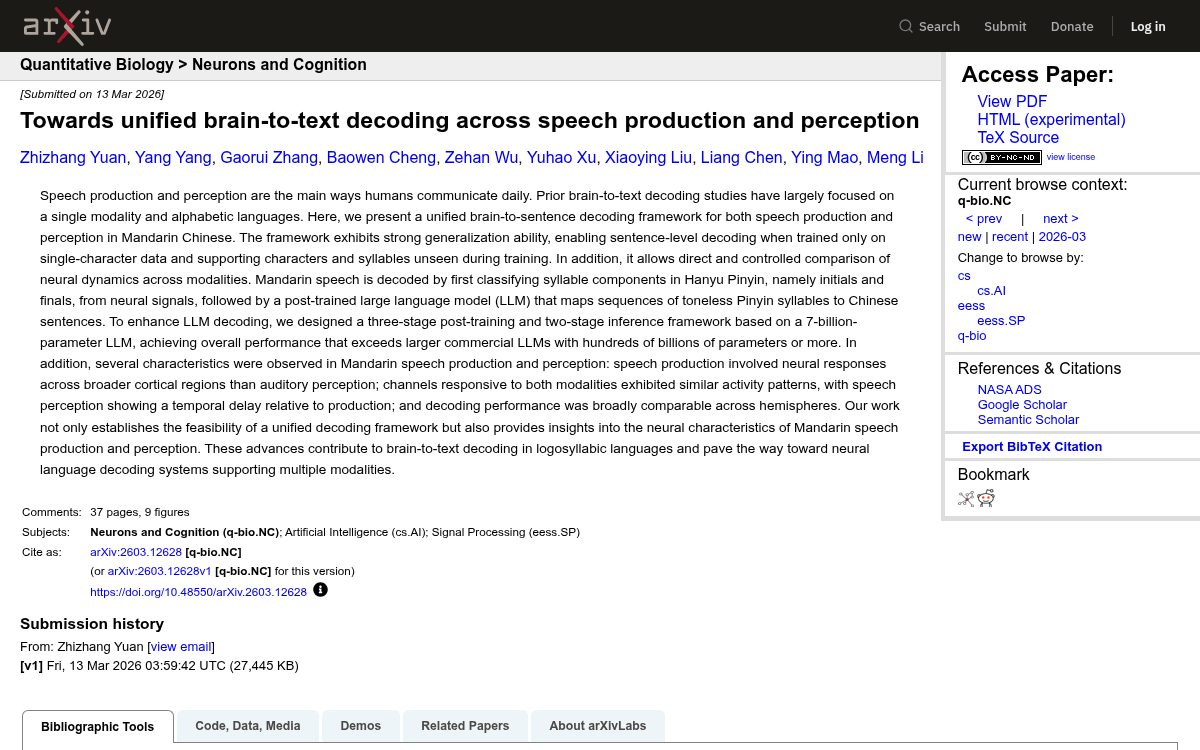
A team spanning Zhejiang University, the Shanghai Institute of Microsystem and Information Technology, and Huashan Hospital has built a brain-to-text system that reads Mandarin Chinese out of neural recordings, and it works whether the person is speaking or listening. The paper, Towards unified brain-to-text decoding across speech production and perception, tackles two problems that have kept Mandarin BCIs behind their English counterparts: the language is tonal and logosyllabic, and prior systems only decoded one modality at a time.
The authors collected neural data from 12 participants implanted with depth electrodes and achieved full-sentence decoding across multiple participants, with best-case Chinese character error rates of 14.71% for spoken sentences and 21.80% for heard sentences. Those numbers are notable because the model was trained only on isolated characters and still generalized to full sentences, including characters and syllables it had never seen.
Why Mandarin has been the hard case
Most invasive speech BCIs to date have targeted English, using phoneme-level decoders. Speech brain-computer interfaces offer a promising means to provide functional communication capacity for patients with anarthria caused by neurological conditions such as ALS or brainstem stroke, but current research has predominantly focused on English using phoneme-driven architectures, whereas real-time decoding of tonal monosyllabic languages such as Mandarin Chinese remains a major challenge. Mandarin does not decompose neatly into an alphabet. Each character maps to a syllable made of an initial (consonant), a final (vowel cluster), and a tone, and thousands of characters share the same pronunciation.
A second gap: prior Mandarin work has been production-only. Earlier frameworks decoded Mandarin sentences from invasive neural recordings by dissecting speech onset, base syllables, and lexical tones, integrating them with contextual information through Bayesian likelihood and a Viterbi decoder. Nothing before this paper handled both speaking and listening under the same model, which matters because a practical BCI for a patient who cannot speak would ideally leverage neural signals from either intended speech or perceived speech.
How the pipeline actually works
The system is a two-stage decoder that deliberately throws away tone information at the neural layer and lets a language model handle disambiguation. Mandarin speech is decoded by first classifying syllable components in Hanyu Pinyin, namely initials and finals, from neural signals, followed by a post-trained large language model that maps sequences of toneless Pinyin syllables to Chinese sentences.
To make this reliable, the team wraps a 7B model in a custom training and inference recipe. They designed a three-stage post-training and two-stage inference framework based on a 7-billion-parameter LLM, achieving overall performance that exceeds larger commercial LLMs with hundreds of billions of parameters or more. Concretely, the LLM is benchmarked against a lineup that includes Qwen2.5-7B-Instruct, Qwen2.5-72B-Instruct, Qwen-3 Max, Deepseek-v3.2-exp, Doubao-1.6, GPT-5-chat-latest, Grok-4-fast, and Llama-3.1, and the smaller specialized model wins on the syllable-to-sentence step.
Steps in plain terms:
- Record intracranial signals from depth electrodes while the participant either speaks or listens to Mandarin.
- Classify each syllable slot into a Pinyin initial and final. Tone is intentionally dropped.
- Feed the toneless Pinyin string to the post-trained 7B LLM.
- Run two-stage inference: beam search over candidate character sequences, then LLM-based correction of the top-k candidates.
The ablations spell out what each piece contributes. A baseline used an IME-style decoder based on lexicon- and language-model-driven search; Top-1, Top-3, and Top-20 correction groups performed direct correction of the top-k beam search candidates; and auxiliary component ablations were labeled 'w/o translation' and 'w/o vocabulary.'

What the neural data revealed
Because the same framework runs on both modalities, the authors could compare speaking and listening on equal footing. Speech production involved neural responses across broader cortical regions than auditory perception; channels responsive to both modalities exhibited similar activity patterns, with speech perception showing a temporal delay relative to production; and decoding performance was broadly comparable across hemispheres.
The hemispheric result is clinically interesting. Language function is traditionally considered left-lateralized in most people, and prior Mandarin ECoG studies confirmed this bias. In an earlier study, researchers recorded neural activity of five native Mandarin-speaking participants who underwent awake surgery to treat brain tumors, and all participants had left-lateralized language functions; in two cases, ECoG arrays were placed over the right hemisphere for clinical purposes. Getting comparable decoding from either side widens the surgical options for future implants.
Why the generalization claim matters
The most practical breakthrough is data efficiency. Training on single characters and decoding full sentences means clinicians would not need to record hours of natural sentence speech to bootstrap a system, which is often infeasible with patients who have already lost speech. A related Mandarin BCI similarly converted brain signals into sentences by decoding Pinyin syllables and could handle the full set of Chinese characters despite being trained with only 407 syllables. This new work pushes that idea into a unified production-and-perception model.
Where it falls short
- Character error rates of 14.71% and 21.80% are the best cases, not the average. Real deployments would see worse numbers on harder participants.
- Perception decoding lags production by roughly 7 points of CER, so listening-based BCI use cases are still weaker.
- Tone is dropped at the neural stage. The LLM has to guess it from context, which will fail on ambiguous homophones without strong priors.
- The paper does not appear to release code or model weights publicly, so reproducing the pipeline outside the authors' clinical setting is not immediately possible.
- All participants had electrodes implanted for clinical reasons unrelated to speech loss, so this is not yet a demonstration in the target patient population.
Who should care
Anyone building neural decoders for non-alphabetic languages should read the syllable-decomposition and LLM-correction sections carefully. The recipe of splitting neural classification (initial plus final) from linguistic disambiguation (LLM over toneless Pinyin) is a template that likely transfers to Cantonese, Japanese kana-to-kanji, and Korean. And for researchers working on invasive BCIs generally, the demonstration that a unified model can handle both speaking and listening starts to blur a distinction that has structured the field for a decade.