
Zhejiang University Matches Joint Training by Distilling Surveillance Data Into Synthetic Noise
A new lifelong person re-ID framework fuses many training images into a single synthetic sample, matching joint-training accuracy while sidestepping raw-image privacy risks.
 Pro
Takeaways
- New LReID framework condenses many training images into single synthetic samples via gradient matching.
- Beats state-of-the-art by +5.0% Seen-Avg mAP and traditional replay methods by +6.0%.
- Overall accuracy across 12 domains matches joint training on all data (63.2% vs 63.1% mAP).
- Synthetic samples visually look like noise, defeating pixel retrieval while preserving feature-level identity.
- Membership Inference Attack AUC drops to 0.6153, near random chance (0.5).
- Bidirectional style alignment harmonizes features across current and buffered past domains.
Person re-identification systems have to keep learning as new camera domains, seasons, and cities show up in the data stream. The catch: retraining from scratch on all historical data is impractical, and naive fine-tuning triggers catastrophic forgetting. A team from Zhejiang University and the University of Windsor has proposed a workaround that reframes the problem entirely, and their approach essentially closes the gap to a model trained on all data at once.
The paper, Distilling the Past: Information-Dense and Style-Aware Replay for Lifelong Person Re-Identification, tackles a stubborn dilemma in Lifelong Re-ID (LReID). Replay-based methods store a small buffer of past images and rehearse them, but they hit strict memory ceilings and raise privacy issues since the buffer contains raw surveillance photos of real pedestrians. Exemplar-free methods dodge memory limits but lose the fine-grained identity cues that Re-ID depends on.
Compressing a dataset into a handful of synthetic pixels
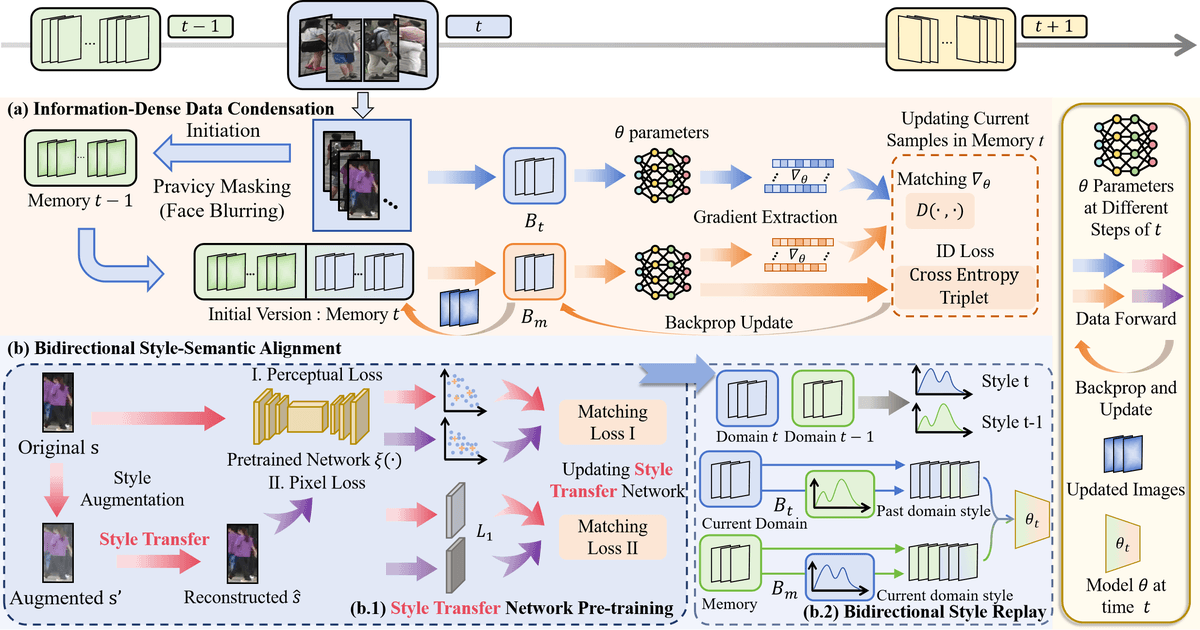
Instead of picking which raw images to keep, the authors condense many images into a single synthetic image. The idea comes from dataset distillation: optimize synthetic samples at the pixel level so they produce similar parameter updates to the network as the original dataset would.

The condensation uses multi-stage gradient matching. During initial training on real data, the model saves parameter snapshots at evenly spaced epochs, capturing both early rapid convergence and late-stage refinement. The synthetic samples are then optimized so their gradients match the real data's gradients at each of those checkpoints, using cosine distance so only direction (not magnitude) needs to align.
Gradient matching alone tends to collapse identity boundaries, which is fatal for Re-ID where inter-class differences are already small. To fix that, the authors bolt on identity supervision during pixel optimization: a cross-entropy classification loss plus a hardest-sample triplet loss that pushes each anchor away from its nearest wrong-identity match and toward its farthest same-identity match. The synthetic pixels end up encoding decision boundaries, not just averaged gradient trajectories.
Privacy shows up as a free byproduct
Because the synthetic images are optimized in feature space rather than pixel space, they end up looking like unintelligible noise. When the authors use a condensed image as a query, pixel-level retrieval via Euclidean distance completely fails to find the right identity, but feature-level retrieval via cosine similarity matches it correctly. Structural identity survives; visual biometrics do not.
They also test resistance to Membership Inference Attacks, where an adversary tries to determine if a specific photo was in the training set. The MIA ROC-AUC is 0.6153, close to the 0.5 random-chance baseline and far below the greater-than-85% success rate typical against raw image buffers. A Gaussian blur is also applied to facial regions before condensation as an additional safeguard.
Bidirectional style alignment across domains
Condensing history is only half the fight. The replay buffer holds samples from many past domains, and the domain shift between old and new tasks keeps driving forgetting. The Bidirectional Style-Semantic Alignment (BSSA) module does a two-way stylization:
- Inject past-domain styles into current streaming data
- Inject current-domain style into buffered replay samples
Prior style-transfer methods for Re-ID lean on pixel-level L1 losses, which smooth over the high-frequency edges and textures that identify a person. The authors add a perceptual loss computed in the feature space of a pretrained network, so structural identity is preserved even as color and illumination change.
Results approach the joint-training ceiling
The framework was evaluated on five Re-ID datasets (Market-1501, CUHK-SYSU, DukeMTMC, MSMT17, CUHK03) plus seven unseen datasets to measure generalization. Against the best baselines in each category, it delivered gains of +15.2%/+17.8%, +6.5%/+6.2%, and +3.6%/+3.5% in Seen-Avg mAP/R@1 across the two training orders, versus class-incremental, replay-based, and non-exemplar methods respectively.
The most striking number: across all twelve seen and unseen domains, the method reaches 63.2% mAP and 66.5% R@1, essentially matching the 63.1%/65.0% of Joint Training, which sees all data simultaneously and represents the theoretical upper bound.

An ablation with only two samples per class showed the condensed buffer nearly matches full-dataset training on Market-1501 (78.8 vs 78.9) and DukeMTMC (71.0 vs 71.2), well above random or K-center selection.
Where it fits, and where it doesn't
This is a strong fit for continually deployed surveillance and retail analytics pipelines where you cannot legally retain raw pedestrian images. The synthetic buffer is small, computationally cheap to maintain, and provides an inherent defense against reconstruction and membership inference attacks without dedicated encryption.
Two caveats worth noting. On completely unseen domains, DASK still edges out this method because its aggressive abstract distribution blurring generalizes further, though at the cost of forgetting more on historical domains. And the paper does not release code or a pretrained model, so reproduction currently requires reimplementing multi-stage gradient matching and the AKPNet-based style transfer module from the algorithm description.