
Zhejiang's Memp Lets AI Agents Inherit Skills, Cutting Steps by 37%
A new framework gives LLM agents a growing library of how-to knowledge, cutting steps and boosting accuracy on long-horizon tasks
Takeaways
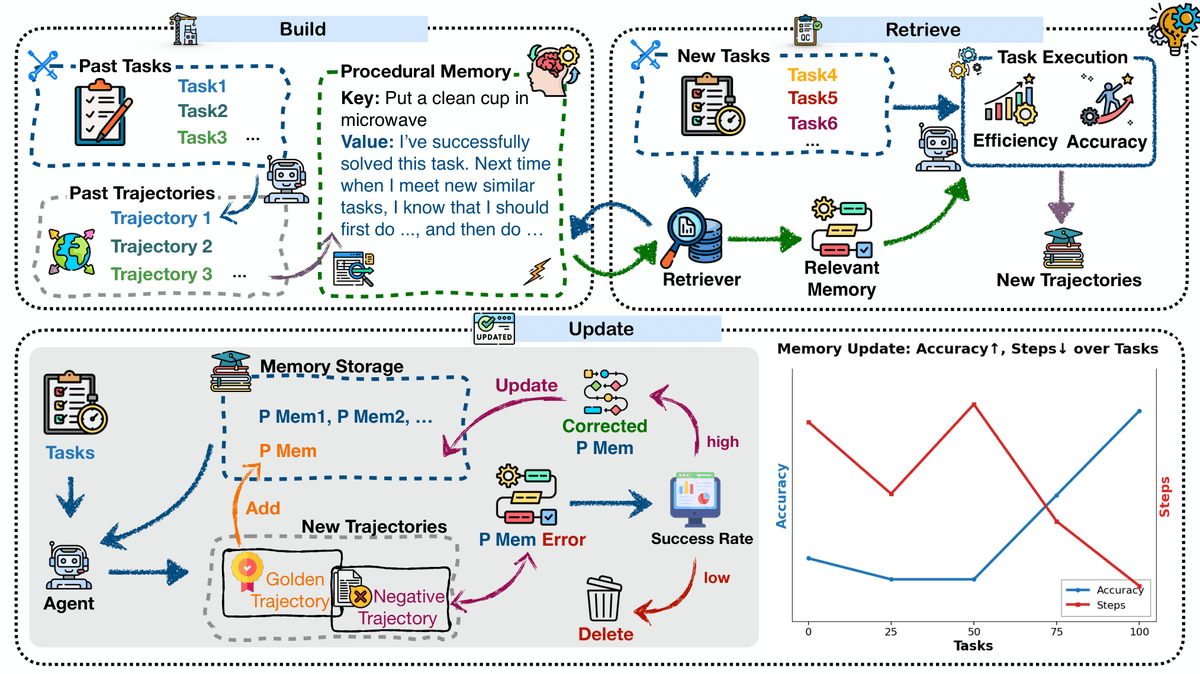
- Memp gives LLM agents a build-retrieve-update pipeline for procedural memory distilled from past task trajectories.
- Combining verbatim trajectories with abstracted scripts ("Proceduralization") gave the best results on both benchmarks tested.
- Reflexion-style memory updates that revise failed entries beat vanilla append and success-only filtering.
- On ALFWorld with GPT-4o, test success rose from 42% to 78% while step count dropped by around 37%.
- Memory built by GPT-4o transferred to Qwen2.5-14B, lifting its TravelPlanner completion rate by 5 percentage points.
- Code is available at github.com/zjunlp/MemP; paper at arxiv.org/abs/2508.06433.
LLM agents keep re-solving the same problems from scratch. Every time one tackles a multi-step task, whether booking travel with tool calls or navigating a household simulator, it burns tokens rediscovering things it already figured out on a previous run. A team from Zhejiang University and Alibaba has proposed a fix called Memp that treats an agent's step-by-step know-how as something you can build, retrieve, update, and even transfer between models.
The brittle memory problem
Contemporary agents built on LLMs can compose short action plans or call external tools, but their procedural knowledge is either hand-crafted, stored as fragile prompt templates, or implicitly entangled in model parameters that are expensive to update. Frameworks like LangGraph, AutoGPT, and cognitive architectures such as Soar offer memory buffers or rule chunks, but nobody has systematically studied how skills should be stored, indexed, patched, and retired over an agent's lifetime.
Procedural memory, in the human sense, is the automatic knowledge behind skills like typing or riding a bike. For an agent, the equivalent is the reusable pattern that says "to heat an egg, first find the fridge, then the microwave, then run these commands in this order." Without it, a fresh task means fresh trial and error, and on unfamiliar problems the agent burns many actions and tokens just understanding the environment before it can act.