
ZeroWBC Teaches Humanoid Robots Human Moves Without Expensive VR Rigs
ZeroWBC trains humanoid robots to sit, kick, and navigate using only human egocentric video — no robot teleoperation data required
 Pro
Takeaways
- No robot teleoperation needed: ZeroWBC learns humanoid whole-body control from human egocentric video + MoCap data, skipping expensive VR teleoperation.
- 12x faster data collection: One human with a GoPro collects 300 demos in 2 hours vs. 100 demos in 8 hours for robot teleoperation.
- Two-stage pipeline: Fine-tuned Qwen2.5-VL-3B generates motion tokens from image + text; an RL tracker executes them on the Unitree G1.
- Strong real-world results: 84% sofa sitting, 96% obstacle avoidance, and 76% zero-shot chair sitting across 50 trials each.
- Key innovation: Interaction-oriented reward prioritizes global wrist/foot/root placement over joint-angle matching, enabling precise scene interaction.
- Limitations: Open-loop only (static scenes), ~400ms latency blocks real-time replanning, no tactile feedback for contact-rich tasks.
Teaching a humanoid robot to sit on a sofa or kick a ball sounds simple. But getting it to do those things naturally, without scripting every joint angle, has been one of the hardest unsolved problems in robotics. The dominant approach today is teleoperation: a human operator puppets the robot through a VR headset, recording demonstrations that the robot can later imitate. It works, but it does not scale. Collecting 100 good demonstrations for a single task takes two operators and roughly eight hours. Researchers from USTC, Shanghai AI Laboratory, and Tsinghua University have now published ZeroWBC, a framework that sidesteps this bottleneck entirely by learning from human egocentric video instead.
The data collection wall
The humanoid robot field is accelerating fast. The Unitree G1 is the world's best-selling humanoid robot, with Unitree shipping more than 5,500 units in 2025 and capturing roughly 32% of the global market. But hardware availability is only half the problem. The other half is data. While some recent works have demonstrated autonomous humanoid interactive control, they are constrained to rigid locomotion patterns and expensive teleoperation data collection, lacking the versatility to execute more human-like natural behaviors such as sitting or kicking. Furthermore, acquiring the necessary real robot teleoperation data is prohibitively expensive and time-consuming.
The numbers make this concrete. According to the paper, whole-body robot teleoperation requires two operators for VR control, robot reset, safety monitoring, and task setup. About 8 hours of teleoperation yields only around 100 successful demonstrations. In contrast, a single human demonstrator with a motion capture suit and a chest-mounted GoPro can collect about 300 successful egocentric demonstrations in 2 hours for the same task , a 12x improvement in throughput at a fraction of the cost.
Watch a human, move like one
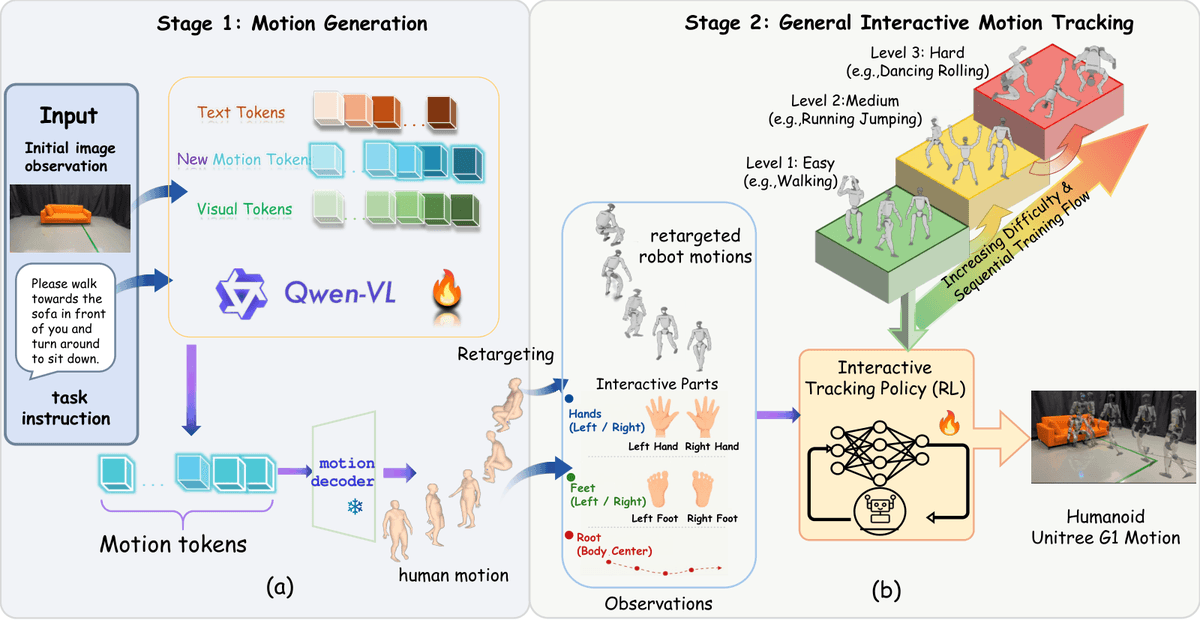
ZeroWBC's core insight is that humans already perform the behaviors robots need to learn, and we have the tools to record them cheaply. The framework follows a generate-then-track formulation: a high-level vision-language model plans the full motion sequence from a single image and a text command, and a low-level reinforcement-learning policy physically executes it on the robot.

The pipeline breaks down into three stages:
- Motion tokenization: A VQ-VAE (a neural codec that compresses continuous motion into a small set of discrete codes, similar to how an audio codec compresses sound) is trained on SMPL-formatted human motion data. It converts a motion clip into a compact sequence of integer tokens.
- Vision-language motion generation: Qwen2.5-VL-3B is fine-tuned to predict those motion tokens autoregressively, conditioned on an initial egocentric image and a text instruction. The model is first pre-trained on 300 hours of the Nymeria dataset (synchronized egocentric video + whole-body MoCap + language annotations), then fine-tuned on 5 hours of self-collected interaction data covering box moving, ball kicking, sofa sitting, and obstacle avoidance.
- Interactive motion tracking: The decoded human motion is retargeted to the Unitree G1's 23-joint kinematics, and an RL policy executes it. Crucially, the tracker does not just minimize joint-angle error , it explicitly tracks global trajectories for the root, both wrists, and both feet, which are the body parts that actually need to be in the right place for a task to succeed.
The tracking policy is trained with a curriculum that starts on simple standing and walking motions (difficulty 1–4) and progressively unlocks dynamic and acrobatic motions (up to cartwheels and backflips at level 9–10). An adaptive scheduler also up-weights clips the policy is currently failing on, ensuring hard motions get more training time without crowding out easier ones.
The interaction reward that makes it click
The key technical contribution is what the authors call interaction-oriented tracking. Standard motion tracking policies minimize the average error across all joints equally. That works for dancing or locomotion, but it fails for interaction tasks. If a robot is supposed to sit on a sofa, what matters is where its hips end up globally , not whether every intermediate joint angle perfectly matches the reference. ZeroWBC's reward function reflects this: wrist and foot interaction position rewards carry a weight of 1.0, while the joint-level reference motion reward carries only 0.1.
This trade-off shows up clearly in the benchmarks. On the interaction-specific metrics (MPIPE and MPIVE , how accurately the key body parts land in the right place), ZeroWBC beats both GMT and SONIC across all evaluation sets. On raw joint-level accuracy (MPJPE), SONIC still edges ahead, because SONIC optimizes purely for joint imitation. The ablation removing interaction-oriented targets confirms the trade-off: it slightly improves MPJPE but substantially degrades key body-part placement.

What it can actually do
The team ran 50 real-world trials per task on a physical Unitree G1. Results for the interactive tracker:
| Task | General Tracker | Interactive Tracker |
|---|---|---|
| Obstacle Avoidance | 80% | 96% |
| Ball Kicking | 60% | 78% |
| Sofa Sitting | 48% | 84% |
| Box Moving | 16% | 64% |
The zero-shot results are arguably more impressive. The system was never trained on chairs , chair-related samples were explicitly filtered from all training data. Yet when asked to navigate to a chair and sit on it, ZeroWBC achieved 90% success on chair navigation and 76% on chair sitting across 50 trials with four different chair types. Sitting on a chair is harder than a sofa: the seat width is nearly identical to the robot's torso, leaving almost no margin for spatial error.
Where it breaks down
The limitations are real and worth understanding before anyone tries to deploy this:
- Static scenes only. The pipeline generates the full motion sequence from a single initial image and executes it open-loop. If an object moves after the robot starts, it cannot replan.
- Latency blocks closed-loop control. Even with short-horizon generation (4 tokens), end-to-end latency hits ~400 ms on an RTX 4090 , too slow for high-frequency feedback. This causes phase lag and jitter in dynamic environments.
- Contact-rich tasks are fragile. In box moving, the robot often approaches and lifts correctly but drops the box during transport due to limited hand friction and no force or tactile feedback.
- Single robot tested. All experiments are on the Unitree G1. Deploying on a different humanoid requires re-running the motion retargeting and likely retraining the tracker.
The real shift
To the best of the authors' knowledge, this is the first model to leverage human video data paired with corresponding human motion capture data to enable humanoid whole-body control for real-world interaction tasks. The significance goes beyond the benchmark numbers. The bottleneck in humanoid learning has never been compute or model capacity , it has been data. ZeroWBC demonstrates that the MoCap-suit-plus-GoPro setup, which any lab can afford, is a viable substitute for the VR teleoperation rigs that currently gate progress. As the Nymeria dataset alone contains 300 hours of synchronized egocentric video and motion, and similar large-scale human activity datasets keep growing, the supervision source for this approach scales naturally without any robot involvement.
Code and models are not yet publicly released, but the project page is live at zerowbc.github.io. The paper has been accepted to ICRA 2026.