
Yunnan University's OmniFood8K Counts Calories From Phone Photos Better Than Depth Sensors
A CVPR 2026 highlight paper introduces a Chinese-cuisine nutrition dataset and a single-RGB framework that beats depth-sensor methods on the standard benchmark.
Takeaways
- CVPR 2026 highlight: OmniFood8K estimates food nutrition from a single RGB photo.
- Dataset: 8,036 Chinese dishes with weights, recipes, cooking videos, and six-view images.
- Companion synthetic set NutritionSynth-115K provides 115K compositionally varied training samples.
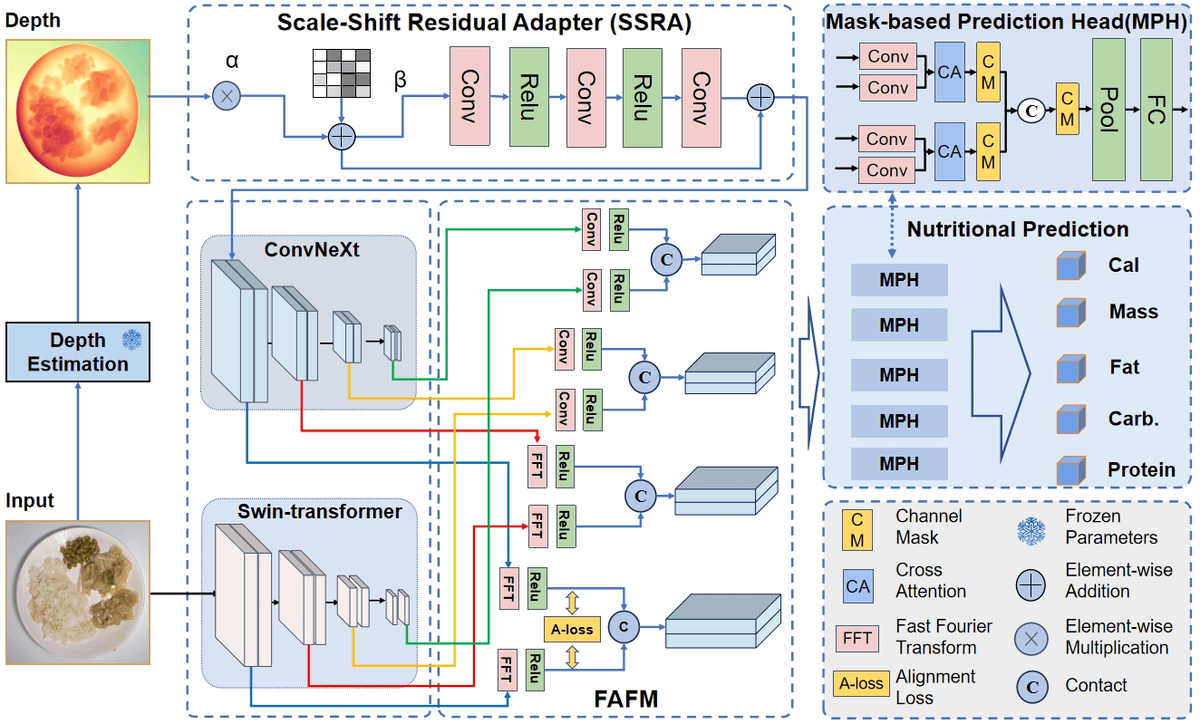
- Pipeline refines Depth Anything v2 output, fuses RGB and depth via FFT frequency bands.
- Beats RGB-D state of the art on Nutrition5k: 16.5% vs 17.3% mean PMAE.
- Code and dataset released on GitHub.
Estimating calories from a photo of your dinner sounds simple until you try it. Portion size, hidden ingredients, and the sheer visual complexity of home cooking have kept most reliable methods tethered to depth cameras. A team from Yunnan University and the Chinese Academy of Sciences is trying to cut that cord with OmniFood8K, a new dataset and model that predicts calories, mass, fat, carbs, and protein from a single RGB image, outperforming prior methods that require depth sensors.
The paper was accepted to CVPR 2026 as a highlight, and the authors have released both the code and dataset.
The blind spot in food AI
Existing food datasets skew heavily toward Western cuisines, with limited representation of Chinese food, whose diverse ingredients and non-standardized preparation make quantitative nutritional analysis particularly challenging. Hardware is the other bottleneck. Many advanced approaches rely on depth maps from specialized cameras for accurate nutrition estimation, while real-world food photos come from ordinary RGB phone cameras, restricting practical adoption.
OmniFood8K attacks both problems. The dataset comprises 8,036 food samples representing commonly consumed Chinese dishes, collected from real-world cooking scenarios including raw ingredients, structured recipes, cooking videos, and final dish presentations. Raw ingredients were first weighed and photographed, followed by video recording of the cooking process and textual documentation of the recipes. The prepared food was then captured simultaneously from six viewpoints at a horizontal height of 50 cm.