
York University Study Reveals AI Expertise Takes Five Sessions to Matter
A CHI 2026 study tracked 12 UX pros over five sessions with novice and expert-style AI assistants, revealing how trust and workflow shift with familiarity.
 Pro
Takeaways
- CHI 2026 study tracked 12 UX evaluators using novice-style and expert-style conversational AI assistants over five sessions
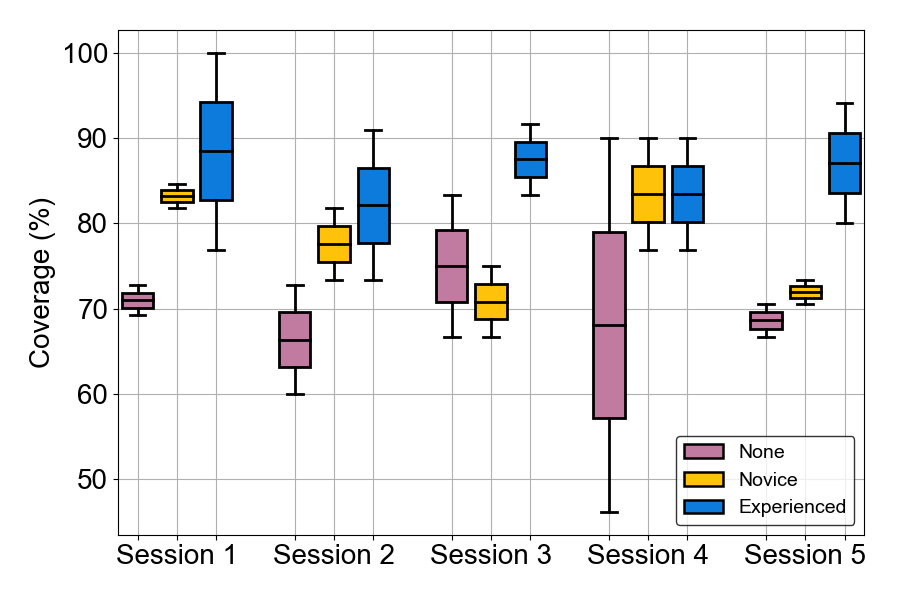
- Perceived expertise differences were invisible early but decisive by study end, favoring the Experienced CA
- Trust followed a U-shape: novelty in session one, dip in session two, recovery afterward
- Evaluators collapsed the standard two-pass video review into a single AI-assisted pass
- Suggestion quantity masked accuracy differences early, a warning for AI product demos
- Builds on Kuang's prior CHI 2024 work on proactive dialogue timing in UX evaluation
Watching a usability test video and cataloguing every fumble, hesitation, and misclick is one of the more tedious jobs in product design. A new CHI 2026 paper from Emily Kuang and collaborators at York University, HKUST Guangzhou, Google DeepMind, and RIT asks what happens when a conversational AI sits next to the evaluator, and whether framing that AI as a novice or a seasoned expert changes how people work.
Perceived expertise matters, but not on day one. Evaluators could not tell the two assistants apart at first, went through a slump in trust after the novelty wore off, and only after five sessions did they consistently rate the expert-style assistant as more efficient, trustworthy, and comprehensive.
Why usability analysis needs help
Analyzing usability recordings is labor-intensive, time-consuming, and intricate, and the results are notoriously inconsistent across reviewers. This is the well-documented evaluator effect, where individual differences among reviewers lead to inconsistent identification and interpretation of usability problems. Two qualified UX researchers watching the same recording often flag different issues, which undermines the whole point of running a study.
Conversational assistants powered by LLMs are an obvious candidate to smooth this out, but prior work in this line from Kuang has mostly looked at one-shot factors like voice versus text modalities, and whether AI suggestions arrive before, during, or after a usability problem. Nobody had tested what happens across many sessions, when the initial excitement fades and evaluators actually have to live with the tool.
The setup
The team built a Usability Analysis Tool with three modes: no conversational assistant as a baseline, a Novice CA, and an Experienced CA. The two assistants were deliberately engineered to feel different along two axes: how many suggestions they offered, and how accurate those suggestions were. The Experienced CA gave fewer, sharper responses. The Novice CA was chattier and less reliable.
Twelve UX evaluators worked through 15 usability videos across all three conditions, in a within-subjects design that stretched to six hours per participant across five sessions. The researchers captured three layers of data:
- Behavioral logs: number of passes through each video, and how often evaluators accepted the AI's suggestions
- Subjective ratings after each session covering trust, perceived efficiency, and comprehensiveness
- Semi-structured interviews to catch the reasoning behind behavior changes
The trust curve nobody predicted
The headline behavioral result is a U-shape. A novelty effect drove lower perceived efficiency and trust in session two, which then recovered over time. Evaluators started enthusiastic, hit a wall once the sheen wore off and the AI's quirks became visible, and then rebuilt confidence as they learned when to lean on it and when to override it.
Novelty effects are common in AI tool studies, but they usually show up as a decline from an inflated baseline. Here the recovery is what makes the curve interesting, and it lines up with a broader pattern: the desire to use a new technology runs high at first and then diminishes, tied to a stress response where users focus harder, embrace trial and error, and perceive higher performance. Once that adrenaline fades, real calibration begins.
From two passes to one
The efficiency gains came from a workflow shift. Evaluators traditionally watch a usability video twice, once to get a feel for it and again to systematically log problems. With the AI riding along, they collapsed this into a single pass, using the assistant's running suggestions as a scaffold rather than doing an independent first read.
That is a meaningful change to a workflow that mirrors the recommended practice of independently evaluating the video before engaging in collaborative analysis with another UX researcher to improve reliability. Whether one-pass analysis with an AI reaches the same reliability bar as two independent human passes is exactly the kind of question the paper's design implications point toward.
Expertise: invisible at first, decisive later
Early sessions gave the two assistants nearly identical ratings. By the end of the study, evaluators rated the Experienced CA as significantly more efficient, trustworthy, and comprehensive. AI expertise reads as a lagging trait, something users perceive only after enough interactions to see the pattern of good and bad answers.
The paper title captures the tone of the interviews: the assistant became a buddy, but not one the evaluators were afraid to disagree with. That maps onto the concept of calibrated trust, where reliance tracks actual capability rather than surface polish or verbosity.
What is actually new here
Most human-AI collaboration studies run for a single session, which is exactly the window where novelty effects distort the data. The real contribution of this work is longitudinal:
- Perceived AI expertise is a lagging indicator, not a leading one, so short studies systematically underestimate it
- Suggestion volume can mask accuracy differences early, which has implications for how vendors demo AI features
- Users restructure their own workflow (two-pass to one-pass) in response to AI presence, which changes downstream reliability assumptions
- A dip in trust in session two is not a failure signal, it is calibration in progress
Where it applies and where it does not
The findings are most directly useful for teams building AI copilots for expert analytic work: UX research platforms, qualitative coding tools, medical chart review, legal document review, anywhere a human is looking at time-series evidence and cataloguing events. The design lesson is that a chatty, high-volume assistant may test well in a demo but lose to a quieter, more accurate one over weeks of use.
The study's limits are worth naming. Twelve participants and 15 videos is small, the CAs were engineered wizard-of-oz style rather than being production LLM systems, and the domain is one where ground truth is itself contested. There is no released code or model, since this is an HCI study rather than a system paper, so what practitioners take away is the experimental design and the trust curve, not a repo to pull.
For anyone shipping AI features into professional workflows, the most actionable finding is the simplest one: run your user studies longer than one session, and treat the mid-study trust dip as a signal that calibration is happening, not that the product is failing.