
York University's RAISE Framework Tackles Safety Risks in Voice-Controlled Self-Driving Cars
A new framework called RAISE proposes safety case patterns for autonomous driving systems that take natural language instructions from users.
 Pro
Takeaways
- RAISE is a new safety case framework specifically for Vision-Language-Action driving systems that accept natural language instructions.
- Traditional ML safety methods do not address hazards from user instructions entering the multimodal control loop of autonomous vehicles.
- The approach extends Hazard Analysis and Risk Assessment with Safe Events describing outcomes of safe instructions.
- Two GSN argument patterns cover rejecting dangerous instructions and accepting adequate ones, with placeholders for system-specific evidence.
- Case study demonstrated on SimLingo, the camera-only VLA model that won the CARLA challenge 2024.
- Currently manual, single case study only, with no coverage of adversarial language attacks or ethical trade-offs.
Autonomous driving stacks are quietly changing shape. Instead of a fixed pipeline that only reads sensors, a new class of models called Vision-Language-Action (VLA) systems takes a camera feed plus a passenger's spoken instruction and turns both into steering and throttle commands. A new paper from York University and the National Institute of Informatics argues that this shift breaks the safety assumptions traditional automotive engineering was built on, and proposes a framework called RAISE to fix it.
When the passenger joins the control loop
VLA models fuse three jobs into one network: perceiving the scene, interpreting language, and generating an action. A vehicle can read its surroundings, plan a path, and explain in natural language what it is about to do, which helps passengers follow along. Systems like SimLingo and LMDrive have shown this works well enough to win competitions. SimLingo runs on a vision-language model using only cameras, no LiDAR, and took first place at the CARLA Challenge 2024 with state-of-the-art results on the simulator's Bench2Drive benchmark.

The catch is that the passenger now sits inside the control loop. A voice instruction like "turn right here" or "just go" flows into the same multimodal reasoning that produces the trajectory. If the model complies with a request to reverse without checking the situation, or overtakes when it should not, people get hurt. Traditional ML safety assurance methods, built for perception or trajectory prediction modules, lack the vocabulary to argue that a system correctly rejects a bad instruction.
Rethinking hazard analysis around safe events
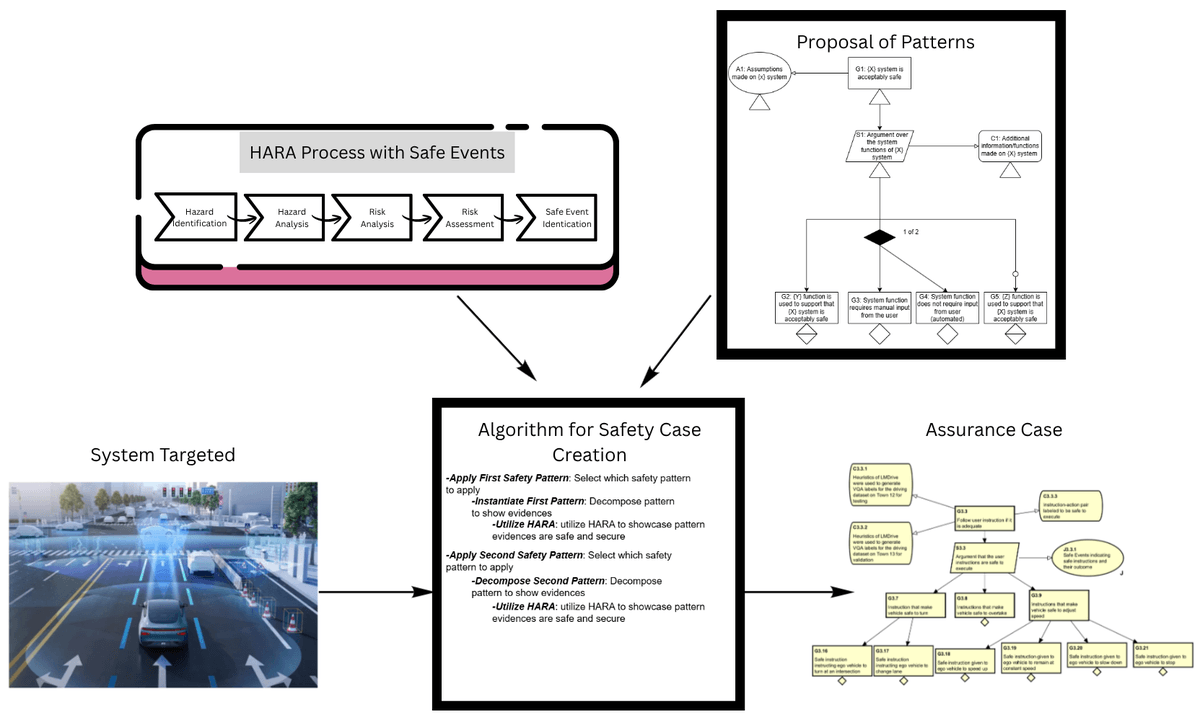
The authors' answer, RAISE (assuRance of vlA-based drIving SystEms), layers three pieces on top of the standard automotive safety toolkit. The first extends Hazard Analysis and Risk Assessment (HARA), the industry-standard method for enumerating what can go wrong in a car. HARA normally asks only what happens when a function fails. RAISE adds the notion of Safe Events, which describe what a safe instruction should produce in each operational scenario.
For SimLingo, this produced a matrix of five system functions (including "reject dangerous instructions") crossed with nine operational scenarios: intersections, lane changes, U-turns, overtaking, reversing, and others. Each cell is either a hazardous event with a severity and controllability rating, or a safe event with an expected outcome.
Two patterns: reject and accept
The second piece is a pair of reusable argument templates written in Goal Structuring Notation (GSN), the graphical language safety engineers use to lay out claims, strategies, and evidence. The two patterns are:
- RI (Reject Instruction) for arguing that the system refuses dangerous commands, such as a passenger telling the car to accelerate into an occupied intersection.
- AAI (Accept Adequate Instructions) for arguing the system correctly follows safe commands, which matters because a car that ignores every instruction fails its mission just as badly as one that follows bad ones.
Each pattern contains hot spots, placeholders that safety analysts fill in with system-specific evidence when they instantiate the pattern for a real vehicle.

The algorithm that stitches it together
The third piece is an algorithm that walks a safety analyst through building the full case. It reads the system documentation, runs the extended HARA, then iteratively picks patterns from the library and decomposes each goal into sub-goals until every leaf is backed by concrete evidence from the system under analysis. The output is a top-level claim that the VLA system is sufficiently safe, supported by a tree of arguments traceable back to specific hazards and scenarios.
What was actually demonstrated
The evidence is a single worked case study on SimLingo rather than a large empirical evaluation. The authors instantiated both patterns to argue safety for the top-level goal that SimLingo can drive safely in CARLA, with sub-goals covering intersection handling, lane changes, and speed control. Their complete HARA results sit on an anonymous GitHub repository, though there is no code release for the RAISE algorithm itself yet.
The limits deserve honesty. RAISE is a manual process aimed at safety engineers rather than an automated verifier. The patterns cover instruction acceptance and rejection, leaving out adversarial language attacks, ambiguous phrasing, and ethical trade-offs, all of which the authors flag as future work alongside case studies on EMMA, OpenDriveVLA, and DiffVLA.
Why this matters beyond the paper
The real contribution is conceptual. Automotive safety has spent a decade figuring out how to argue about ML perception modules. RAISE is one of the first attempts to extend that vocabulary to systems where a human utterance is a first-class input to the control loop. If Toyota, Tesla, or Waymo ship an instruction-driven vehicle, regulators will want structured arguments about how it handles "just merge already" from an impatient passenger. This paper is an early sketch of what those arguments look like.