
York University's EMFusion Beats 5G Radiation Forecasting Baselines by 24%
EMFusion uses conditional diffusion models to forecast per-frequency, per-operator EMF exposure in 5G networks, beating baselines by up to 24% on probabilistic accuracy metrics.
 Pro
Takeaways
- EMFusion is a conditional diffusion model for forecasting per-frequency, per-operator EMF exposure in wireless networks -- the first application of conditional diffusion to this domain.
- It beats the best baseline by 23.85% in CRPS (probabilistic accuracy) and 13.93% in NRMSE across 29 frequency channels from 4 Italian operators.
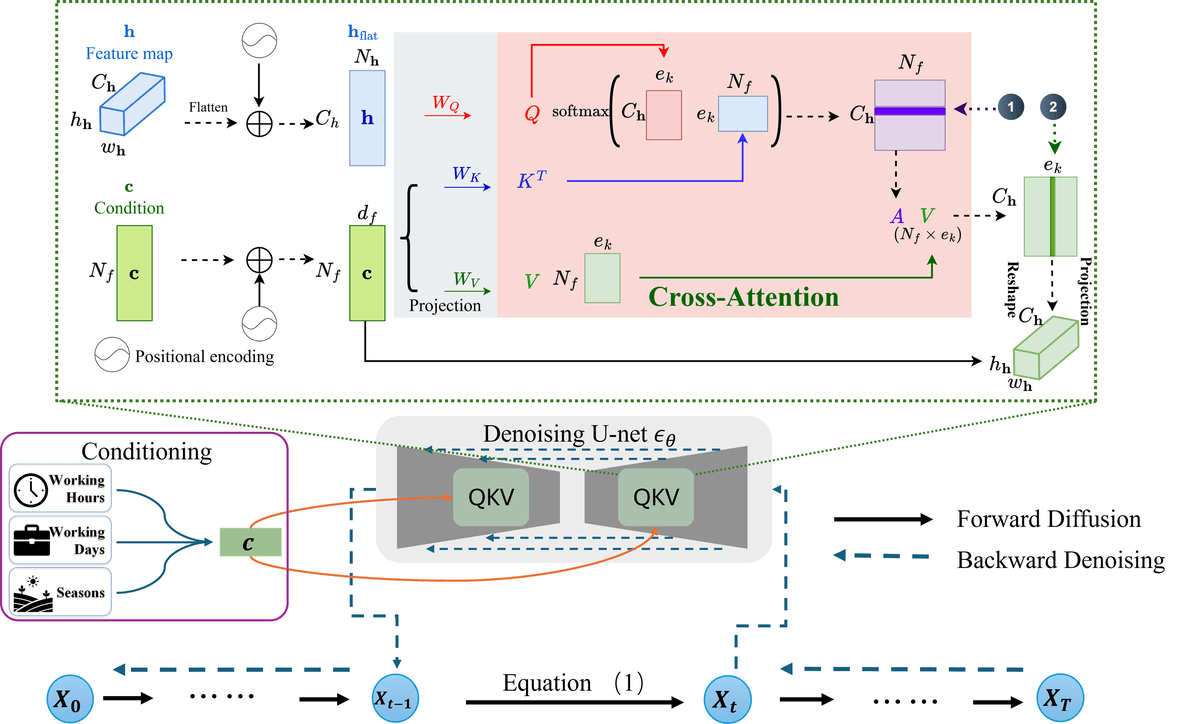
- A residual U-Net backbone with cross-attention dynamically injects calendar context (working hours, season, holidays) into the denoising process at multiple scales.
- Forecasting is framed as temporal inpainting, letting the model handle missing or irregular sensor data without a separate imputation step.
- The working-hour condition alone outperforms season, working-day, and multi-condition combinations -- simpler context beats richer context here.
- Prediction intervals are empirical, not calibrated; PICP sits at ~50-65% vs. the nominal 80% target -- a known limitation flagged by the authors.
As 5G infrastructure keeps densifying, regulators and network operators face a growing headache: knowing not just how much electromagnetic field (EMF) exposure a site is generating, but which operator and which frequency band is responsible, and what those levels will look like tomorrow. A new paper from researchers at York University, Huazhong University of Science and Technology, and the University of Rome Tor Vergata introduces EMFusion, a conditional diffusion-based forecasting framework that tackles this problem head-on.
The problem nobody was solving
Until now, virtually all EMF forecasting research treated the problem as univariate: aggregate the signal across all frequencies into one wideband number, then predict that single time series. The rapid growth in wireless infrastructure has increased the need to accurately forecast EMF levels for compliance, but existing studies rely on univariate forecasting of wideband aggregate EMF data, while frequency-selective multivariate forecasting is needed to capture the inter-operator and inter-frequency variations essential for proactive network planning.
That gap matters for two concrete reasons. First, to verify compliance with exposure standards enforced by local or national authorities, measurement or numerical simulation assessment is normally carried out by network operators. Second, rapidly evolving radio-frequency technologies pose a challenge to accurate prediction of EMF exposure, and simple ray-tracing evaluation recommended by current guidelines does not take into consideration the radically different network architectures and radio technologies adopting 5G standards. A wideband aggregate number can mask a single operator's band approaching its regulatory ceiling while others stay well below it.

The market pressure is real. As telecommunications operators deployed 5G infrastructure across developed and emerging markets, the electromagnetic radiation landscape became substantially more complex, with base stations now operating across multiple frequency bands simultaneously, including sub-6 GHz and millimeter wave frequencies, requiring sophisticated monitoring capable of measuring multi-band electromagnetic exposure. The global electromagnetic field monitoring market was valued at $2.8 billion in 2025 and is projected to reach $5.2 billion by 2033, expanding at a CAGR of 8.4%.
Why standard deep learning falls short
The paper identifies four compounding challenges that make this problem hard for conventional architectures:
- Correlated dynamics across bands: EMF measurements across different frequencies, operators, and wireless technologies exhibit correlated temporal patterns that aggregate forecasting cannot capture.
- Uncertainty quantification: Regulatory decisions require probabilistic intervals, not point estimates. RNNs and Transformers are primarily designed for deterministic prediction and often produce overconfident forecasts.
- Contextual dependence: EMF exposure follows human activity patterns -- working hours, holidays, and seasons all drive device usage and, consequently, base station power output.
- Missing data: Real-world monitoring systems contain gaps from sensor outages and operational constraints. Most forecasters assume clean, regularly sampled inputs.
EMFusion: diffusion as a forecasting engine
EMFusion reframes time-series forecasting as a generative problem. Instead of predicting a single future trajectory, it learns the full conditional distribution of future EMF values given historical observations and external context. The architecture has three core components working together.
The backbone: residual U-Net. The noise-prediction network is a symmetric encoder-decoder U-Net with residual blocks. Each block applies GroupNorm, SiLU activation, and 3x3 convolutions, then injects a sinusoidal timestep embedding so the network knows which step of the denoising process it is at. In the multivariate setting, 2D convolutions act jointly on the time and frequency dimensions simultaneously, letting the model learn cross-band correlations.
Context injection: cross-attention. Rather than simply concatenating calendar features to the input, EMFusion uses a cross-attention mechanism at multiple layers of both the encoder and decoder. The feature map from the U-Net acts as the Query, while the external condition vector (working hours, season, holiday flags) provides the Keys and Values. This lets the model dynamically attend to the most relevant contextual signals at different temporal scales -- a fundamentally different approach from static feature concatenation.
Forecasting as inpainting. During inference, the model treats the full sequence [X_past, X_future] as a partially observed image. Known historical values are "clamped" back at each denoising step, while the future window is iteratively filled in from noise. This masked imputation strategy means the model handles irregular or missing past measurements gracefully -- it just treats them as additional unknowns to fill in.
To generate probabilistic intervals, EMFusion runs the reverse diffusion process N=100 times, producing an ensemble of 100 independent future trajectories. Kernel Density Estimation (KDE) is then applied to the ensemble at each forecast horizon to reconstruct a smooth predictive distribution, from which any confidence interval can be extracted without assuming Gaussian outputs.

The dataset: eight months at a hospital rooftop
The received power measurements were collected continuously from July 26, 2023 to March 10, 2024 across 29 frequency channels spanning from 9 kHz to 6 GHz, organized according to the predefined frequency bands of major Italian network operators and corresponding cellular technologies. The four operators -- Iliad, TIM, Vodafone (VF), and Wind3 (W3) -- cover 2G, 3G, 4G, and 5G bands. The monitoring chain uses an omnidirectional Keysight N6850A antenna connected to an Anritsu MS27102A spectrum analyzer running unattended on the rooftop.
The model uses a 7-day lookback window (1,344 time steps at 7.5-minute resolution) to forecast the next 24 hours (192 steps). The dataset is split 60/20/20 for train, validation, and test. Three calendar features are used as conditions: Italy_WorkingDay, Italy_WorkingHour (business hours 9am-5pm), and Italy_Season.
Results: context is everything
EMFusion was benchmarked against NF (normalizing flows), IQLSTM, DDPM, VAE, LSTM-Dropout, WGAN, TimeGrad, and the prior state-of-the-art EMForecaster. The key metrics are CRPS (Continuous Ranked Probability Score -- a single number that scores the full predictive distribution, lower is better) and NRMSE.
The headline numbers:
- EMFusion outperforms the best baseline by 23.85% in CRPS and 13.93% in NRMSE.
- The working-hour condition is the single most valuable context signal, outperforming season, working-day, and multi-condition combinations.
- Multivariate EMFusion with working-hour conditioning achieves the lowest ND, NRMSE, and MAPE across all compared methods when averaged over all carriers.
- Legacy bands (2G, 3G, 4G) see the largest gains; 5G remains the hardest to forecast due to more volatile traffic patterns.
One important caveat: EMFusion's Prediction Interval Coverage Probability (PICP) sits in the 50-65% range rather than the nominal 80% target. The model's intervals are empirical uncertainty estimates, not fully calibrated confidence intervals. DDPM and NF produce wider intervals that cover more ground but at the cost of much worse CRPS -- they are essentially hedging by being vague. EMFusion is sharper and more accurate, but users should not treat its 80% intervals as statistically rigorous 80% guarantees.

The real breakthrough
The genuine novelty here is not just better numbers -- it is the formulation itself. To the best of the authors' knowledge, conditional diffusion models have not been applied to time-series forecasting in wireless networks in general, nor to EMF forecasting in particular. By treating the forecasting problem as conditional inpainting, EMFusion inherits all the flexibility of diffusion models: it handles missing data, generates full distributions rather than point estimates, and can be conditioned on arbitrary external signals without architectural changes.
The practical implication is a shift from retrospective compliance reporting to proactive exposure management. Forecasted EMF trajectories can be plugged directly into network optimization pipelines as future constraints -- letting operators adjust transmit power, beamforming, or scheduling before a regulatory threshold is approached, rather than after a violation is logged.
Limitations and what comes next
The current evaluation is limited to a single monitoring site at the University Hospital Tor Vergata in Rome. The rolling-window analysis confirms temporal consistency within this environment, but cross-site generalization is untested. The authors also note that multi-conditioning (combining season + working day) actually degrades performance -- the cross-attention mechanism struggles when certain contextual states are underrepresented in training data, a practical concern for rare events like holidays.
No code or pretrained model has been publicly released alongside the paper. The dataset itself was described as open-source by the authors, collected in collaboration with ARPA-Lazio. Future work targets multi-site datasets, richer contextual features, and closed-loop integration with EMF-aware network control systems.