
York Researchers Turn Vague AI Ethics Rules Into Machine-Checkable SLEEC Code
A team from York, Toronto, and Polytechnique Montréal proposes a five-stage engineering process to convert abstract AI ethics principles into verifiable rules.
 Pro
Takeaways
- York, Toronto, and Polytechnique Montréal researchers propose a five-stage process for operationalising AI ethics.
- SLEEC covers social, legal, ethical, empathetic, and cultural norms, translated from abstract principles into checkable rules.
- A when-then-unless DSL encodes triggers, guards, responses, and defeaters that formal tools can analyse.
- Tools SLEEC-TK and LEGOS-SLEEC detect conflicts, redundancies, insufficiency, and over-restrictiveness in rulesets.
- An ALMI care-robot example shows how checkers catch subtle timing conflicts human reviewers would miss.
- Open challenges: value conflicts, timing scales, runtime adaptation, and shared normative-requirement repositories.
Everyone from the OECD to UNESCO to the EU has published lofty principles about how AI should respect privacy, autonomy, and human dignity. The problem: none of these documents tell an engineer what to actually write into a care robot's control logic when a user falls on the floor and refuses help. A new survey paper from the University of York, University of Toronto, and Polytechnique Montréal proposes a systematic engineering process to close that gap, translating high-level norms into machine-checkable rules that can be verified before deployment.
The authors call the target class of constraints SLEEC norms, short for social, legal, ethical, empathetic, and cultural. The tutorial distinguishes between high-level normative principles such as autonomy, non-maleficence, and privacy, and the specific normative requirements (SLEEC rules) that operationalise them within a given context, which are significantly more difficult to elicit, formalise, and verify. Traditional requirements engineering was not built for this kind of work, which involves ethicists, lawyers, regulators, sociologists, and end users arguing over subtle value conflicts.
Five stages from principle to deployment
The proposed workflow is a five-stage pipeline with feedback loops. If any stage fails and cannot be salvaged by revisiting an earlier one, the agent does not get deployed, which the authors treat as a legitimate and desirable outcome.

- Capability specification. Enumerate what the agent can perceive and do, and identify which capabilities either trigger normative concerns (a camera implies privacy) or are needed to satisfy them (a comms channel to alert carers).
- SLEEC requirements elicitation. Stakeholders map high-level principles to actionable proxies (e.g. spoken assent as a proxy for autonomy), then write rules in a domain-specific language.
- Well-formedness checking. Formal tools scan the ruleset for conflicts, redundancies, insufficiency, and over-restrictiveness.
- SLEEC-aware implementation. Rules become training-data schemas plus runtime guardrails that sit alongside the agent.
- Compliance verification. Model checking proves the agent conforms to its ruleset, or produces counterexample traces when it does not.
The DSL that makes rules checkable
The heart of the approach is a small language with a when-then-unless shape. A rule names a trigger event, an optional guard over sensor measures, a required response, and any number of defeaters, which are exceptions of the form unless [condition] then [alternative response]. This structure was co-defined with ethicists, lawyers and stakeholders from health and social care, and uses the CSP refinement checker FDR4 to identify redundant and conflicting rules in a SLEEC specification via the SLEECVAL and SLEEC-TK tooling.
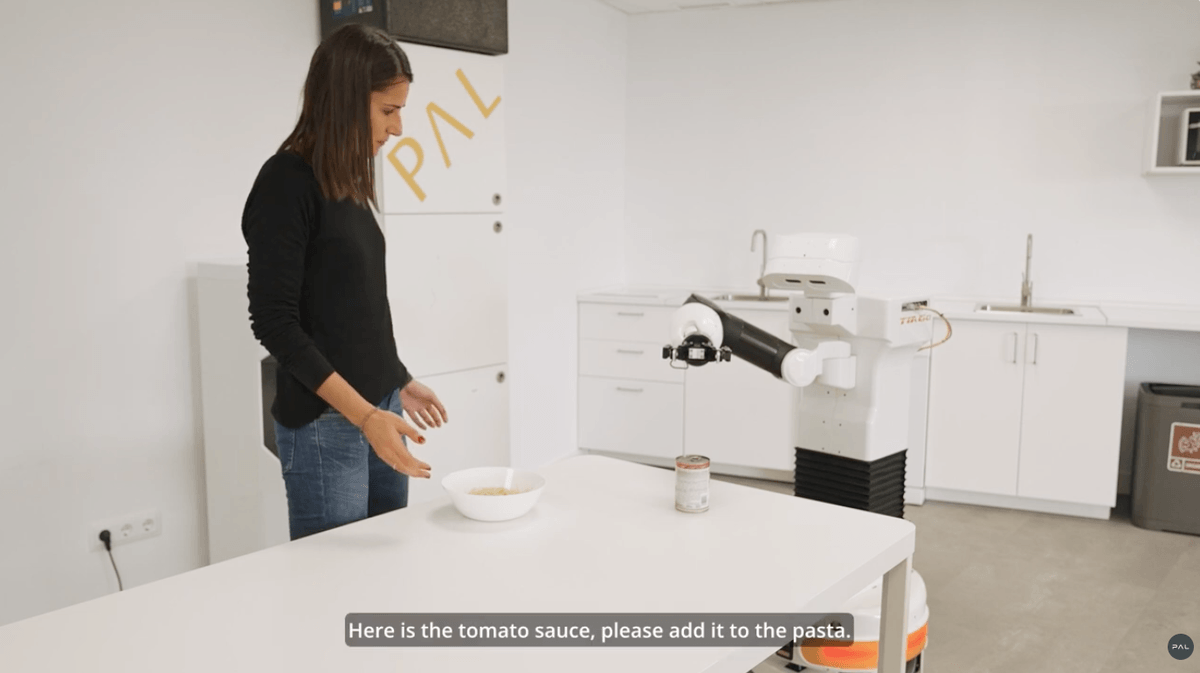
The paper walks through a concrete example using the ALMI assistive-care robot, a TIAGo mobile manipulator that helps a user with mild cognitive impairment cook pasta and calls emergency services if the user falls. Three sample rules illustrate the mechanics:
R1 when MealTime then InformUser within 10 minutes
   unless userOccupied then RemindLater
R2 when SmokeDetectorAlarm then CallEmergencySupport within 2 minutes
R3 when HumanOnFloor then CallEmergencySupport within 4 minutes
   unless (not humanAssents) then not CallEmergencySupport within 4 minutes
Where the rules break
Running these three rules through the toolchain surfaces two problems that a human reviewer would probably miss. The process-algebraic checker finds a timing conflict: if a smoke alarm fires within three minutes of a fall event where the user withheld assent, R3 blocks the emergency call R2 mandates. Separately, a logic-based tool called LEGOS-SLEEC catches an over-restrictiveness bug, because an unresponsive person on the floor cannot give assent, so the robot would never call help for the very scenario it was built to handle. The fix requires adding a new userResponsive measure and retraining perception to detect it.
Verification in stage five uses tock-CSP, a timed process algebra, together with the RoboChart diagrammatic modelling language. When an engineer accidentally lets the robot finish fetching ingredients before responding to a fall, the checker returns a counterexample trace with five tock ticks between the trigger and response, exceeding the four-minute bound.
What is still hard
The authors are candid that the process is far from complete. Several problems remain genuinely open:
- Reifying principles. Turning UNESCO-level phrases like human dignity into rules for a specific dressing robot is application-specific labour with no shortcuts.
- Value conflicts. Transparency can undermine privacy, safety can undermine autonomy, and there is no formal stopping criterion for when a ruleset is sufficient.
- Timing mismatch. Consent is renewed over days, but sensor loops run in milliseconds, and reconciling those scales is non-trivial.
- Runtime adaptation. Static rulesets cannot handle unseen cultural preferences, and dynamic adaptation risks breaking the formal guarantees earned at development time.
Who this is useful for
This is not a model release or a repo drop, it is a review paper and a research agenda, but it does point at concrete open-source tools (SLEEC-TK, LEGOS-SLEEC, RoboTool) that teams building assistive robots, medical decision systems, or other regulated autonomous agents can pick up today. Anyone shipping an agent into a domain covered by the EU AI Act will eventually need something like this pipeline. And for teams working on runtime guardrails or LLM-based agents, the DSL and its checkers offer a more rigorous alternative to the ad-hoc prompt-and-pray approach that dominates current practice.