
Yonsei and UC Berkeley's PE-SAC Fixes Broken Symmetry in Robot Learning
A new reinforcement learning framework selectively enforces symmetry only where it holds, preventing local violations from corrupting the entire value function.
 Pro
Takeaways
- ICLR 2026 paper introduces Partially Group-Invariant MDPs to handle local symmetry-breaking in reinforcement learning.
- A learned gate routes each state-action pair to either equivariant or standard Bellman updates.
- PE-DQN and PE-SAC outperform strict and approximate-equivariant baselines across Grid-World, MuJoCo, and manipulation tasks.
- Gate is trained via disagreement between an equivariant and an unconstrained one-step dynamics predictor.
- PE-SAC remains stable on UR5e Reach where strictly equivariant SAC collapses due to free orientation.
- Paper on arXiv, project page at perl_page, code coming soon.
Symmetry has long been one of the most reliable tricks in machine learning. If a task looks the same after you rotate it, a model that knows about rotations can learn from far fewer samples. But in reinforcement learning, that assumption tends to fall apart the moment you introduce an obstacle, a joint limit, or a floor. A team from Yonsei University and UC Berkeley just proposed a fix: apply equivariance only in the parts of the state space where symmetry actually holds, and quietly turn it off everywhere else.
Their paper, Partially Equivariant Reinforcement Learning in Symmetry-Breaking Environments, was accepted at ICLR 2026. It introduces a framework called the Partially Group-Invariant MDP (PI-MDP) and two practical algorithms, PE-DQN and PE-SAC, that consistently outperform both strict equivariant baselines and looser approximate-equivariant methods across grid worlds, MuJoCo locomotion, and robotic manipulation.
Why strict symmetry is fragile
Equivariant RL, in short, means the policy and value function are structured so that if you rotate the world, the action rotates with it. This is enormously helpful for sample efficiency because the agent effectively sees every symmetric variant of a state for free. Most existing equivariant RL methods are grounded in the notion of a group-invariant Markov Decision Process (MDP), where invariance of the reward and transition functions implies symmetry in the optimal policy.
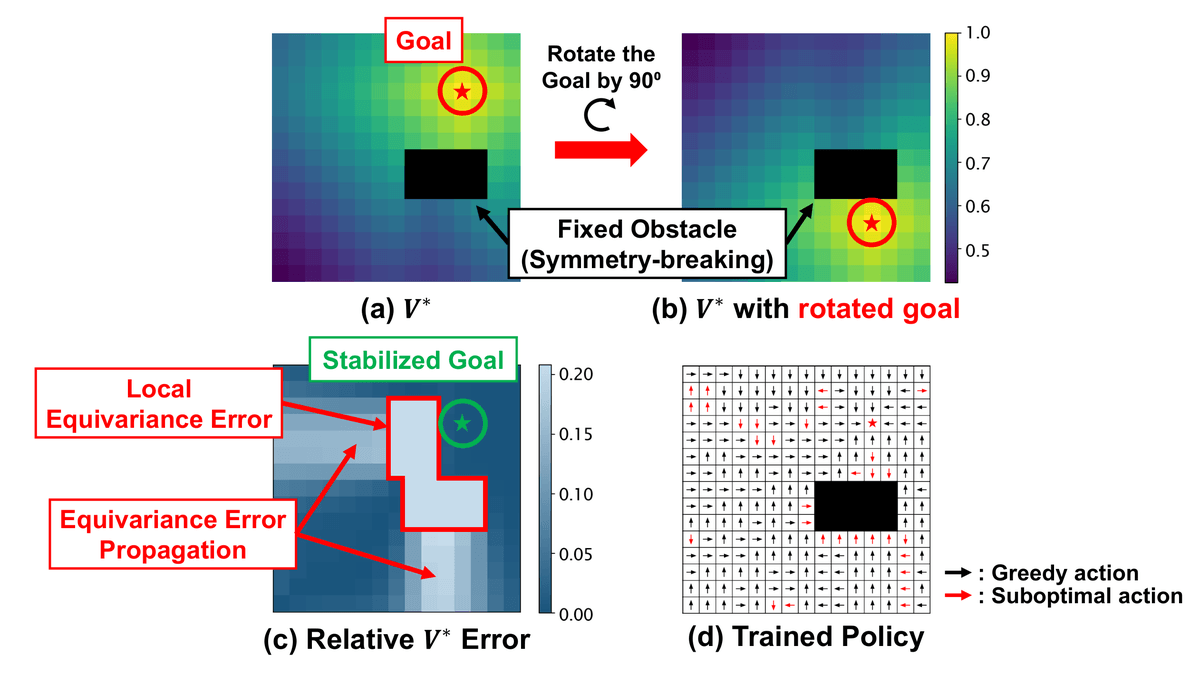
The problem is that real environments almost never satisfy this cleanly. Real-world environments introduce symmetry-breaking factors such as dynamics, actuation limits, or reward shaping. A wall, gravity, or a kinematic singularity can violate rotational symmetry in just a few states. In a standard equivariant setup, that local violation does not stay local. Under the Bellman backups based on the group-invariant MDP, even local violations of symmetry can introduce errors that propagate across the state and action space, leading to degraded value estimates, suboptimal policies, or even training failure.
The authors formalize this with a bound showing that a one-step mismatch δ(s,a) gets amplified by 1/(1-γ), meaning a small pocket of broken symmetry can shift the entire learned value function. Prior fixes relaxed equivariance globally, softening the architecture everywhere, which sacrifices the sample efficiency gains that made equivariance appealing in the first place.

A gate that knows when symmetry lies
The core idea of the PI-MDP framework is a learned gating function λ(s,a) that decides, for each state-action pair, whether to trust the symmetric shortcut or fall back to a standard Bellman update. The reward and transition kernels are blended pointwise: R_H = (1-λ)R_E + λR_N, and similarly for the transition kernel. When λ=0, the update behaves like a fully equivariant one. When λ=1, it routes to the true environment's dynamics.
The theoretical payoff is clean: the value gap vanishes whenever, at every state-action pair, either the gate routes to the true MDP or the group-invariant approximation coincides with it. In practice the authors use hard binary gating for stability, sampled per minibatch and treated with stop-gradient during critic and actor updates.
Learning where symmetry breaks
The trick is figuring out the value of λ(s,a) without an oracle. The authors train two one-step dynamics predictors side by side:
- An equivariant predictor constrained to respect the group symmetries.
- An unconstrained predictor free to model whatever the environment actually does.
Where symmetry holds, both predictors agree. Where it breaks, the equivariant one can only capture the group-averaged surrogate while the unconstrained one tracks the real dynamics, so their predictions diverge. This disagreement d(s,a) tends to be larger precisely in regions where the equivariant and true reward or transition functions disagree, providing an indirect detector of symmetry-breaking. High-disagreement samples in the upper tail of the empirical distribution are used as pseudo-labels for training the gate with binary cross-entropy.
The gate is then wired into the critic as a mixture Q = (1-λ)Q_E + λQ_N and, on the policy side, through a state-only gate that arises naturally from SAC's information projection as a product-of-experts between an equivariant policy and an unconstrained one.
What the numbers show
The authors test PE-DQN and PE-SAC across five environments with increasing symmetry-breaking severity:
- Grid-World with obstacles: With no obstacles, PE-DQN converges to λ near 0 and behaves like a purely equivariant agent, matching strictly equivariant DQN. As obstacles are added, strictly equivariant DQN degrades much more rapidly while approximately equivariant methods offer only minor gains.
- MuJoCo locomotion: PE-SAC matches or beats baselines on Hopper and Ant. On Swimmer, where symmetry is nearly exact, strict equivariance wins slightly, though PE-SAC stays competitive.
- Manipulation: In UR5e Reach, where symmetry-breaking is substantial due to realistic dynamics and free orientation, the strictly equivariant and approximately equivariant SAC variants become unstable or collapse, whereas PE-SAC remains stable and attains the best overall returns.
They also stress-test the gate with reward-level symmetry-breaking (passable obstacles that return a negative reward) and stochastic transitions, and PE-DQN keeps its lead in both.
Design choices worth flagging
A few implementation details are useful to know if you want to try this:
- Hard gating beats soft gating in practice. Using
λas a continuous mixing weight hurt stability. A binary Bernoulli gate with stop-gradient worked best. - Separate trunks matter. Sharing an equivariant backbone across the critic and policy significantly harmed performance. The authors use fully separate networks for critics, policy, and predictors.
- The
κthreshold is forgiving. The gate uses a z-score cutoff on the disagreement distribution, and ablations show performance is not overly sensitive to it, provided you have a rough sense of whether symmetry violations are sparse or common. - Warm-start the gate. Before the dynamics predictors stabilize, the gate training is disabled to avoid noisy labels.
Where it helps and where it doesn't
The framework is most useful when symmetry is partially present, which is the common case in robotics: manipulation with joint limits, locomotion with contact dynamics, or navigation with fixed obstacles. In those regimes, PE-RL gets to keep the sample-efficiency gains of equivariance in most of the state space while gracefully degrading in the awkward regions.
The authors are candid about the limitations. Training two predictors and two heads increases compute cost, and under pervasive symmetry-breaking, such as gravity acting everywhere, the framework mostly defaults to the non-equivariant network and offers marginal benefit over standard SAC. The OpenReview submission notes that code is coming soon on GitHub. For teams working on robotic control where symmetry is a useful but imperfect prior, this is worth watching.