
Yonsei and Meta Rebuild Surface Scanning With One LED and an Event Camera
A single rotating LED plus an event camera and a small per-pixel MLP recover surface normals under bright light, shadows, and specular highlights.
 Pro
Takeaways
- Event-based photometric stereo replaces multiple synchronized lights with a single LED rotating around the camera's optical axis.
- A per-pixel MLP predicts surface normals from a polarity sum vector, needing no light or threshold calibration.
- Achieves 7.12% lower mean angular error than prior event-based methods (paper).
- Robust in event-sparse regions, high ambient light, and specular scenes where frame cameras saturate.
- Trained on synthetic Blender events, validated on real captures with a DAVIS 346 event camera.
- Trajectory-locked at training time; different rotations require retraining, and no public code released yet.
Reconstructing the fine geometry of a surface from photos is a decades-old trick called photometric stereo: take several images under different light directions, and each pixel's brightness variations reveal which way the surface is facing. It works beautifully in a lab and poorly almost everywhere else. A new paper from Yonsei University and Meta Reality Labs proposes a setup that swaps the multi-light rig for a single rotating LED and a standard frame camera for an event camera, then trains a tiny per-pixel network to read the resulting spikes directly.
The work reports a 7.12% average reduction in mean angular error against the previous best event-based photometric stereo methods, and holds up in places where those methods fall apart: dim regions with almost no events, harsh ambient light, and shiny specular surfaces.
Why the classic setup breaks in the wild
Frame cameras have limited dynamic range, so strong ambient light saturates pixels and destroys the intensity cues photometric stereo depends on. Traditional rigs also require multiple carefully calibrated light sources, which increases system complexity and limits deployment in unconstrained environments. That is why the technique has largely stayed in darkroom demos.
Event cameras sidestep both problems. Instead of exposing frames at a fixed rate, they emit an asynchronous stream of per-pixel events whenever the log intensity changes by a threshold, with a dynamic range around 120 dB versus roughly 60 dB for conventional sensors. Move a light continuously and you get a rich, temporally precise record of how each pixel's brightness ebbs and flows, without ever integrating over an exposure window.

One LED on a belt, one MLP per pixel
The hardware is deliberately minimal: a DAVIS 346 event camera looking down at the object, and a bright LED mounted on a hollow disk driven by a DC motor and timing belt. The disk spins the light around the camera's optical axis at a fixed elevation, tracing a circle roughly once per second. A photointerrupter marks each cycle.
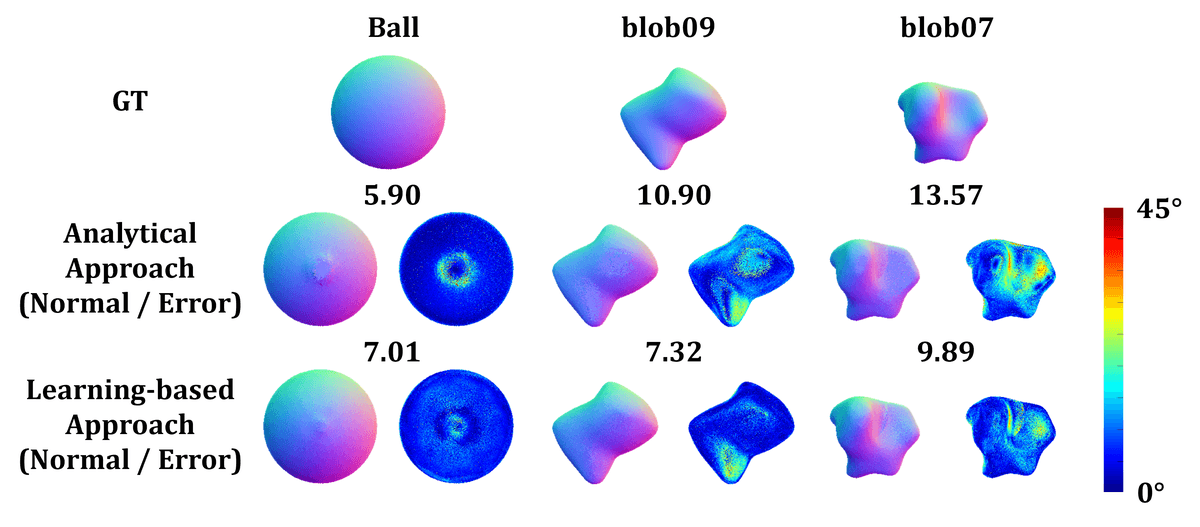
Rather than reconstructing intensity images from the event stream and running a classical solver, the authors reformulate photometric stereo directly in the event domain. Under Lambertian assumptions, the accumulated event polarities over one rotation trace a cosine in time whose amplitude, phase, and offset are algebraic functions of the surface normal. That gives a closed-form analytical solution, but real objects are not Lambertian, so the paper hands the problem to a small network instead.
The input representation is a polarity sum vector: one rotation cycle is chopped into M uniform time bins, and each bin stores the signed sum of events that fired in that pixel during that slice. Because only polarities are used, the network never needs an explicit calibration of light directions or the camera's contrast threshold, since both are absorbed into the learned mapping. Feed this 96-length vector into a per-pixel MLP (five dense layers with 4096/4096/2048/2048/2048 units, Tanh activations, 0.2 dropout) and read off a 3D unit normal.
Training data and numbers
Real event data with ground-truth normals is expensive to collect, so the authors train entirely on synthetic events simulated in Blender from 20 Blobby and 20 Sculpture objects with randomized BRDFs, then test on real captures. Ground-truth normals for real scenes come from 3D-printing the objects and registering the printed geometry to the camera via mutual-information alignment in MeshLab, then rendering normals in Mitsuba 3.
Against the three EventPS baselines (OP, FCN, CNN), the proposed method wins on average across all three test sets:
- DiLiGenT-EV semi-real + CW real: 12.24 degrees MAE vs 12.72 for EventPS-CNN, 14.88 for EventPS-FCN, 16.91 for EventPS-OP.
- CCW real (their own rig): 9.77 vs 9.89 / 11.07 / 13.32 degrees.
- Biggest gains on shiny objects like Cow, Pot2, and Reading, where non-Lambertian effects usually wreck analytic methods.
Where it helps, where it hurts
The most interesting practical result is behavior in event-sparse regions. Where the surface normal points near the viewing direction, the light barely modulates intensity and few events fire. The paper bins pixels by event count and shows the proposed method has the lowest MAE in the sparsest bins, which are precisely where prior per-pixel event methods struggle. Under deliberately overexposed illumination, a frame camera saturates and normal estimates collapse, while the event pipeline still recovers the geometry.
Limitations are honest and worth noting:
- The light trajectory has to be fixed at training and inference. A new elevation or rotation direction means retraining, unlike EventPS which handles arbitrary trajectories through an explicit null-space formulation.
- Errors still concentrate at object silhouettes and steep edges.
- The current setup assumes a single repeatable rotation cycle for time indexing, so multi-view or moving-object capture is out of scope.
The paper does not currently ship code or pretrained weights on arXiv; the network architecture, training recipe, and hardware are described in enough detail to reproduce, but there is no linked repository yet. For anyone building a compact scanning rig for small objects, or trying to do photometric capture outside a controlled studio, the combination of a single rotating LED, an event sensor, and a per-pixel MLP is a striking simplification of a problem that has historically demanded a dome of lights.