
Yazd University's Robot Team Navigates GPS-Dead Zones 56% More Accurately
A distributed EKF framework tracks multiple robots in GPS-denied spaces using LiDAR, event-triggered messaging, and dual static-plus-dynamic landmarks.
 Pro
Takeaways
- Decentralized EKF framework for multi-robot localization in GPS-denied environments: arxiv.org/abs/2603.12075
- 34% RMSE reduction versus centralized cooperative localization; 56% with dual static-plus-dynamic landmarks.
- Robots initialize with arbitrary reference frames; transformation matrices align them automatically.
- Event-triggered messaging cuts communication bandwidth by roughly 65% versus continuous broadcasting.
- Uses ROS message_filters ApproximateTime to fuse 6 Hz encoders with 10 Hz RPLiDAR A2 scans.
- Validated in Gazebo and a real basement with OptiTrack ground truth over ten trials.
Multi-robot teams working in tunnels, warehouses, basements, or underwater share one nasty problem: no GPS, weak radio, and often no shared map to anchor to. A new paper out of Yazd University and collaborators at IST Lisbon and Birmingham tackles this with a decentralized cooperative localization (DCL) framework that lets each robot run its own Extended Kalman Filter locally, exchanging tiny bundles of state information only at the moments when they actually see each other.
The headline number: in real-world basement trials, the decentralized filter cut RMSE by 34% versus a classical centralized cooperative localization baseline, and a variant that also uses static landmarks cut it by 56%.
Why centralized fusion breaks in the field
Cooperative localization, where robots refine their pose estimates through mutual observations, has been studied for two decades. The trouble is that most existing methods assume conditions field robots rarely get: globally aligned coordinate frames known ahead of time, synchronous sensor sampling across the team, and continuous bandwidth to broadcast state. Centralized architectures also introduce a single point of failure.
The other subtle killer is cross-correlation. When two robots update each other's pose from a shared observation, their estimation errors become statistically linked. Ignoring that link, as many lightweight filters do, causes the covariance to shrink artificially and the filter to diverge. Conservative alternatives like covariance intersection preserve consistency but pay for it in accuracy.

How the framework works
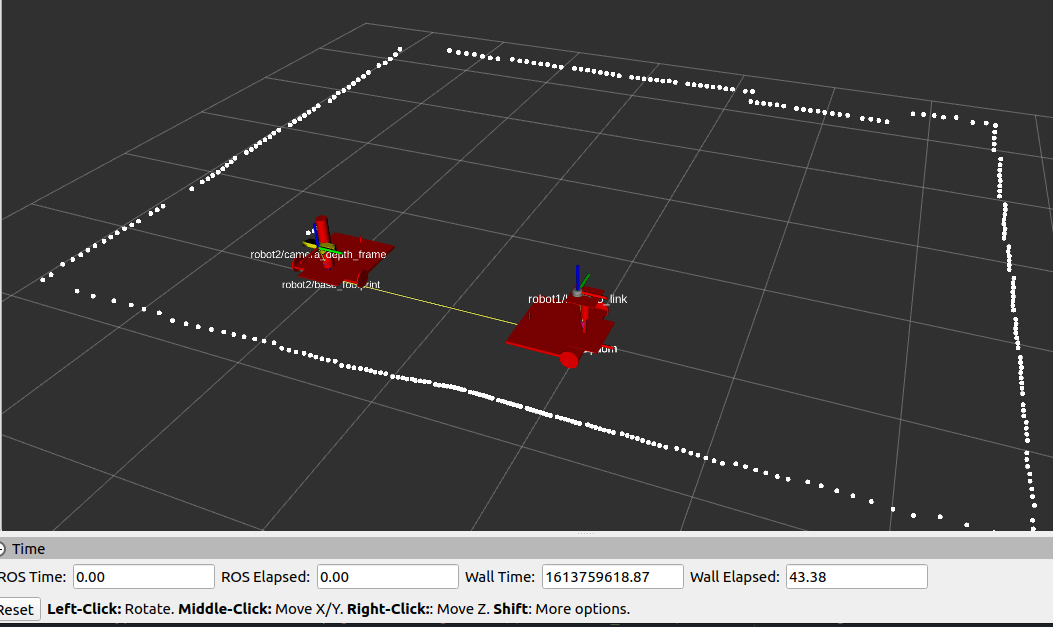
Each robot maintains its own pose, self-covariance, and a cross-covariance term with its partner. Prediction runs locally from wheel-encoder odometry. The interesting part happens when Robot 1's RPLiDAR A2 spots Robot 2, which carries a 12 cm cylindrical marker acting as a dynamic landmark. Robot 1 computes the Kalman gain, then transmits only a compact packet containing the cross-covariance, the partner's updated covariance and state, the innovation, and the partner's gain. Both robots then apply the update in lockstep.
Three engineering choices make this work outside the lab:
- Arbitrary starting frames. A rotation matrix embedded directly in the measurement model aligns the two robots' coordinate systems on the fly, so no manual calibration or global frame is required.
- Asynchronous sensor fusion. Encoders tick at 6 Hz and the LiDAR at 10 Hz. The pipeline uses ROS message_filters with the ApproximateTime policy plus odometry interpolation to align timestamps before every update.
- Event-triggered communication. Robots stay silent until a mutual observation actually happens. The authors report this cuts bandwidth by about 65% versus continuous state broadcasting.
Landmark detection uses the Adaptive Breakpoint Detector, which segments a LiDAR scan by checking whether the geometric gap between consecutive range returns exceeds a distance-dependent threshold. That separates walls from the cylindrical robot marker, which shows up as a distinct feature point. The dual-landmark variant, DCL-LM, also opportunistically observes known static features. Those "private" measurements update only the observing robot's local state without any inter-robot communication, keeping uncertainty bounded during the long stretches when the two robots cannot see each other.
What the numbers look like
The team ran ten trials in a roughly 30 m² concrete basement with weak WiFi and multipath, using an OptiTrack six-camera rig at 120 Hz as ground truth. Two differential-drive robots executed curved trajectories with intermittent mutual visibility. Averaged over both robots:

| Method | RMSE X (Robot 1) | RMSE Y (Robot 1) | Max Err Y (Robot 2) |
|---|---|---|---|
| Dead reckoning | 0.152 m | 0.181 m | 0.559 m |
| Centralized CCL | 0.056 m | 0.070 m | 0.201 m |
| DCL (this work) | 0.037 m | 0.053 m | 0.162 m |
| DCL-LM (dual landmark) | 0.025 m | 0.031 m | 0.119 m |
The authors attribute the win over the centralized baseline to timing rather than filter math. Because DCL corrections happen on-board at the sensing rate, they land while the state estimate is still fresh. Centralized corrections have to travel over the network and often arrive after the robot has already moved through a sharp turn, blunting their effect.
Where it fits, and where it does not
The framework targets the messy middle ground between full SLAM and beacon-only localization: teams of two or a few robots that need each other more than they need a map. Concrete use cases the authors call out include underground inspection with sparse RF coverage, subsea operations with acoustic links, warehouse automation on flaky WiFi, and disaster response inside enclosed structures.
Limitations are worth flagging. The experiments cover only two robots in a 6 by 7 meter workspace. The RPLiDAR A2-based feature extractor produced ambiguities when the robot got within about 0.3 m of a wall, since the geometry starts to blend the cylindrical marker into the background. Scaling the distributed EKF to larger teams will require structured cross-covariance management, which the authors flag as future work along with adding IMU, visual odometry, and UWB into the same asynchronous fusion pipeline. No public code release is mentioned with the paper.
The practical takeaway is that combining explicit cross-correlation tracking, event-triggered messaging, and timestamp-aware fusion is enough to beat a centralized filter on its own turf, without demanding pre-aligned frames or synchronous clocks. For anyone building a multi-robot stack on ROS and commercial LiDARs, that is a reasonably direct recipe.