
Yann LeCun's Team Makes AI Plan 60% Better by Straightening Time
A curvature regularizer inspired by human vision makes gradient-based planning in world models dramatically more reliable, boosting goal-reaching success by 20 to 60 percent.
 Pro
Takeaways
- NYU, Brown, and Toronto team led by LeCun introduces temporal straightening for latent planning at ICML 2026.
- A cosine-similarity curvature regularizer flattens JEPA latent trajectories so Euclidean distance approximates geodesic distance.
- Open-loop gradient-based planning success improves 20-60 percent; MPC gains 20-30 percent across four goal-reaching tasks.
- Gradient descent nearly matches CEM's success rate at roughly 10x lower wall-clock cost.
- Theoretical bound shows curvature epsilon controls planning Hessian condition number as exp(6 epsilon K).
- Code and details available at agenticlearning.ai/temporal-straightening.
A team from NYU, Brown, and Toronto, including Yann LeCun, has shown that world models plan better when their internal representations follow straight lines through time. Their forthcoming ICML paper introduces a simple curvature penalty that reshapes the latent space of a JEPA world model, turning it into a geometry where gradient descent can actually find good actions.
Why planning in latent space keeps breaking
Modern world models compress pixels into compact latent states, learn dynamics in that latent space, and then optimize actions by rolling the model forward and minimizing a cost between predicted and goal states. In principle, this should let you plan with plain gradient descent through the differentiable dynamics. In practice, it rarely works. The induced planning objective is typically highly non-convex, potentially causing gradient-based optimizers to struggle. That is why most successful systems fall back on sampling methods like CEM or MPPI, which work but are slow.
The paper pins down a specific culprit: geometry. When latent trajectories are highly curved, straight-line distances in embedding space misrepresent the geodesic distance along feasible transitions. Pretrained encoders like DINOv2 produce beautiful semantic features, but those features were never optimized for control, so the Euclidean cost that a planner minimizes points in the wrong direction.
Borrowing an idea from neuroscience
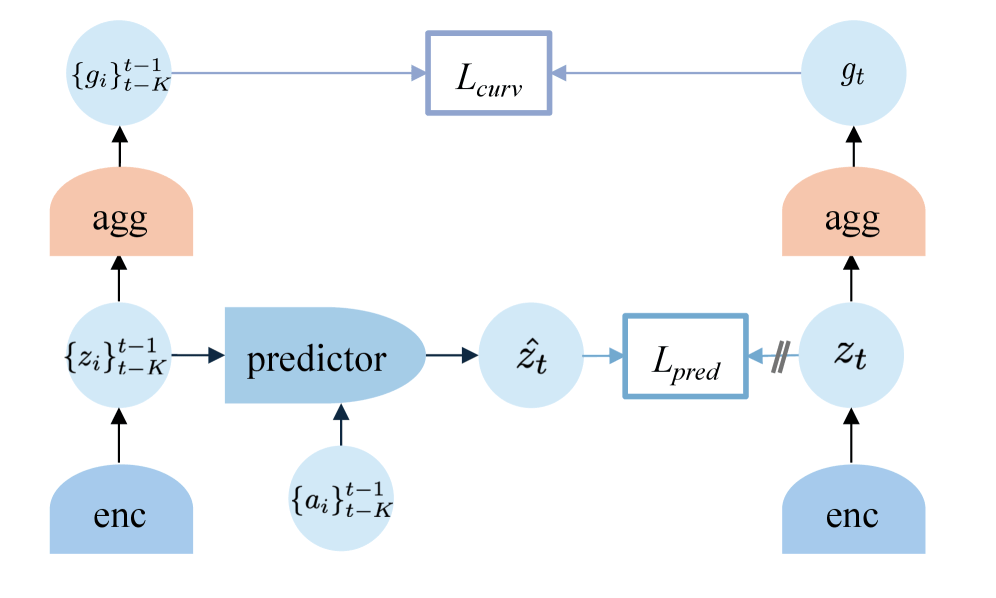
The fix is inspired by the perceptual straightening hypothesis, a finding from human vision research suggesting that the brain transforms complex natural videos into straighter internal trajectories to make prediction easier. The authors apply the same principle to a Joint-Embedding Predictive Architecture (JEPA), a family of world models where a predictor learns to forecast future embeddings rather than reconstruct pixels.
The mechanism is disarmingly simple. Given three consecutive latent states, they define approximate velocity vectors as the differences between them, then add a loss that maximizes the cosine similarity between consecutive velocities. A latent trajectory whose velocity direction barely changes from step to step is, by definition, locally straight.

The full objective combines the standard JEPA prediction loss with the curvature term, weighted by a coefficient lambda. A stop-gradient on the target branch prevents the encoder from collapsing all states to a single point. Interestingly, the JEPA prediction objective alone induces implicit straightening to some extent, and introducing an explicit curvature regularizer further strengthens and stabilizes this effect.
What actually changes in the latent space
Straightening does three concrete things to the representation:
- Curvature drops sharply. PCA projections of latent trajectories go from tangled loops to nearly linear paths.
- Euclidean distance starts tracking geodesic distance. In PointMaze, distance heatmaps computed from the straightened embeddings closely match ground-truth shortest-path distances from A-star search, even though the model was trained only on suboptimal, non-expert trajectories.
- The action-space loss landscape becomes closer to convex. The authors prove that for linear dynamics, an epsilon-straight transition (meaning the dynamics matrix stays close to the identity) bounds the condition number of the planning Hessian by roughly
exp(6 * epsilon * K)over horizon K, which directly controls gradient descent's convergence rate.
The numbers
The team tests on four environments used by DINO-WM: Wall, PointMaze UMaze, PointMaze Medium, and PushT. The baseline is DINO-WM with frozen DINOv2 features. Gradient descent is used as the planner, with a horizon of five steps after frameskipping.
Gains are consistent and often large. On PointMaze UMaze with a lightweight projector on top of frozen DINOv2, open-loop success jumps from 44 percent to 94 percent when straightening is added. A ResNet trained from scratch goes from 14.67 percent to 64.67 percent on the same task. We prove that reducing curvature improves convergence of gradient-based planners, and observe superior empirical gains across a suite of goal-reaching tasks: open-loop planning success improves by 20 to 60 percent and MPC by 20 to 30 percent with a simple gradient-based planner.

The comparison with CEM is where this becomes practically interesting. CEM usually beats GD on absolute success but needs roughly 10x more wall-clock time. With straightening, GD closes most of that gap, giving a much better success-per-second trade-off. The authors also tried more common temporal regularizers, smoothness and time-contrastive InfoNCE, and found neither matched the straightening gains, and both could hurt performance at higher weights.
Where it breaks and what it means
The method is not magic. Long-horizon rollouts (50 steps out) still see prediction errors compound, and decoded rollouts start drifting from simulator ground truth. The symmetric Euclidean goal cost also assumes reversibility, which fails in environments with asymmetric or irreversible dynamics. The authors introduce a Teleported-PointMaze where touching one wall warps the agent across the maze, and note that quasimetric costs may be needed for such settings, though the straightened model does learn to exploit the shortcut.
There is also a useful pragmatic finding for anyone building these systems: preserving spatial structure matters more than channel width. Compressing DINOv2 patches from 384 channels down to 8 does not degrade planning, but collapsing all patches into a single global vector does.
Code is available at the project's official page. For anyone using pretrained visual features for control, adding a cosine-similarity term to the training loss is a very cheap experiment with an unusually favorable return.