
Yann LeCun's Polymathic AI Beats Pixel Models at Learning Real Physics
A Polymathic AI study shows JEPA-style latent prediction beats pixel-based masked autoencoders and even rivals physics-specific models on parameter estimation.
 Pro
Takeaways
- Polymathic AI paper shows JEPA-style latent prediction beats pixel-based masked autoencoders on physics parameter estimation. Paper
- Evaluated on active matter, shear flow, and Rayleigh-Bénard convection from The Well benchmark suite.
- JEPA cuts MSE by 28-51% versus VideoMAE across all three PDE-driven systems tested.
- Approaches physics-specialized DISCO on active matter; DISCO still wins on Rayleigh-Bénard by an order of magnitude.
- JEPA with 10% of fine-tuning data beats VideoMAE trained on 100% of it.
- Code, configs, and pretraining scripts released on GitHub.
A team from the Polymathic AI collaboration, including Yann LeCun, just put a pointed question to the physics-ML community: if the goal is to actually understand a physical system, why keep training expensive pixel-perfect emulators? Their new paper argues that predicting in latent space, in the style of Joint Embedding Predictive Architectures (JEPAs), produces representations that are more physically meaningful and dramatically more sample-efficient than the pixel-reconstruction approaches that dominate the field.
The setup. Most machine learning work on physical systems focuses on autoregressive surrogate modeling, learning frame-by-frame, pixel-by-pixel emulators of expensive numerical simulations. The problem is that those emulators are costly to train, accumulate errors during long rollouts, and, crucially, nobody has really checked whether their internal representations encode anything a scientist would call physics.
Testing physics literacy instead of pixel accuracy
The authors propose a cleaner evaluation: instead of grading models on how well they predict the next frame, grade them on how well their frozen embeddings can recover the governing parameters of a system, things like Reynolds number, Prandtl number, or the active dipole strength of a swarm of self-propelled rods. If a model has really learned the physics, those parameters should be recoverable from its representations with a lightweight probe.
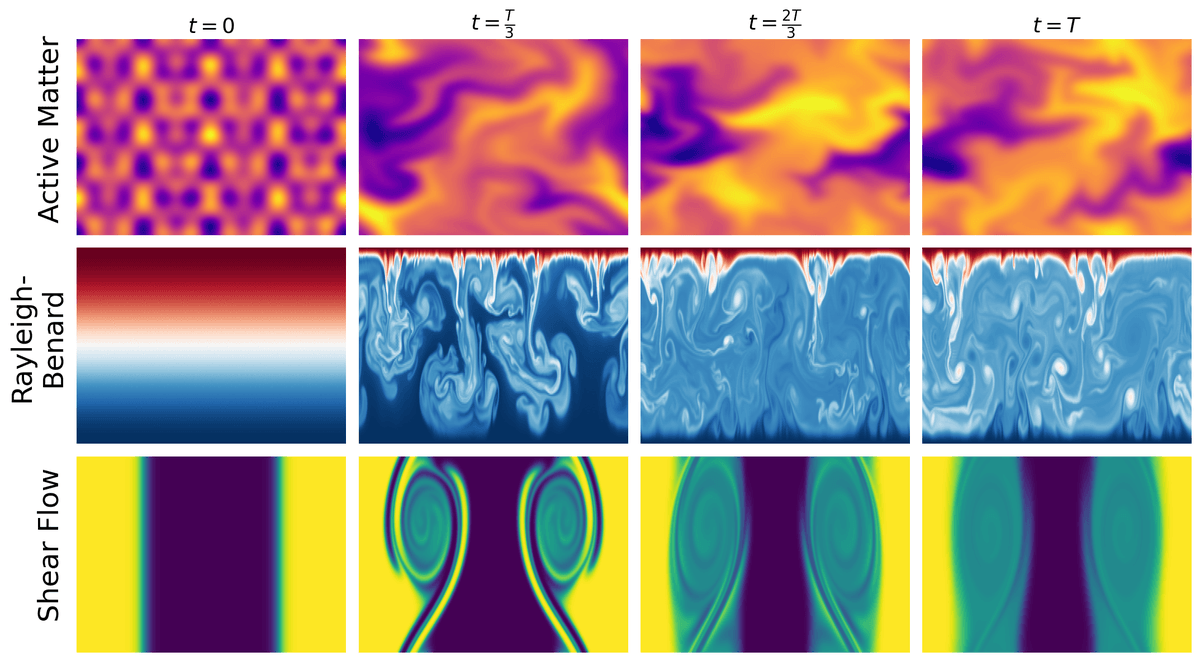
They ran this test on three PDE-driven systems drawn from The Well benchmark suite: active matter (rodlike particles in a Stokes fluid), Rayleigh-Bénard convection (fluid heated from below), and shear flow governed by incompressible Navier-Stokes.

JEPA, adapted for dynamics
The core method is a JEPA trained specifically for temporal dynamics. Unlike traditional self-supervised methods, JEPAs are trained to predict in the model's learned latent space rather than the granular, low-level space of pixel values. Concretely, given a trajectory split into chunks of k frames, an encoder f embeds the current chunk and a predictor g tries to match the embedding of the next chunk. To stop the network from cheating by collapsing all embeddings to a constant, the loss uses VICReg regularization, which combines three terms:
- Invariance: pull matching context and target embeddings together with MSE.
- Variance: keep each embedding dimension above a minimum standard deviation.
- Covariance: decorrelate the embedding dimensions to spread information across features.
The encoder is a downsampling ConvNeXt-style 3D CNN, and the predictor is a CNN with an inverse channel-dimension bottleneck. Input clips are 16 frames long. They compare against a VideoMAE ViT-tiny/16 (pixel masked autoencoder), Multiple Physics Pretraining (MPP, an autoregressive physics foundation model), and DISCO, an operator-learning method with strong physical inductive biases.
The numbers
All encoders are frozen and probed with attentive probes over 100 fine-tuning epochs. MSE on parameter regression (lower is better):
| Model | Active matter | Shear flow | Rayleigh-Bénard |
|---|---|---|---|
| JEPA | 0.079 | 0.38 | 0.13 |
| VideoMAE | 0.160 | 0.67 | 0.18 |
| DISCO | 0.057 | 0.13 | 0.01 |
| MPP (full FT) | 0.230 | 0.59 | 0.08 |
Two headlines jump out. First, JEPA beats VideoMAE across the board, with roughly a 51% relative improvement on active matter, 43% on shear flow, and 28% on Rayleigh-Bénard convection. Second, the pixel-level autoregressive foundation model MPP is often the worst of the four, echoing an old lesson from NLP that generative pretraining is not the same as good representation learning.
Sample efficiency is the real story
On shear flow, the authors sweep fine-tuning dataset size. With just a fraction of the data, JEPA outperforms VideoMAE's best performance with 100% of the available examples. Specifically, JEPA at 10% of the fine-tuning set (MSE 0.57) already beats VideoMAE at 100% (MSE 0.67), and JEPA hits 95% of its own peak performance with only half the data.
For anyone whose ground-truth labels come from a supercomputer, that gap matters more than the raw MSE numbers. Parameter labels for turbulent flow or convection cost real simulation hours; a pretraining recipe that converts unlabeled trajectories into embeddings you can probe with 10% of a labeled set changes the economics of the pipeline.
What it is and is not good for
The paper is careful to frame JEPA as a representation learner, not a forecaster. You get:
- Good at: parameter estimation, regime classification (laminar vs turbulent), any downstream task where a compact physical summary of a trajectory is useful, and transfer with limited labeled data.
- Not for: producing pixel-accurate rollouts. There is no decoder, so if you need a full next-frame emulator, JEPA is not a drop-in replacement for a surrogate model or a neural operator.
- Caveat: physics-specialized DISCO still wins on absolute MSE, dramatically so on Rayleigh-Bénard (0.01 vs 0.13). Domain priors matter when you can afford them.
Code and reproducibility
The official code repository requires Python 3.10+ and PyTorch 2.0+ with CUDA and is available on GitHub. The repo ships pretraining and fine-tuning scripts organized per dataset, with configs that expose learning rate, epochs, and noise level, and it pulls data through the the-well package so you can point THE_WELL_DATA_DIR at your local copy and reproduce the numbers above.
The broader takeaway is a nudge for scientific ML: if your downstream task is inference, not generation, spending compute on pixel-perfect autoregressive rollouts may be the wrong bet. A JEPA-style encoder trained with VICReg gets you closer to the physics with far less data, and the gap to bespoke physics models like DISCO is small enough that a general-purpose recipe is now a credible starting point.