
Yangtze University Squeezes Seismic Maps 19x Into Tiny Neural Fingerprints
A SIREN auto-decoder squeezes 70x70 seismic velocity maps into 256-dim latent codes with 32.47 dB PSNR and zero-shot super-resolution up to 4x.
 Pro
Takeaways
- SIREN auto-decoder compresses 70x70 OpenFWI velocity maps into 256-dim latents at 19:1 ratio.
- Achieves 32.47 dB PSNR and 0.956 SSIM averaged across 1,000 samples in five geological families.
- Periodic sine activations overcome the spectral bias that limits ReLU MLPs at sharp fault interfaces.
- Zero-shot super-resolution up to 280x280 (4x) with only 1.5 dB PSNR drop, no retraining needed.
- Smooth latent interpolation generates plausible intermediate geologies, enabling potential FWI in latent space.
- Limitations: 2D only, does not generalize to unseen patterns, degrades on 40K-sample datasets. Paper.
Seismic velocity models, the maps of how fast sound waves travel through rock, are the backbone of oil and gas exploration, earthquake monitoring, and carbon storage verification. They are also getting painfully large. A new paper proposes squeezing them into tiny neural fingerprints using SIREN auto-decoders, achieving 19:1 compression while keeping the geological structure sharp enough to be scientifically useful.
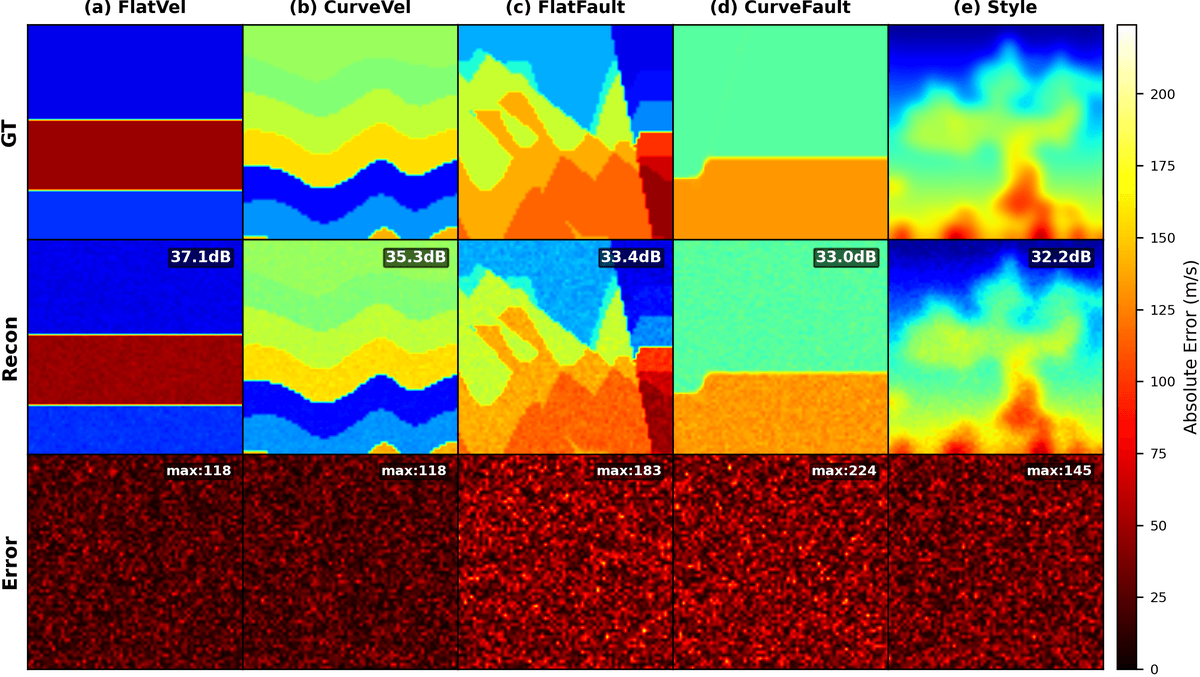
The team from Yangtze University trained a shared sinusoidal network that reduces each 70x70 velocity map (4,900 grid points) into a 256-dimensional latent vector. The OpenFWI benchmark provides comprehensive datasets for data-driven FWI research, including diverse structures: flat layers (FlatVel), curved layers (CurveVel), faulted interfaces (FlatFault, CurveFault), and complex patterns from natural images (Style). Across 1,000 samples spanning all five families, the model averaged 32.47 dB PSNR and 0.956 SSIM, and it can also render the same latent code at 2x or 4x resolution without any retraining.
Why grids are choking geophysics
Traditional velocity models live on discrete Cartesian grids so they play nicely with finite-difference wave solvers. That convenience is expensive: storage scales cubically with resolution, and hard grid boundaries introduce staircase artifacts right where geology gets interesting, along sharp fault lines and thin stratigraphic layers.
Implicit Neural Representations (INRs) fix this by treating a velocity field as a continuous function f(x, z) -> v parameterized by a neural network. You query any coordinate, at any density, and get a value. That is the same trick behind NeRF for scenes and DeepSDF for shapes, but applied here to subsurface physics.

There is a catch. Plain MLPs with ReLU activations suffer from what researchers call spectral bias, meaning they preferentially learn smooth, low-frequency signals and struggle with sharp edges. For seismic imaging, where fault discontinuities carry the whole geological story, that is a dealbreaker. This is where SIREN comes in: it replaces ReLU with sin(w0 * (Wx + b)), a periodic activation that keeps a near-uniform frequency response and captures discontinuities cleanly.
The auto-decoder trick
Instead of the usual encoder-decoder pair, the framework uses an auto-decoder, the same idea Park et al. introduced for DeepSDF. There is no encoder. Each velocity model gets its own learnable latent code z_i, and a shared SIREN network learns to decode all of them jointly.
The training loop is straightforward:
- Randomly initialize a 256-dim latent code per sample from a small Gaussian.
- Concatenate
(x, z, z_i)and pass it through a 4-hidden-layer SIREN with 512 units per layer. - Compute MSE against the ground truth grid, add L2 regularization on the latent codes (lambda = 1e-4).
- Backprop into both decoder weights and every latent code with Adam.
Total footprint: about 1.05M decoder parameters plus 256K for the latent codes, trained in roughly an hour on a single RTX 3080.
Where it works and where it doesn't
Reconstruction quality tracks geological complexity in a predictable way. Simple flat layered structures (FlatVel) hit 35.82 dB PSNR and 0.978 SSIM. Faulted structures are harder: CurveFault drops to 30.56 dB and 0.941 SSIM because the sharp discontinuities push against SIREN's frequency ceiling. Error maps show the residuals concentrate exactly where you would expect, right along the fault planes.
Two capabilities stand out beyond raw compression. First, linearly interpolating between two latent codes produces geologically plausible intermediates, not garbled averages. Second, because the decoder is a continuous function, you can query it on a 280x280 grid and get a 4x super-resolution reconstruction at 30.95 dB PSNR, with no retraining.

The authors do not sugarcoat the limits. The model overfits to its training set and does not generalize to fundamentally unseen geological patterns without fine-tuning. Everything is 2D, and scaling to 3D means dealing with cubic growth in coordinate queries. Compression is lossy, so this is not the right tool if you need bit-exact preservation. And preliminary experiments on 40,000-sample datasets already show reconstruction quality degrading, hinting that the current latent optimization strategy will need work before it scales to production seismic archives.
Why it matters beyond geophysics
The most interesting downstream idea in the paper is doing full waveform inversion directly in the compressed latent space. Rather than optimizing millions of grid values against observed seismic data, you optimize a 256-dim vector z that already lives on a learned manifold of plausible geologies. That is a huge dimensionality reduction that also bakes in a geological prior for free.
More broadly, this is another data point that INRs with periodic activations are a solid general-purpose tool for scientific fields that mix smooth regions with sharp transitions, climate data, fluid dynamics, materials science. The authors say they will release code and trained models to support reproducibility, though a repository link is not yet posted alongside the arXiv submission. For anyone building on OpenFWI or working on compression for scientific fields, this is a compact recipe worth studying.