
Yale's SciMDR Trains a 7B Model to Match GPT-5.2 on Scientific Papers
A two-stage synthesize-and-reground pipeline builds a 300K scientific QA dataset that pushes a 7B model to match GPT-5.2 on document-level reasoning.
 Pro
Takeaways
- SciMDR is a 300K QA multimodal training dataset built from 20K scientific papers with explicit reasoning chains.
- The synthesize-and-reground pipeline separates faithful QA generation on atomic contexts from realistic full-document training.
- Backward construction uses claims as blueprints, turning reasoning generation into a constrained articulation task to reduce hallucinations.
- Fine-tuned Qwen2.5-VL-7B scores 49.1 on SciMDR-Eval, effectively matching GPT-5.2 at 49.9 and beating GPT-5.1.
- Ablations: removing localization drops performance to 22.8; removing reasoning chains drops it to 16.9.
- SciMDR-Eval provides 907 expert-annotated QA pairs across five reasoning types for full-document scientific evaluation.
Training multimodal models to actually read a scientific paper, cross-referencing text, figures, and tables the way a human researcher does, has been stuck on a data problem. If you generate QA pairs from short, clean snippets, the labels are trustworthy but the task is too easy. If you generate them from the whole messy PDF, you get realistic questions and hallucinated answers. A team from Yale, University of Chicago, and TCS Research is proposing a way out with SciMDR, a 300K QA dataset built on a pipeline that decouples the two goals.
The dilemma nobody wanted to name
Scientific papers remain difficult for general-purpose models because evidence is distributed across long, multimodal documents (text, figures, and tables) and often requires domain expertise to interpret specialized terminology and connect claims to supporting context. The authors frame the core training-data issue as a faithfulness-realism tradeoff. To achieve faithfulness, QA generators can be prompted with concise, atomic contexts, which simplifies the task to yield verifiable outputs. But that sanitized approach doesn't teach a model to navigate a real paper. Conversely, querying with lengthy, unprocessed documents more closely mirrors practical use cases, but this long-context approach leads to attention dilution, increasing the likelihood of hallucinations and undermining faithfulness in the generated ground-truth answers.

Synthesize first, then reground
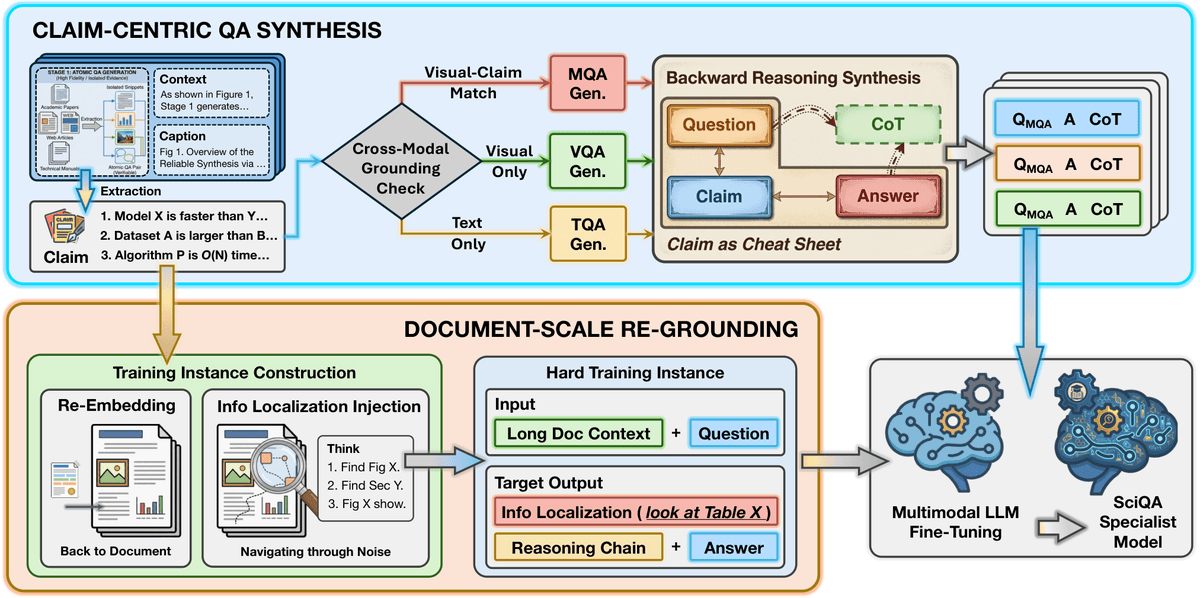
The proposal is a two-stage pipeline that separates where the QA pair is written from where the model is trained on it.
- Claim-Centric QA Synthesis. The generator (GPT-5.1) works on a tiny multi-modal unit: a text segment, one figure or table, and a caption. It first breaks the text into discrete, declarative claims, each representing a core finding or conclusion, then checks each claim against the visual to decide whether the resulting QA should be text-only, vision-only, or multimodal.
- Document-Scale Regrounding. Those atomic QA pairs are then re-embedded into the full noisy paper. The claim, which was a generation blueprint, becomes a ground-truth evidence map used to prepend an explicit
Information Localizationstep to the reasoning chain, something like "consult Section X, then cross-reference Table Y."
The clever bit is what the authors call backward construction for the chain-of-thought. Instead of asking the model to reason its way from question to answer, the claim is provided upfront as the conclusion, and the generator only has to articulate the steps connecting them. This turns open-ended inference into a constrained writing task, which is much harder to hallucinate through.
What's in the box
- SciMDR: approximately 300K QA pairs with claim-centric reasoning chains from 20K research papers, generated with GPT-5.1. Sources are arXiv CS papers (about 9,847, with 97% from 2023 to 2025) and 9,273 Nature Communications articles.
- Split into TQA (47K text-only), VQA (125K visual-only), and MQA (132K multimodal).
- SciMDR-Eval: 907 human annotated QA pairs requiring evidence localization within lengthy, noisy documents. Annotators were three CS graduate students, and each entry was authored by one and verified by the other two.
- Five reasoning types in the eval set: evidence-based explanation, concept-to-instance mapping, hypothesis validation, critical analysis, and argumentative synthesis.
A 7B model that punches at GPT-5.2's weight
The headline result: fine-tuning Qwen2.5-VL-7B on SciMDR takes it from 19.8 to 49.1 on SciMDR-Eval, essentially tying GPT-5.2 at 49.9 and beating GPT-5.1 at 47.2. On broader benchmarks the gains are also substantial: CharXiv-D jumps by 10.6 points, and SPIQA-A by 2.2, while SPIQA fine-tuning on the same base model actually degrades performance on CharXiv-D by 14.1 points.
The ablations are what make the methodology convincing. Removing the explicit information localization step drops SciMDR-Eval from 49.1 to 22.8. Removing the full reasoning chains and training on plain QA pairs drops it to 16.9, worse than the base model. In a controlled comparison, re-annotating SPIQA's source papers with the SciMDR pipeline improved SPIQA-A performance from 35.7 to 39.8, isolating the gain to the methodology rather than the data selection.
The noise experiment
To quantify why regrounding matters, the team ran the base Qwen2.5-VL-7B on SciMDR-Eval under three settings. With an oracle context of only ground-truth evidence, it scored 32.9. With the standard setting (limited noise, max 8 images and 6 paragraphs), 19.8. Given the full paper, 12.8. The gap between Oracle Context (32.9) and Full-Paper (12.8) confirms that long-context distractors are a source of error; even when the information is present, the model struggles to localize evidence within dense content. That is the exact skill the regrounding stage is designed to teach.
Where it's useful, where it isn't
The practical takeaway is that if you're building a research-assistant agent that has to answer questions grounded in real PDFs, training data with explicit evidence localization traces is a much stronger signal than clean atomic QA pairs. The failure analysis shows the fine-tuned model cuts incorrect evidence localization from 18 to 5 out of 100 sampled errors and hallucinations from 11 to 3.
The caveats are honest. Fidelity is bounded by GPT-5.1 as the teacher, so any biases in niche domains propagate to the student. The empirical work is confined to STEM, mostly computer science and general science from Nature Communications, so humanities and social science reasoning patterns are untested. And the pipeline still leans on a proprietary model for synthesis, which the authors flag as a future distillation target. The full paper includes the complete prompt library for claim extraction, visual grounding, and each QA category, which is probably the most reusable artifact if you want to run this pipeline on your own corpus.