
Yale Fixes AI Depth Models for Fisheye Cameras Without Retraining Anything
A lightweight set of trainable tokens teaches frozen depth foundation models to handle fisheye distortion without retraining, finetuning, or camera calibration at inference.
 Pro
Takeaways
- Calibration Tokens adapt frozen depth foundation models to fisheye cameras without retraining or finetuning. Paper
- A tiny set of trainable tokens per transformer layer shifts fisheye embeddings toward the perspective distribution the model was trained on.
- Training is self-supervised: synthesize fisheye from perspective images, use the frozen model's perspective output as pseudo-label.
- Delivers 12-17% RMSE improvements on MiDaS, DepthAnything, and UniDepth across ScanNet++ and KITTI-360 benchmarks.
- Adds under 1 MB of parameters and less than 1 ms of latency, and stays backward-compatible with perspective images. Code
- Finetuning the same models on synthetic fisheye data causes catastrophic forgetting, Calibration Tokens avoid it entirely.
Foundation models for monocular depth estimation have quietly become one of the most reliable pieces of the computer vision stack. Trained on tens of millions of images, systems like MiDaS, DepthAnything, and UniDepth generalize across indoor and outdoor scenes with impressive zero-shot accuracy. There is one catch that shows up the moment you deploy them on a real robot, drone, or headset: they were trained almost entirely on perspective (pinhole) images, and they fall apart on fisheye cameras.
A team from Yale and Michigan State is proposing a fix that avoids retraining anything. Their ICCV 2025 paper introduces Calibration Tokens, a tiny set of trainable vectors that get appended to the transformer's input sequence and nudge the fisheye image embeddings back toward the distribution the model was originally trained on. The full method, code, and training recipe are on GitHub.
Why foundation depth models break on fisheye
Fisheye lenses are everywhere in robotics, autonomous driving, and XR because they capture a much wider field of view than a standard lens. The tradeoff is heavy geometric distortion: straight lines in the world curve, and objects near the borders are stretched and warped. A perspective-trained model interprets those distortions as strange geometry and produces blurry, wrong depth maps, especially at the edges where distortion is worst.

The usual workarounds all have problems:
- Undistort the image first. Requires accurate calibration, introduces stretching and cropping artifacts, adds latency, and the artifacts themselves cause a fresh covariate shift.
- Train a fisheye-specific model. Public fisheye datasets are 10 to 100 times smaller than perspective ones, and you lose the generality of the foundation model.
- Finetune the foundation model on fisheye. Causes parameter drift, the model forgets how to do perspective images, and you now need separate models for every camera type on your platform.
The core idea: recalibrate in latent space, not pixel space
The authors' insight is that the depth foundation model already knows how to decode good depth maps, it just needs the fisheye features to look like perspective features to its encoder. Instead of warping pixels, they modulate the transformer's latent embeddings using a small set of learnable tokens.
Concretely, for each layer of the vision transformer encoder, they concatenate a set of Calibration Tokens (they use 8 tokens per layer) to the patch embedding sequence. The self-attention mechanism naturally mixes these tokens with the image patches, shifting the fisheye embeddings toward the perspective distribution. After the encoder runs, the calibration tokens are discarded and the decoder produces depth as usual. The decoder is never touched.

Two design choices matter:
- Layer-wise tokens beat a single token set. A single set of tokens injected only at the first layer loses influence by mid-network. Injecting a fresh set at every encoder layer maintains attention to distorted border regions throughout the forward pass.
- Backbone stays frozen. Only the tokens are trained. For a ViT-L backbone, that is roughly 0.8 MB of extra parameters, a 0.05% memory increase, and under 1 ms of extra latency.
Training without any fisheye data
The training loop is fully self-supervised and never touches a real fisheye image. Instead:
- Take a perspective image from any standard dataset (NYUv2, Hypersim, IRS, VOID, Waymo).
- Run the frozen foundation model on it to get a high-quality depth map. This is the pseudo-label.
- Warp the perspective image into a synthetic fisheye image using the Kannala-Brandt distortion model with randomized parameters.
- Run the frozen foundation model on the synthetic fisheye image, with Calibration Tokens attached.
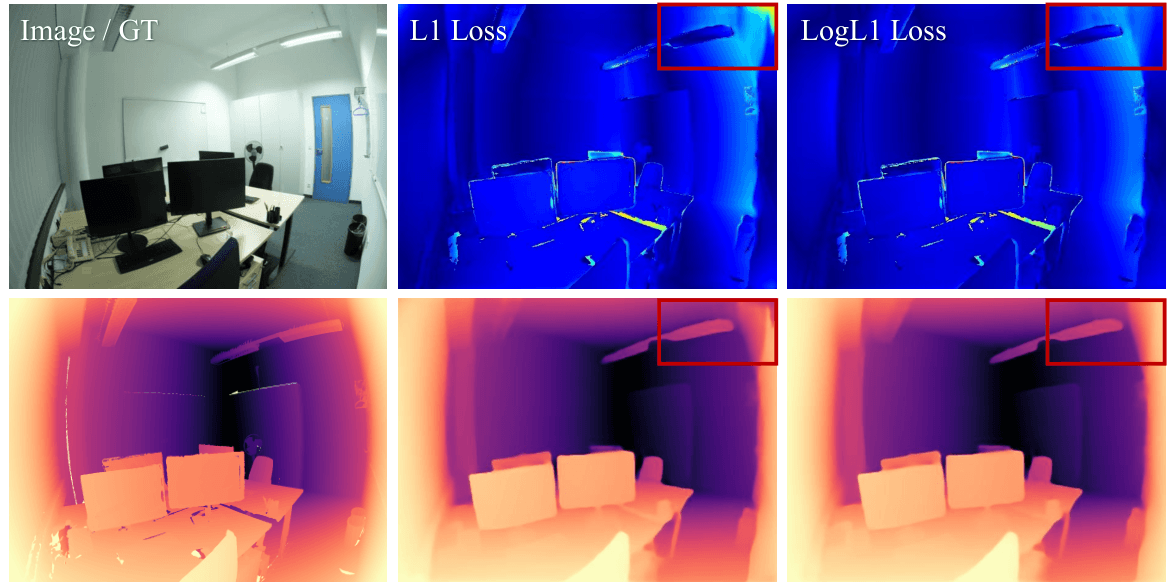
- Unwarp the resulting depth map back to the perspective reference frame, then compute a log-L1 loss against the pseudo-label.
Computing the loss in the perspective frame (rather than the fisheye frame) is deliberate. Warping the pseudo-label into fisheye space would introduce interpolation artifacts and information loss, in one KITTI-360 example around 17% of pixels are corrupted, and would then push the model to fit those artifacts.
What the numbers show
The team evaluated on ScanNet++ (indoor, real fisheye) and KITTI-360 (outdoor, fisheye with over 180 degree FOV), plugging Calibration Tokens into MiDaS, DepthAnything, and UniDepth. A single set of tokens is trained jointly on indoor and outdoor data, then evaluated in both settings.
| Model | Dataset | RMSE baseline | RMSE + Calibration Tokens |
|---|---|---|---|
| MiDaS | ScanNet++ | 0.506 | 0.446 |
| DepthAnything | ScanNet++ | 0.731 | 0.607 |
| UniDepth | ScanNet++ | 0.279 | 0.244 |
| MiDaS | KITTI-360 | 3.312 | 2.348 |
| DepthAnything | KITTI-360 | 2.214 | 2.043 |
| UniDepth | KITTI-360 | 2.085 | 2.040 |
UniDepth with Calibration Tokens beats DepthAnyCamera, the previous state of the art for fisheye depth, by 11% RMSE on ScanNet++, and matches or exceeds it on KITTI-360, without needing camera intrinsics at inference and without training separate indoor and outdoor models.
The comparison against finetuning is even more striking. When the team finetuned MiDaS on the same synthetic fisheye data, RMSE on ScanNet++ jumped from 0.506 to 2.178, an example of catastrophic forgetting. Calibration Tokens on the same model achieved 0.446.
Where it helps, where it doesn't
The practical appeal here is operational. If your platform has a mix of perspective and fisheye cameras, which is standard on cars and robots, you no longer need to ship two depth models. Append tokens for the fisheye stream, drop them for the perspective stream, use the same weights.
Limitations are worth flagging. The method inherits whatever weaknesses the underlying foundation model has, if the base model struggles in low light or with reflective surfaces on perspective images, Calibration Tokens will not fix that. It also works only with transformer-based FMDEs, though that covers essentially all recent state-of-the-art models. And while the tokens generalize across a wide range of distortion parameters, extreme calibration configurations outside the training distribution may still degrade.
The broader takeaway is architectural. Instead of retraining a large model to handle a new input modality, you can often train a handful of tokens that steer the existing latent space. The authors note this general recipe should extend to optical flow, semantic segmentation, and other perception tasks that inherit the same perspective-image bias from their pretraining data.