
Yale and Snap's FlexRec Boosts AI Recommendations by 109% Without Retraining
A new RL post-training method turns a 3B LLM into a recommender that swaps ranking behavior on demand, beating specialized systems by up to 109% on Recall@5.
 Pro
Takeaways
- FlexRec is an RL post-training framework aligning LLMs to flexible, need-specific recommendation objectives via a new reward design.
- Introduces swap-based item-level rewards using counterfactual swaps within the remaining candidate pool for fine-grained credit.
- Adds uncertainty-aware GRPO that down-weights advantages when the critic's reward variance is high.
- Reports up to 59% NDCG@5 and 109.4% Recall@5 gains over Qwen2.5-3B-Instruct on KuaiRec Maximizing Interest.
- Generalizes zero-shot to unseen needs, with up to 24.1% Recall@5 improvement in transfer settings.
- Limited to closed-set reranking; retrieval and open-world item dynamics are left for future work.
Recommender systems have a rigidity problem. Most are trained to chase one metric, typically clicks or watch time, and they cannot easily switch objectives when a merchant wants to promote trending items or a user wants to explore new genres. A team from Yale and Snap has proposed FlexRec, a reinforcement learning post-training framework that turns a general purpose LLM into a ranker that can reconfigure itself on the fly through natural language instructions.
The headline numbers are large. FlexRec improves NDCG@5 by up to 59% and Recall@5 by up to 109.4% in need-specific ranking, and further achieves up to 24.1% Recall@5 improvement under generalization settings, outperforming strong traditional recommenders and LLM-based baselines. The base model is Qwen2.5-3B-Instruct, which makes those gains especially notable given how small the policy is relative to typical LLM baselines.
Why single-objective rankers keep breaking
Production recommenders are usually optimized for a fixed target like click-through rate or purchases. User intents are inherently dynamic, and merchants' objectives can also shift over time, for example, between brand awareness and driving sales. Retraining a specialized model every time the business need changes is expensive and slow.
LLMs look like a natural fix because they follow instructions well, but there is a catch. Because LLMs are predominantly trained on large-scale general-purpose text corpora, they remain weakly aligned with recommendation tasks and cannot be directly deployed as recommenders without further adaptation. Recent work like Rec-R1 tried to close this gap with GRPO-style reinforcement learning, but two structural problems kept getting in the way.
The two obstacles blocking RL for ranking
The first is credit assignment. Existing RL methods for LLM-based recommendation systems typically operate with sequence-level rewards, assigning a single scalar value to the entire ranked list. That means if the model produces a list of 30 items and one item is in the wrong place, every token gets punished equally. There is no signal about which specific decisions were good or bad.
The second is sparse supervision. In real datasets, most user-item pairs have no interaction data at all. A common workaround is to train a small neural critic to fill in the blanks, but these estimates inevitably contain error and can vary substantially in reliability. This is especially problematic in RL, where high-variance reward estimates can strongly distort advantage estimation and destabilize policy updates.
Counterfactual swaps as atomic ranking actions
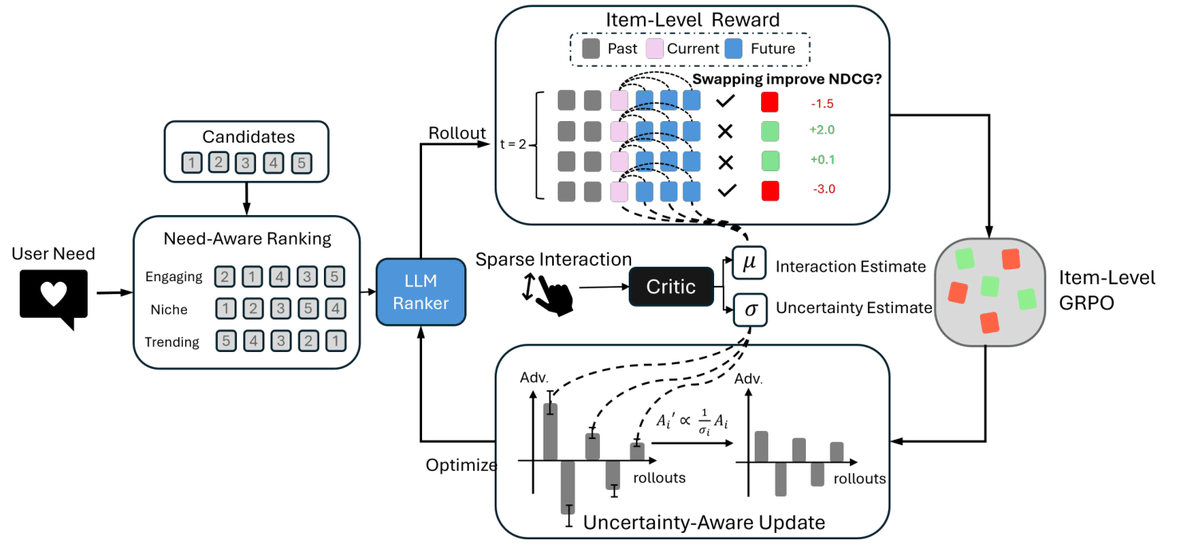
FlexRec's first contribution is a reward built from a simple observation. The contribution of an item at position k is defined only relative to the remaining pool, because earlier-ranked items are already fixed and cannot be affected by the choice of that item. So the natural way to score an individual placement is to ask a counterfactual question: what happens to the list quality if we swap this item with a later one?
Formally, any permutation can be obtained by composing pairwise swaps, so a single swap can be viewed as an atomic local edit of a ranking, and local changes in listwise quality can be attributed to swapping. For each item placed at rank k, FlexRec averages the change in NDCG across all valid swaps with items later in the list. That average becomes the item-level reward, which the paper proves is an unbiased estimator of the item's marginal contribution.
The computational overhead is modest. Computing item-level rewards is O(K squared) in the number of ranked items, which is negligible in the reranking stage where candidate pools are small (K=30 in their experiments).
These per-item rewards then feed into a modified GRPO update. Item tokens get normalized item-level advantages pooled across all rollouts in a prompt group. Reasoning and formatting tokens still get standard sequence-level advantages, since they influence overall list quality rather than any single position.
Teaching the critic to say I don't know
The second contribution addresses the noisy critic problem. FlexRec trains a two-tower MLP that predicts both a mean reward and a predictive variance for any user-item pair, using a heteroscedastic Gaussian likelihood. Rollouts whose sequence-level reward has high variance get their advantages down-weighted before the policy update. The weighting uses inverse variance, normalized within the group and clipped at 1 so high-confidence rollouts are never boosted above their nominal value.
This matters because critic errors compound. In their training curves, removing the uncertainty-aware update produces strong early gains but performance degrades later as critic error accumulates and introduces increasingly spurious updates.
Benchmarks and what the numbers actually say
FlexRec was tested on three datasets covering different recommendation styles:
- KuaiRec, a short-video dataset where the paper subsamples 10% of interactions per user to simulate sparse implicit feedback
- MovieLens-1M for long-horizon rating-based preferences
- Amazon ESCI for query-driven product search
The team constructed three need instructions on top of each dataset: Maximizing Interest (rank by predicted engagement), Explore New Topics (prioritize niche items in genres the user has not seen), and Trend Promotion (balance personalization with recent popularity from the last 24 hours).
On KuaiRec's Maximizing Interest task, FlexRec pushes Qwen2.5-3B-Instruct from 0.375 NDCG@5 to 0.597, a 59.2% relative gain, while Rec-R1 and Rank-GRPO both actually underperform the zero-shot base model. The Recall@5 improvement of 109.4% comes from that same comparison. On MovieLens-1M, gains are more modest but still consistent: 23.7% NDCG@5 improvement over the base model.
Generalization and the universal ranker claim
The more interesting result may be zero-shot transfer. When trained only on Maximizing Interest and tested on Explore New Topics for MovieLens-1M, FlexRec still improves Recall@5 by 24.1% over the base model, suggesting the fine-grained rewards teach reusable ranking principles rather than a single objective. A single FlexRec model jointly trained on all three needs remains competitive across scenarios, adjusting its ranking behavior at inference based on the instruction alone.
The qualitative reasoning traces are worth noting. Under Trend Promotion, the model performs lightweight numerical reasoning over recent watch counts. Under Explore New Topics, it explicitly enumerates genres in the user's history and looks for complementary underexposed themes. This is closer to interpretable recommendation than most black-box rankers offer.
Where it falls short
The scope is deliberately narrow. FlexRec addresses closed-set reranking, meaning the candidate pool is already retrieved by an upstream system and labels are derived from existing engagement signals. The authors are explicit that this abstracts away key components of real-world recommenders such as retrieval and open-world item dynamics. Extending to retrieval-augmented personalization and evolving item spaces is left as future work.
There is also one clear regression in the generalization results: when transferring from Maximizing Interest to Trend Promotion on KuaiRec, Recall@5 drops 27.4% versus the base Qwen2.5-3B-Instruct, even though other metrics improve. Trend Promotion involves numerical reasoning over popularity counts that appears to conflict with pure interest-based training.
What is genuinely new here
Two things stand out beyond the benchmark deltas:
- Item-level rewards that are actually comparable across rollouts. Prior rank-based GRPO methods computed rewards that depended on the prefix and remaining pool, making cross-rollout normalization biased. The counterfactual swap formulation gives an unbiased per-item signal that can be normalized meaningfully.
- Uncertainty as a first-class training signal. Most RLVR pipelines treat the critic's predictions as ground truth. Explicitly modeling variance and using it to modulate advantages is a cleaner way to handle the sparse-feedback problem than heuristic reward shaping.
The paper does not appear to include a public code release, which is unusual for a benchmark-heavy RL contribution and worth watching. If reproducibility follows, the swap-based reward and uncertainty-aware update are simple enough to bolt onto existing GRPO pipelines like Verl, which is what the authors used for their 4x A100 training setup.