
Yale and Google's AlphaEvolve Cracks a 40-Year Economics Mystery
Google DeepMind's AlphaEvolve cracks a 40-year-old economics puzzle, proving a key trading mechanism is worse than theorists believed
 Pro
Takeaways
- New lower bound: AlphaEvolve found a distribution pair proving the Random Offerer mechanism can be at least 2.0749x worse than optimal, up from the prior 2.02.
- The mechanism: The Random Offerer (RO) randomly picks between seller-makes-offer and buyer-makes-offer; it is a standard benchmark in mechanism design theory.
- AI-guided search: AlphaEvolve evolved Python code for seller distributions, treating the math problem as program synthesis.
- Key discovery: The AI found a sinusoidally modulated power-law distribution, a non-intuitive structure human theorists had not tried.
- Broader impact: RO is used as a building block in proofs about double auctions and multi-sided markets, so a tighter bound has downstream effects on many results.
- Open question remains: The true worst-case ratio is still unknown; the paper also hints at a ratio of ~2.08 via further evolution, left for future work.
A 40-year-old open question in mechanism design just got a sharper answer, and the tool that cracked it was not a human theorist but an AI-guided evolutionary coding agent. Researchers from Yale and Google used AlphaEvolve to discover a new worst-case counterexample for a foundational trading mechanism, pushing a known bound from 2.02 to 2.0749. The result is a small number with large implications for how we think about the limits of fair, efficient trade.
The 40-Year Impossibility at the Heart of Markets
The backdrop is the Myerson-Satterthwaite theorem, a celebrated 1983 result in economics. It proves that in any two-party trade (one seller, one buyer), you cannot simultaneously have all three of the following:
- Full efficiency: trade happens whenever the buyer values the item more than the seller does
- Incentive compatibility: both parties are always better off telling the truth about their valuations
- Budget balance: no external subsidy is needed to make the deal happen
This is not a practical limitation. It is a mathematical impossibility. So the natural follow-up question is: how close can a practical mechanism get? The metric researchers use is the Gains from Trade (GFT) ratio: how much total surplus does a real mechanism capture compared to the theoretical maximum if everyone were honest?
The Random Offerer and Its Mystery Bound
The most studied practical mechanism is the Random Offerer (RO). It works by flipping a coin: with 50% probability the seller makes a take-it-or-leave-it price offer to the buyer (Seller-Offering, or SO), and with 50% probability the buyer makes an offer to the seller (Buyer-Offering, or BO). Each party sets their price to maximize their own expected profit given the other side's value distribution. The final GFT is the average of the two sub-mechanisms.
The RO mechanism is popular precisely because it is simple, incentive-compatible, and budget-balanced. But how badly can it underperform the theoretical best? For years, researchers conjectured the worst-case ratio was at most 2x. Then cracks appeared: Cai et al. proved the ratio could exceed 2, and Babaioff et al. found an explicit example at approximately 2.02. The true upper bound remained unknown, sitting somewhere above 2.02 and below the best-known upper bound of around 3.15.
Turning a Math Problem Into a Code Evolution Problem
The new paper, from Yang Cai (Yale), Vineet Gupta, Zun Li (Google DeepMind), and Aranyak Mehta (Google Research), reframes the search for worst-case distributions as a program synthesis problem. Instead of a human mathematician trying to construct a pathological distribution by hand, they let AlphaEvolve evolve Python code that generates seller value distributions designed to maximize the efficiency gap.
AlphaEvolve is an evolutionary algorithm from Google DeepMind that maintains a population of candidate programs, uses LLMs to propose mutations or refinements, evaluates the resulting programs with a scoring function, and feeds the best candidates back into later generations for further evolution. Unlike approaches that adapt model weights to a specific problem, the discovery process happens entirely at inference time, leveraging the existing code generation and reasoning capabilities of pretrained LLMs without training on the target problem.
The search setup was deliberately constrained to focus the search:
- Fixed buyer distribution: the buyer's valuations were held at the Discrete Equal Revenue Distribution (where the probability of valuing the item at least
mis exactly1/m), following the structure of the previous best counterexample - Evolved seller distribution: AlphaEvolve iteratively mutated the Python function
get_seller_distributions(), which constructs the seller's CDF, starting from a simple uniform distribution - Fitness function: the approximation ratio itself, computed exactly using integer arithmetic to avoid floating-point errors
What the AI Found That Humans Missed
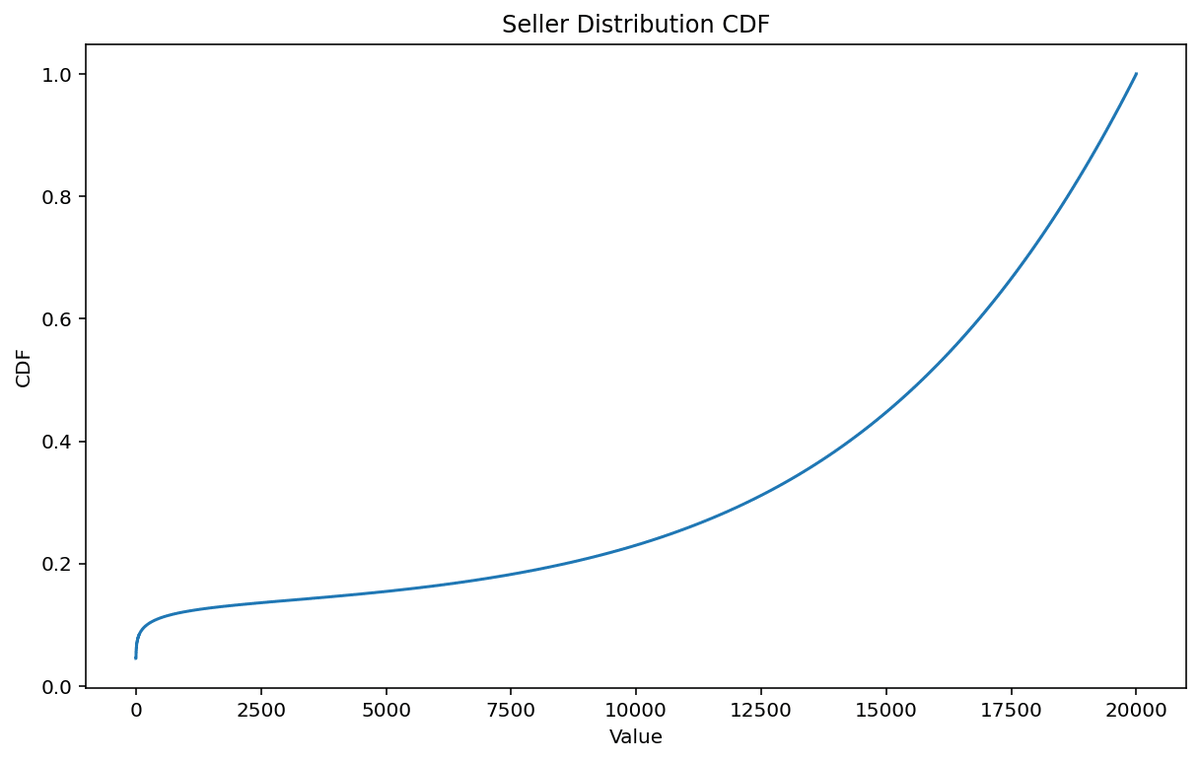
The key discovery was a mixture of modulated power laws. Standard power-law distributions had been used in previous counterexamples. What AlphaEvolve found was that sinusoidally modulating the exponent of the power law was critical. The evolved seller CDF takes the form:
def get_seller_distributions():
    H = 20000
    a1_base = 0.15  # Base exponent for first component
    a2 = 4.0        # Exponent for second component
    w = 0.20        # Weight for first component
    # Sinusoidal modulation discovered by AlphaEvolve
    a1_amp = 0.05   # Amplitude of modulation
    a1_freq = 2.0   # Frequency (cycles over domain)
    cdf_s = {}
    norm_factor = H + 1.0
    for m in range(H + 1):
        base = (m + 1.0) / norm_factor
        a1_eff = a1_base + a1_amp * math.sin(a1_freq * math.pi * base)
        cdf1_val = base ** a1_eff
        cdf2_val = base ** a2
        cdf_s[m] = w * cdf1_val + (1.0 - w) * cdf2_val
    return H, cdf_s
The sinusoidal modulation parameter a1_amp = 0.05 is the non-obvious piece. It is a small, oscillating perturbation on the exponent of a power law, something a human theorist would be unlikely to try. The paper notes that this structure is "significantly different from the previous worst-case distribution."
The Numbers
The discovered distribution, discretized over a domain of H = 20,000 and paired with the fixed buyer distribution, yields the following breakdown:
| Component | GFT Value |
|---|---|
| First-Best (theoretical max) | 1.2322 |
| Seller-Offering sub-mechanism | 0.3312 |
| Buyer-Offering sub-mechanism | 0.8565 |
| Random Offerer (average of SO + BO) | 0.5939 |
| Approximation ratio (FB / RO) | 2.0749 |
The asymmetry between the two sub-mechanisms is striking: the Buyer-Offering mechanism captures 0.8565 in GFT while the Seller-Offering mechanism only captures 0.3312. This lopsidedness is what the evolved distribution is exploiting. The RO mechanism, by averaging the two, is dragged down by the weak seller-offering side.
The team also noted a further result in passing: by then fixing the evolved seller distribution and evolving the buyer distribution, they reached a ratio of approximately 2.08, though they do not fully characterize that instance in the paper.
Why This Matters Beyond the Number
The practical stakes here extend well beyond bilateral trade between two parties. The RO mechanism is used as a building block in proofs about double auctions and multi-sided markets. Every result that says "the optimal mechanism is within a constant factor of the RO mechanism" inherits any looseness in the RO bound. A tighter lower bound on RO's worst-case performance narrows the gap that theorists need to close.
More broadly, this is a demonstration of AlphaEvolve being applied to pure theory. AlphaEvolve pairs the creative problem-solving capabilities of Gemini models with automated evaluators that verify answers, and uses an evolutionary framework to improve upon the most promising ideas. Previous applications included discovering a new algorithm for multiplying 4x4 complex-valued matrices using just 48 scalar multiplications, surpassing Strassen's 1969 result. This paper extends that track record into microeconomic theory, a domain where the search space is distributions over valuations rather than matrix entries.
The true worst-case ratio of the Random Offerer mechanism remains an open problem. The new lower bound of 2.0749 is a floor, not a ceiling. Whether the true value is 2.1, 2.5, or something else entirely is still unknown. But the fact that an AI found a counterexample that eluded human researchers for years suggests the ceiling might be higher than anyone expected.