
XSkill Gives Gemini 3 Flash a Growing Memory to Stop Repeating Mistakes
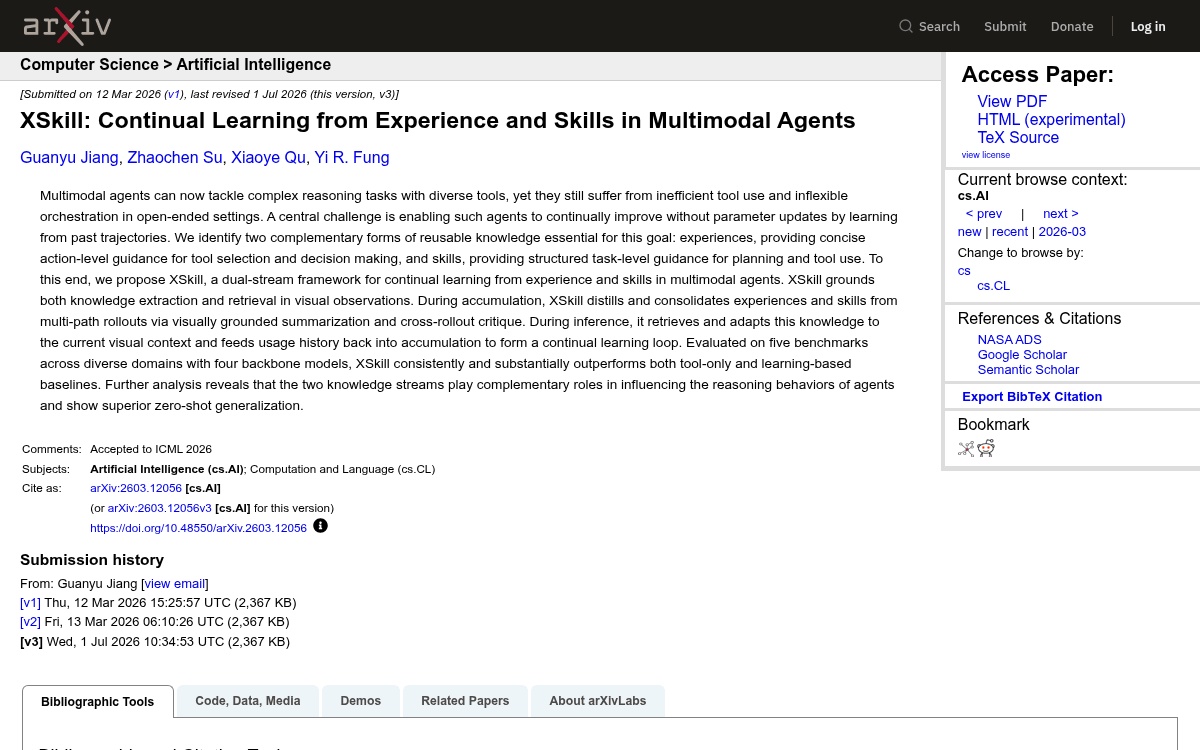
A dual-stream memory system lets multimodal agents accumulate skills and experiences from past runs, boosting tool-use accuracy across five benchmarks.
 Pro
Takeaways
- XSkill gives multimodal agents dual memory: task-level skills and action-level experiences, both visually grounded.
- Beats tool-only baselines by 2.58-6.71 points Average@4 across four frontier backbone models.
- Surpasses Agent-KB by 11.13 points on TIR-Bench with Gemini-3-Flash, the largest single gain reported.
- Skills cut tool execution errors from 29.9% to 15.3%; experiences shift tool selection toward more targeted strategies.
- Knowledge transfers across models: GPT-5-mini and o4-mini improve using memory built by Gemini-3-Flash.
- Transfer to weaker open-source models like Qwen3-VL is inconsistent, showing base capability limits.
Multimodal agents that call tools like code interpreters, web search, and image search have gotten impressively capable, but they tend to repeat the same mistakes across tasks because nothing carries over between runs. A new framework called XSkill tackles this by giving agents a structured, non-parametric memory that grows as they work, and it shows meaningful gains on top of frontier models like Gemini 3 Flash and GPT-5-mini.
The bottleneck: agents that never learn
Current multimodal agents face two fundamental bottlenecks: tool use remains inefficient, as agents often spend excessive steps on simple problems yet fail to conduct sufficiently deep multi-turn exploration when faced with complex queries, and tool orchestration remains inflexible, as most existing systems are confined to single-path execution and show limited ability to compose tools in a manner that generalizes across tasks. Prior memory approaches like Agent Workflow Memory or Dynamic CheatSheet mostly log text traces, which loses critical visual signals. Without grounding experiences and skills in the visual state of the task, agents cannot reliably retrieve relevant prior knowledge or adapt it to the current execution context.
Two kinds of memory, working together
The core idea in the paper is that agents need two complementary knowledge streams, not one. Skills are task-level playbooks (structured Markdown workflows with reusable code templates), and experiences are short, action-level tips stored as JSON with embeddings for retrieval. Skills provide task-level guidance through structured workflows, while Experiences offer action-level insights for specific execution contexts. Each experience is capped at 64 words and shaped as a condition-action pair such as "when the image looks upside down before object detection, rotate first."

How the loop actually runs
XSkill splits work between two MLLM instances: one executes tasks, another curates the knowledge base. The framework runs in two phases:
- Accumulation. For each training task, the executor produces N rollouts. The knowledge-base model then does visually grounded summarization (feeding it interleaved images plus trajectory text) followed by cross-rollout critique that contrasts successful and failed attempts.
- Consolidation. Before committing each add operation, the system checks whether any existing entry has cosine similarity above a threshold; if so, entries are jointly merged by the model, and when the repository size exceeds a cap, low-quality items are deleted.
- Inference. At test time, the query is decomposed into subtasks, each subtask retrieves top-k experiences (k=3 in experiments), retrieved entries are rewritten to fit the current visual context, and skills are pruned and adapted before injection into the system prompt.
Usage history from each task feeds back into accumulation, so the knowledge base is designed to keep refining over time rather than staying frozen after training.
The numbers
The team evaluated on five benchmarks spanning visual tool use (VisualToolBench, TIR-Bench), multimodal search (MMSearch-Plus, MMBrowseComp), and the harder AgentVista, using Gemini-2.5-Pro, Gemini-3-Flash, GPT-5-mini, and o4-mini as backbones. XSkill demonstrates substantial improvements over the tool-only baseline, achieving average gains of 2.58 to 6.71 points in Average@4 across different models.
The most striking result: on TIR-Bench with Gemini-3-Flash, the method achieves 47.75% Average@4, surpassing the strongest baseline Agent-KB by 11.13 points. Cross-model transfer also worked. GPT-5-mini and o4-mini gained 2.58 to 4.16 points over the tool-only baseline when using knowledge accumulated by Gemini-3-Flash, suggesting the memory format is portable.

What each stream actually does
Ablations reveal a clean division of labor. Skills cut execution errors: on VisualToolBench with Gemini-2.5-Pro, the overall error rate drops from 29.9% to 15.3%, syntax errors decrease from 114 to 71, and tool name errors are almost entirely removed from 16 to 2. Experiences change what tools get called at all. On MMSearch-Plus, experiences double the use of the code interpreter from 6.18% to 13.21% and increase image search calls from 15.43% to 24.63%. Removing either stream costs 3-4 points on Average@4, so they're genuinely complementary rather than redundant.
Where it stumbles
Transferring knowledge accumulated by Gemini-3-Flash to open-source Qwen3-VL models produced mixed results. The proposed method achieves gains on MMSearch-Plus for both Qwen models, but exhibits negative effects on the Average@4 performance on VisualToolBench compared to the tool-only baseline. This suggests that externally accumulated knowledge can interfere with the native tool-use behaviors of weaker models. The paper's honest take is that the base model needs enough baseline capability to follow the injected guidance without getting confused by it.
The other caveat: the paper demonstrates a single accumulation-then-test cycle. The architecture supports iterative refinement, but the continual-learning-forever behavior isn't measured empirically.
Practical takeaways
The code is on GitHub, and the design is worth studying if you're building agent systems with any of these traits:
- Repeated task types where the agent keeps making the same mistake (say, forgetting to normalize image orientation before OCR).
- Multi-tool orchestration where the right tool sequence isn't obvious from the query alone.
- Cases where fine-tuning is off the table for cost, latency, or governance reasons but you still want the agent to improve.
- Setups where you want humans to audit, edit, or delete pieces of accumulated knowledge, since skills are stored as readable Markdown and experiences as inspectable JSON.
The broader signal here is that non-parametric memory for agents is maturing beyond raw trajectory logs. Grounding retrieval in visual state, splitting knowledge by abstraction level, and rewriting entries at inference time each contribute measurable gains, and combining them appears to matter more than any single trick.