
Xidian's CognitionCapturerPro Reads Mental Images From Brainwaves 25.9% More Accurately
New framework fuses EEG signals with image, text, depth, and edge cues to reconstruct what a person is seeing, boosting Top-1 retrieval by 25.9%.
 Pro
Takeaways
- CognitionCapturerPro reconstructs images from EEG by fusing brain signals with image, text, depth, and edge priors.
- Boosts Top-1 retrieval by 25.9% and Top-5 by 10.6% on THINGS-EEG versus prior CognitionCapturer.
- Introduces uncertainty-weighted similarity scoring to dynamically weight modality reliability during training.
- Uses a fusion encoder plus a simplified asymmetric alignment module for faster training and better reconstruction.
- Reconstruction pipeline pairs multi-modal CLIP embeddings with SDXL-Turbo and IP-Adapter for image synthesis.
- Full code and training pipeline released under MIT license.
Reading pictures out of brainwaves has been one of those research goals that sits somewhere between science fiction and a very messy engineering problem. A team from Xidian University has just pushed the state of the art forward with CognitionCapturerPro, a framework that reconstructs the images a person is looking at from their EEG signals by aligning brain data with a small stack of visual and semantic priors.
The headline number: on the THINGS-EEG benchmark, the method improves Top-1 and Top-5 retrieval accuracy by 25.9% and 10.6%, respectively, compared to its predecessor CognitionCapturer. The full code is on GitHub under an MIT license.
Why EEG-to-image is such a hard problem
Most of the impressive brain-to-image demos over the last few years have been built on fMRI. That works, but it is slow and expensive. The high cost and low temporal resolution of fMRI limit their applications in brain-computer interfaces (BCIs), prompting a high need for visual decoding based on electroencephalography (EEG). EEG is cheap, portable, and captures activity at millisecond resolution, which is why it keeps showing up in BCI research.
The catch is that EEG signals are noisy and low in spatial resolution. Two problems dominate the literature. The first is fidelity loss: when you look at a picture of a bicycle, your brain does not encode every pixel, it encodes what you attended to. The second is representational shift, where the same image evokes different neural patterns depending on context, memory, or emotion. Existing methods try to bridge this by mapping EEG features directly to CLIP image embeddings, but due to the substantial distributional discrepancy between EEG and visual semantic spaces, these methods typically ensure similarity only at a numerical level, leading to unstable training, overfitting, and poor generalization across subjects.

The multi-modal fix
The prior work, CognitionCapturer (AAAI 2025), already argued that squeezing EEG into just an image embedding throws away useful information. Most recent studies have focused solely on the relationship between EEG and image data pairs, neglecting the valuable beyond-image-modality information embedded in EEG signals. This results in the loss of critical multimodal information in EEG. Their fix was to train separate expert encoders for image, text, and depth, then fuse them.
CognitionCapturerPro extends this in three ways:
- More modalities. It adds edge maps to the mix of images, text, and depth, giving the model both a semantic signal (text captions) and two structural signals (depth, edges).
- Uncertainty-weighted similarity. An uncertainty-weighted masking mechanism dynamically quantifies how reliable each modality is for a given sample, so noisy EEG-text pairings do not drag down cleaner EEG-image pairings.
- A fusion encoder plus asymmetric alignment. Instead of forcing symmetric contrastive alignment, a fusion encoder integrates the modality-specific and shared representations, and a simplified alignment module maps them to the reconstruction space more efficiently.
How the pipeline actually runs
Once trained, the system works in three stages: encode the EEG, align it to CLIP-style multi-modal embeddings, then hand those embeddings to a diffusion model for image synthesis. CognitionCapturerPro aligns EEG representations to multi-modal CLIP embeddings (image, text, depth, edge) and synthesizes images with SDXL-Turbo conditioned via IP-Adapter.
The IP-Adapter trick is inherited from the original work and is worth understanding. IP-Adapter lets a pretrained diffusion model take an image-like embedding as a conditioning signal instead of just a text prompt. For the image modality, which contains the richest information, a full IP-Adapter processes the image embedding. For text and depth modalities, which focus on semantic and structural information respectively, modified versions called IP-Adapter-Style and IP-Adapter-Layout process the text and depth embeddings. That is how the multiple decoded modalities all get injected into a single generation pass.

The benchmark and the numbers
Everything is evaluated on THINGS-EEG, which has become the standard testbed for this problem. The THINGS-EEG dataset is a large-scale EEG dataset designed to model visual object recognition. It includes data from ten participants who were exposed to images from the THINGS database, presented using a rapid serial visual presentation paradigm where each image was shown for 100 ms followed by a blank screen for 100 ms. The dataset contains 16,540 training image conditions and 200 test image conditions. The paper also reports results on THINGS-MEG, the magnetoencephalography counterpart.
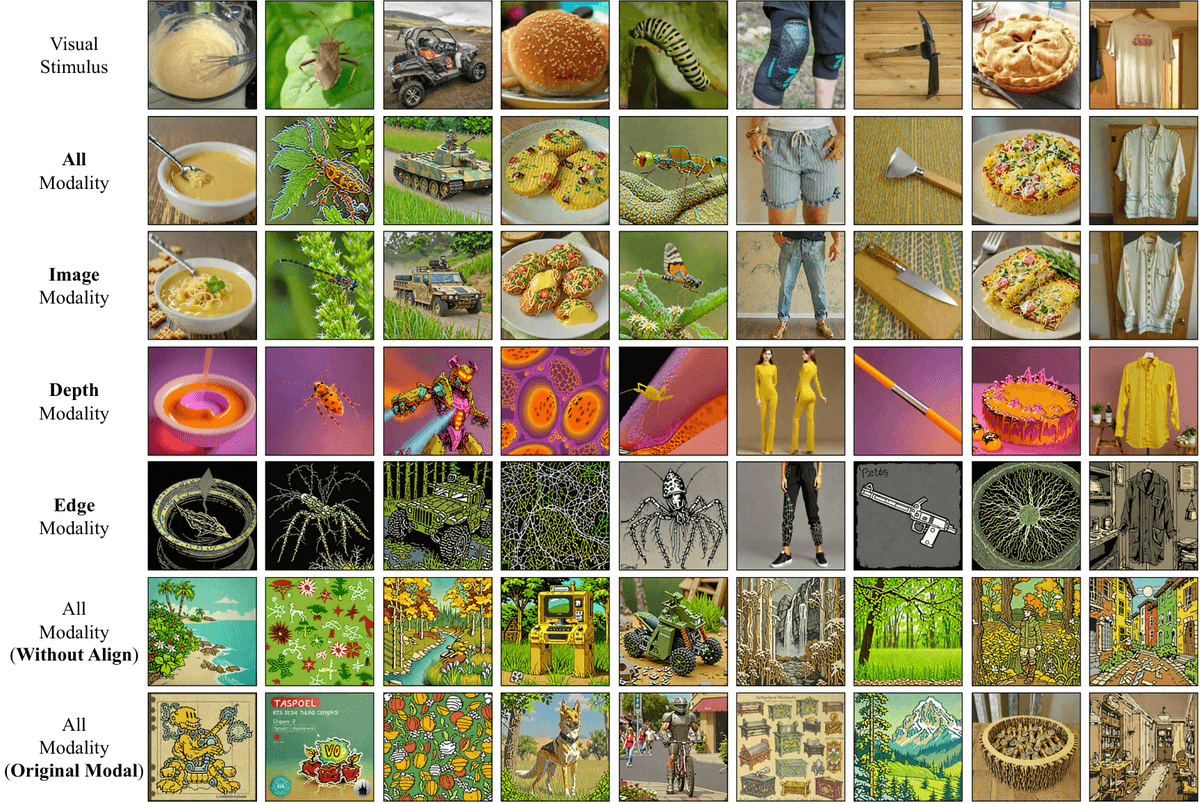
Beyond the big Top-1 and Top-5 jumps versus CognitionCapturer, the qualitative comparisons show reconstructions that recover both object identity and rough layout across categories like food, furniture, vehicles, animals, and clothing.

What it is actually useful for
This is still very much a research artifact, not a product. The obvious applications sit in the BCI space: assistive interfaces for people who cannot speak or move, cognitive-load monitoring, and neuroscience research on how the visual cortex encodes categories. The multi-modal alignment idea also transfers cleanly to any domain where you have a noisy primary signal and several cleaner secondary signals you want to fuse.
The limitations are the ones you would expect. Retrieval accuracy is still measured against a 200-class test set, not open-world images. Training is subject-specific in the main configuration, and cross-subject generalization remains one of the field's open problems. Reconstructions capture semantic category and coarse structure well but still miss fine detail, because EEG simply does not carry that much spatial information.
Running it yourself
The repository ships the full training, alignment, and generation pipeline. The main entry points are main.py for EEG training, src.cogcappro.align.main for the alignment stage, and src.cogcappro.generate_image.batch_generate for reconstruction. You will need to download THINGS-EEG separately along with SDXL-Turbo and IP-Adapter checkpoints, but the config layout is straightforward and the codebase has been validated on Linux with Python 3.9.
A minimal training launch looks like this:
python main.py \
  --config configs/cogcappro.yaml \
  --subjects sub-01 \
  --brain_backbone EEGProjectLayer_multimodal_cogcap_list \
  --vision_backbone RN50 \
  --data_type EEG \
  --uncertainty_aware \
  --epoch 80
For anyone working on multi-modal representation learning, the more interesting takeaway is arguably the uncertainty-weighted fusion recipe. Treating each auxiliary modality as an unreliable teacher with a learned confidence weight, rather than an equal partner in a contrastive loss, is a pattern that should generalize well beyond brain decoding.