
Xiaomi's VST Answers Live Video Questions 15x Faster by Thinking While Streaming
A new paradigm lets video language models reason during playback instead of after your question, cutting QA latency 15.7x versus Video-R1.
 Pro
Takeaways
- VST introduces thinking-while-watching, letting VideoLLMs reason on clips before the user query arrives.
- Achieves 79.5% on StreamingBench and 59.3% on OVO-Bench with a 7B model.
- Runs 15.7x faster than Video-R1 while improving VideoHolmes accuracy by 5.4 points.
- Two-stage post-training combines VST-SFT with streaming attention mask and VST-RL with GRPO.
- Uses a knowledge-graph pipeline with Gemini 3.0 Flash to generate 100K streaming-thought examples.
- Code and 3B, 7B, 32B checkpoints released at github.com/1ranGuan/VST.
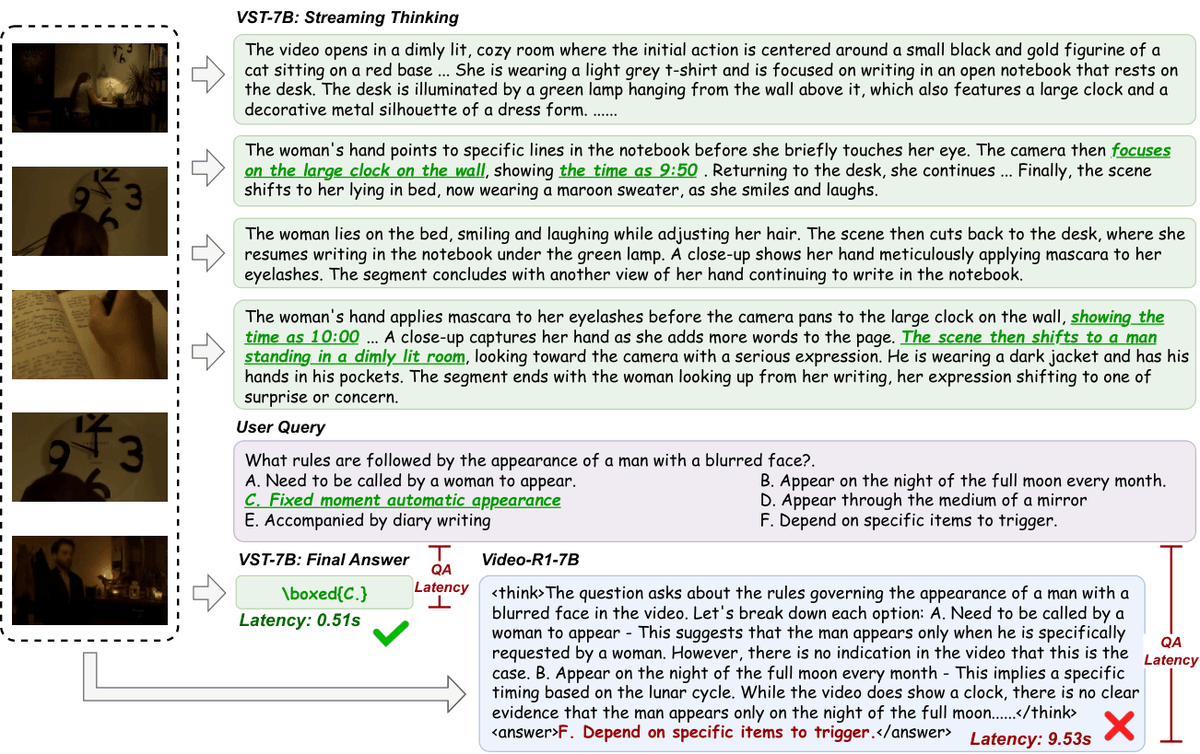
Video language models have a timing problem. When you ask a question about a live stream, most of them freeze up and start reasoning from scratch, chewing through the entire context before producing a single token of the answer. A team from Huazhong University of Science and Technology and Xiaomi's MiLM Plus is proposing a fix called Video Streaming Thinking (VST), which lets the model do its heavy lifting while the video plays, so that when the question finally arrives, the model can answer almost immediately.
The paper reports that VST-7B hits 79.5% on StreamingBench and 59.3% on OVO-Bench, remains competitive on offline long-form or reasoning benchmarks, and compared with Video-R1 responds 15.7 times faster while achieving a +5.4% improvement on VideoHolmes. Code, weights (3B, 7B, and 32B), and training data are already up on GitHub and Hugging Face under Apache 2.0.
The latency trap in streaming video
Existing streaming VideoLLMs mostly optimize how visual tokens are packed or retrieved from a KV cache. That keeps perception cheap, but the LLM itself does little explicit reasoning until you ask a question. The obvious fix, borrowed from text LLMs, is to bolt on Chain-of-Thought at query time. It works, but the price is brutal: on VideoHolmes, the authors measure Video-R1 taking 8.80s per query and Qwen2.5-VL with CoT taking 5.30s, versus 0.54s without CoT.
VST reframes the problem. Instead of thinking after the query, the model thinks between clips as the video streams in. The authors describe this as inspired by neural coupling findings suggesting the brain's logical flow synchronizes closely with the influx of external information. In practical terms, the reasoning cost is amortized over the natural inter-clip waiting time, so it disappears from the user-facing latency budget.

Dual memory, one running thought
Under the hood, VST maintains two memory stores that run in parallel:
- Short-term visual buffer: the most recent L visual tokens from the incoming clip, kept in native visual form.
- Long-term textual memory: a running log of streaming thoughts the model has written about earlier clips, evicted first-in-first-out.
Each time enough visual tokens accumulate to fill a clip, the model samples a new textual thought conditioned on the current clip and prior memory. That thought summarizes what just happened and is appended to long-term memory. When the user finally asks a question, the model conditions on the accumulated thoughts plus the latest visual buffer, and generates the answer directly, with no post-query CoT expansion needed.
Two properties fall out of this formulation. Sequential thought generation naturally respects the temporal causality of a stream (no peeking at future frames), and the CoT compute is front-loaded, which is what buys the latency reduction.
The two-stage training recipe
Turning an offline VideoLLM into a streaming thinker takes more than a prompt. The authors build a post-training pipeline on top of Qwen2.5-VL that runs in two stages:
- VST-SFT adapts the model to causal streaming reasoning. A custom streaming attention mask restricts each token's attention to a sliding window of the most recent L visual tokens while keeping all textual tokens fully visible under the causal constraint. Loss is applied only to streaming thoughts and the final answer.
- VST-RL switches to on-policy reinforcement learning. Trajectories are rolled out through an agentic loop where the policy interacts with the video stream, then optimized with a GRPO-style objective using DAPO clipping. Crucially, the reward is computed only from the correctness of the final answer, but the advantage is spread across every token in the trajectory, including intermediate thoughts, so the model learns which thoughts actually help downstream answering.

Building the training data from knowledge graphs
Off-the-shelf CoT video datasets don't work here because they assume the model has already watched the whole video. If you naively train on them, the model leaks future information into its streaming thoughts. So the authors built an automated synthesis pipeline that produces a knowledge-graph-based data synthesis pipeline yielding 100K streaming-thought examples.
The pipeline works in three phases. First, PySceneDetect chops each video into scene clips, and Gemini 3.0 Flash incrementally extracts (head, relation, tail) triples into a rolling entity bank. Second, the completed knowledge graph is refined with an LLM, then NetworkX runs depth-first search from random start nodes to sample multi-hop evidence chains, with entity overlap between chains kept below 10% to encourage diversity. Third, Gemini synthesizes a query, a streaming CoT rationale grounded in the sampled evidence chain, and the final answer, filtered by rubrics for world-knowledge consistency, logical coherence, format, repetition, and thought validation.
Benchmark results, and where it wins
The gains show up most clearly on tasks that require holding information across long horizons. On OVO-Bench's Backward Tracing track, VST-7B hits 56.7%, +4.7 points over StreamForest. On VideoMME-long it reaches 55.3%, and on LongVideoBench it hits 58.0%. On VideoHolmes, which stresses logical reasoning over video, VST-7B lands at 41.9%.
The scaling ablation is arguably the more interesting result. The same two-stage recipe applied to 3B, 7B, and 32B Qwen2.5-VL base models produces consistent gains at every scale, including +7.7, +7.8, and +9.2 absolute points on StreamingBench Realtime, and +5.4, +9.0, and +5.0 on VideoHolmes. Another useful ablation: VST-SFT mainly helps backward memory (+9.2% on the Backward track), while VST-RL primarily boosts forward prediction (+12.7% on Forward), and combining them yields the best overall numbers.
What it costs at inference
The latency table is the money shot for anyone building interactive video agents:
| Method | QA Latency |
|---|---|
| Qwen2.5-VL-7B (no CoT) | 0.54s |
| Qwen2.5-VL-7B with CoT | 5.30s |
| Video-R1 with CoT | 8.80s |
| VST-3B | 0.53s |
| VST-7B | 0.56s |
| VST-32B | 1.40s |
At inference, the authors cap each step at 8,192 video tokens and limit maximum thinking rounds to 4 for efficient evaluation, though the ablation shows accuracy on backward tasks keeps climbing up to 16 thinking steps if you can afford them.
Where this fits and where it doesn't
VST is a natural fit for anything that behaves like a live video assistant: embodied agents that need to react to what a camera just saw, meeting or lecture assistants that need to answer questions on demand, and long-form video QA where you'd otherwise wait many seconds for post-hoc reasoning. It also generalizes back to offline benchmarks, so you don't lose much by adopting it as a default.
The honest limitations are worth flagging. The authors note that the additional LLM token consumption is still non-negligible, and a promising direction is to explore latent reasoning to enable more token-efficient streaming thinking. In other words, VST hides latency but not compute, so it costs more tokens overall than a non-thinking baseline. It also focuses on text-based memory management, leaving fusion with visual memory schemes for future work. And on tasks where the query itself narrows what evidence matters (short clips, single-question workloads), post-query CoT may still be more token-efficient.